Standardized test scores for Michigan students are on an alarming downward trend. Yet high school graduation rates are rising. These conflicting trends raise serious questions about the standards public schools use to measure academic success. https://t.co/sew46dqzGi
“I cannot be more emphatic: This is an enormous problem that’s not getting enough attention,” said @natmalkus, a senior fellow @AEIeducation@AEI.
https://t.co/yysd7gCynR
The Academic Case for Intellectual Diversity | by my colleague and fellow Council on Academic Freedom at Harvard @cafh member Tyler VanderWeele. https://t.co/6jRUXrVUfg
A Princeton classics professor is teaming up with computer scientists to develop AI-based tools to fill in the gaps of fragmented ancient texts that are written on stone, papyrus and parchment.
Learn more about the humanities at Princeton: https://t.co/ZDWjt19EET
“You can see the surface of the Moon…we just went sci-fi.”
On flight day seven, images from our @NASAArtemis II crew amazed, turning science fiction to reality. From the lunar far side to a solar eclipse from the Moon, the views are EVERYTHING. No pressure to pick a favorite.
'Hay-on-Wye was the first town in the world to make the sale of secondhand books its principal business; at its apogee, it boasted 30 used bookstores. Even now, despite the decline of the book as the sine qua non of intellectual life, the town still has nearly 20 such shops.'
https://t.co/xM1vxHo7Np
The Social Wealth Gap https://t.co/GnyQK7eh8i
'By the 11th and 12th grades, roughly two-thirds of students feel discouraged or disconnected from school. Only about one in five non-college-bound students says they feel prepared for life after graduation.'
'What distinguishes the hopeful minority from the discouraged majority? Relationships. Students who can point to at least one adult at school—a teacher, coach, or advisor who knows them, believes in them, and talks with them about the future—are far more engaged and optimistic. An engaged student is more than four times as likely as a disengaged peer to say they are hopeful about the future.'
Don’t ban teenagers from social media (from @TheEconomist) https://t.co/GTZDJ79plp ‘Politicians say their social-media bans are the only responsible option. In fact, they look like a way of ducking the care children deserve.’
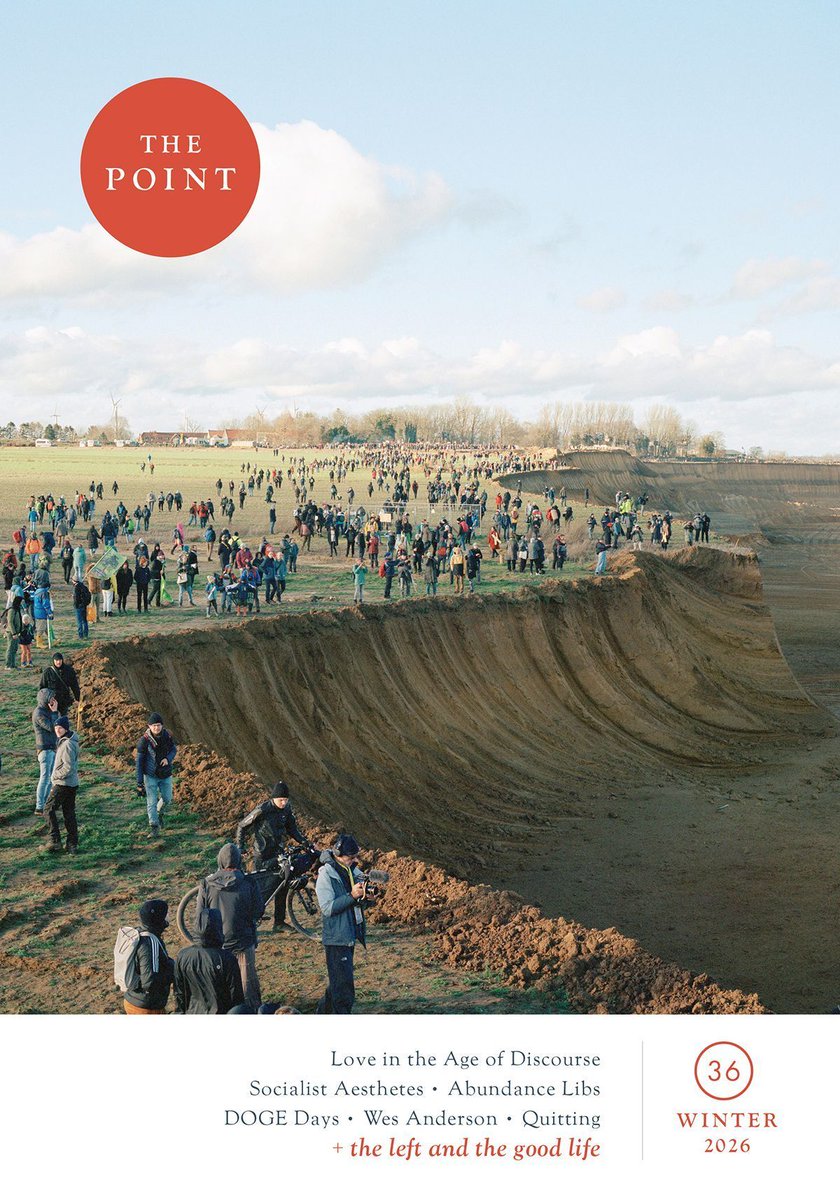
Terrific piece on Great Books programs in The Point:
'When we teach great books we aim at the transformation of a person’s relationships to themselves and to others: as Plato would put it, we aim at a full turning of the soul toward what is good. This is not a reliable formula, and it is not something we can do without the student’s own commitment. But it happens, and I’ve seen it happen: I’ve seen students follow Alcibiades into mad love for Socrates, become captivated by the romance of Tristan and Yseult, and get thrown into spiritual crises by Kierkegaard or artistic crises by Virginia Woolf.
'None of these crises was especially smooth or easy for anybody involved: there isn’t a manual for how to talk a student through the realization that the life they had planned out is no longer compatible with the person they’ve become, but it’s far better for them to figure that out now than to find themselves with a mortgage whose payment depends on living out a contradiction that sheer will can no longer hold together.'
Daniel Walden, The Left Case for Great Books, https://t.co/ZWk6lfgLG9
Robert George on oecologia moralis Americana:
'Here we see the significance of the most basic institutions of civil society — the family; the religious community; private organizations that are devoted to the inculcation of knowledge and virtue; private (often religiously based) educational institutions; and others play the indispensable role of transmitting essential virtues. These are mediating institutions that provide a buffer between the individual and the power of the central state. It is ultimately the autonomy, integrity, and general flourishing of these institutions that will determine the fate of constitutional government.'
'How to Keep Our Republic,' National Review, https://t.co/AtO3TPvqUE
Yuval Levin, "America the Durable":
'But over time, because of the ways in which our system curtails and redirects our political energies, Americans have ended up acting remarkably virtuously and constructively. Our near-term prospects often strike us as dim because we aren’t very good at learning from the long arc of our history.'
National Review, https://t.co/JizjMplwBb
Gordon Wood connects equality and moral ecology:
'But formal schooling was only part of what the revolutionaries meant by education. They created a variety of means for the remaking and republicanizing of their society and culture.'
And: 'By using his copy of an ancient Roman temple in Nîmes, France, from the first century as the model for Virginia’s new capitol in Richmond, Jefferson all by himself virtually created the classical tradition for public buildings in America.'
The Five Greatest Words in the Declaration, National Review, https://t.co/zDk986AJsb
'Angelico lavishes his gift for detail on a magnificent perspective view of Jerusalem as a snow-white (actually lead-white) walled city set on a hill, but he focuses his chief attention on the finely modeled, dramatically diagonal, limp body of Jesus. The dead man’s skin, as pale as parchment, is crisscrossed with the bruises from his flagellation, but these wounds are so fine as to be barely perceptible; what we see instead is an extraordinarily beautiful human figure. Near the base of the Cross, drops of vermilion blood stream downward and form rivulets on the ground. For Fra Giovanni, the blood of Christ, spilled at the Crucifixion, contained the essence of that eternal life his sacrifice offered to flawed humanity. Thomas Aquinas, the Dominicans’ great theologian, declared that just one drop of it could save the world. Fittingly, whenever possible, Angelico used the finest vermilion or kermes red to paint this divine substance. Its conspicuous presence in his paintings can almost be taken as a signature. According to Vasari, he never painted a crucifix without weeping.'
Painted Sermons, Ingrid D. Rowland, New York Review of Books, https://t.co/crUln1qD1c
Image: https://t.co/QM5tfRBZB1
'“Whoever wants to know the heart and mind of America had better learn baseball,” Jacques Barzun wrote in 1954. “Accuracy and speed, the practiced eye and the hefty arm, the mind to take in and react to the unexpected . . . and the willingness to work in harness without special orders — these are the American virtues that shine in baseball.”'
Allen Guelzo, National Review, https://t.co/CvvHP2D5E5
Stoicism is more other- and community-oriented than popularly thought:
'The Self-Sufficiency Thesis naturally points one in the direction of austerity and detachment, since it requires the agent to treat the goodness of others as a preferred indifferent. By contrast, the Other-Oriented Thesis points to a life deeply involved in human community, not merely because such involvement is to be preferred, but because goodness, whether in oneself or others, is always worthy of our unreserved pursuit.'
Allison Piñeros Glasscock, To Benefit or Succeed: A Tension in Stoic Ethics, https://t.co/07XPYVLnkD