$NAMO $QQQ $SPY
Should I go for round 4 🥊🥊🥊🥊?
Ya’ll got another pair of socks? 🧦🧦 💨
$NVDA at 25 times forward earnings growing faster than $AAPL and $MSFT with a back log for clear path to 50Billion in revenue from 32 Billion currently. Whatever digestion period pundits say about the cloud service providers I raise you Soverign AI - like the Saudi’s for 50 Billion, and NIM, and CUDA, as $4500 bucks per year per chip start to give recurring revenue at higher margins than the hardware - SAAS
$TSM Taiwan Semi reports sales numbers on September 10th and SK Hynix reported Sales less than 2weeks ago and it DOUBLED in China 👀. This will impact $NVDA and other AI names as many like $DELL and $PLTR are already catching a big bid for being added to the S&P500
$NVDA and many companies are at the Goldman Sachs Tech Conference on September 11. I expect Jensen to reiterate and bring everyone up to speed on Blackwell and it’s demand and set the stage for new products coming down the pipeline with the stock down 25% going into that event 👀
Interest rates are coming down and we have priced in more fear and risk as the FED enters a blackout period and sure to cut interest rates in days after 2.5 years. CPI this coming week and Oil is down and Used Car prices have been coming down
We have completed the Average of two corrections of 10% this year with more pain in the Nasdaq 100 to the tune of around 16% both those times. We are even getting a 3rd as headlines now read the worst week since 1929 and the worst day since 2022 👀👀👀… nice company 😂
These are ALLLLL extremes and washout signals and in both of the first two corrections everyone screamed for more downside remember? 😘 It never feels like the right time to buy - that’s when it is
Greed cuts both ways and everyone screaming for more downside just got the worst week since 1929 that’s a win and shorting more than the worst week since 1929 if you already won to that degree is called shorting a hole 🕳️
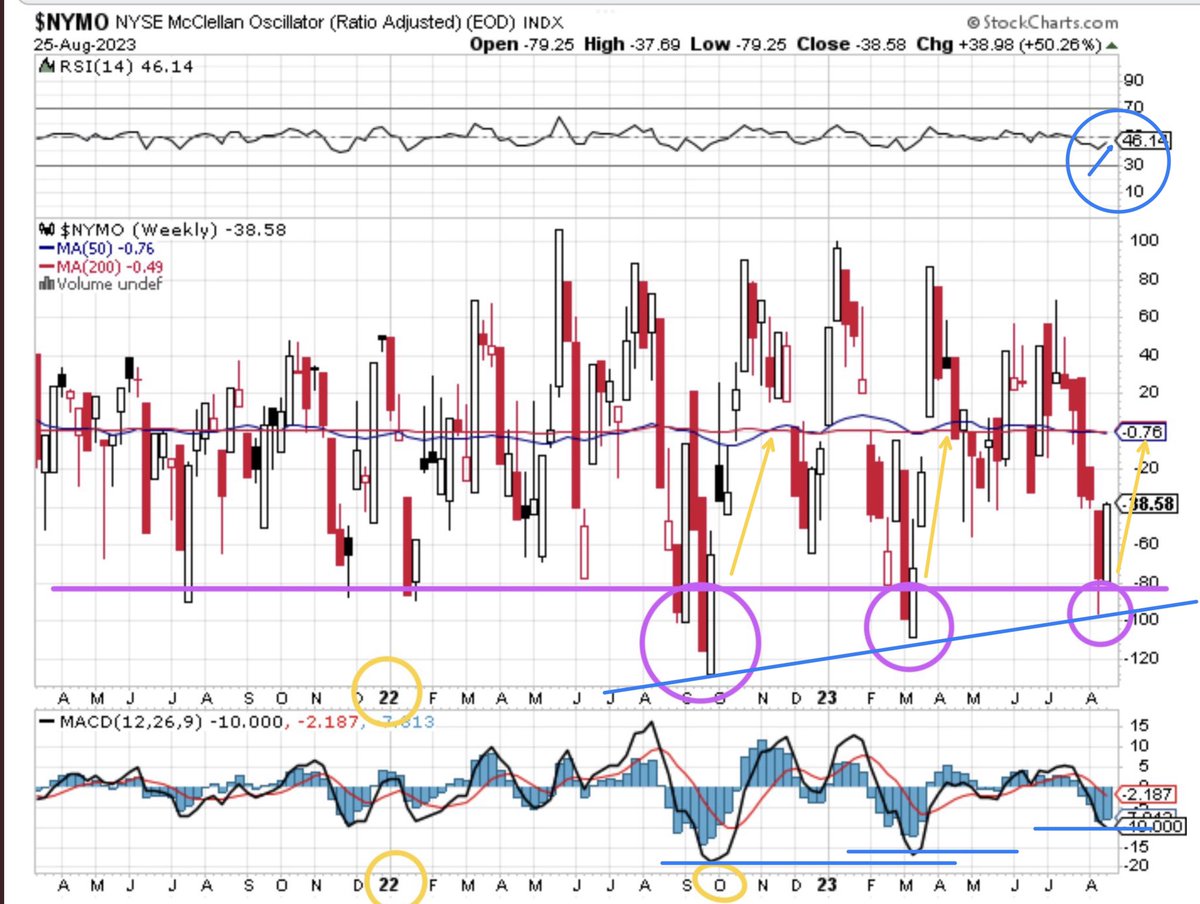
Below is the Nasdaq McClellan Oscillator 📝
Every time we have been in this area of the “Rubber Band” we have a snap back. Yes the rubber band can always get more stretched but it soon snaps back and regains a lot of ground quick
Notice when we have had the extreme declines below my yellow highlighted line below we made a big run above the zero line and at some point come back down but not all the way and make a divergent higher low highlighted by the purple lines
The $VIX hit an ROC (Rate Of Change)of 25% intraday and moves of 15-20% plus in one day are generally more indicative of local bottoms. The VIX put in a hanging man candle on the daily chart which is a bearish candle.
Not financial advice! Much love 💛🍌🍌🍌
Here is my take on the $SOFI convertible notes.
Let's level set here for a second. This is a complicated set of transactions and I'm not going to be able to cover it all in a tweet.
Here is what we know:
1) SoFi is offering $750M in convertible notes
2) With the proceeds they will redeem their preferred shares, cover the costs of the transaction, buy capped calls, and for general purposes, which may include repayment of higher cost indebtedness.
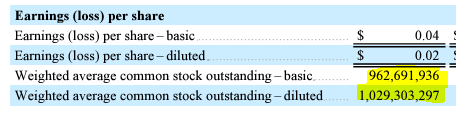
3) They are issuing about 61M shares of stock to retire around $600M of debt
Additionally, there is still a lot we do not know. We don't know the interest rate on the convertible notes, conversion prices, or any details about the capped calls. These will come out in time.
As with any deal, there are upsides and downsides. I'll lay them out, as I see them, as transparently as possible. I'll cover the facts first and then talk about my opinions and thoughts.
Negatives:
61M shares is a lot of shares. We also don't know the final conversion price yet. If it's lower, it'll be even more shares. That's a lot of dilution, around 6%. The original convertible notes didn't convert until just above $22/share and would have only resulted in around a max of 48M shares diluted. So there is an extra 12M shares or so of dilution to pay these off AND they haven't even retired the entirety of the debt, just $600M of the remaining $1.1B.
Using the numbers in the press release, they are paying off $600M of debt with $529.5M raised by offering those shares. So they are paying about 89 cents on the dollar to buy back the debt.
Benefits:
The preferred shares that are being a redeemed have a 12.5% dividend, that's around $40M/yr and it is going to increase in May to over 15%, or around $15M/yr. It costs $323.4M to redeem those shares, which is what a portion of the $750M is for.
Since they are buying back old debt at a discount, it results in a GAAP net income and tangible book value increase in Q1. The entire deal would result in an increase of total risk-based capital increase of "more than 200 basis points from 15.3% to more than 17.3% on a pro forma basis" based on Q4 numbers.
Ok. Everything I've shared up until now are facts. Feel free to share your own opinions about them. Now it's time to get into my opinions. As we get more details in the future, I reserve the right to change my opinion.
Downsides:
I don't like that they are diluting at such a low stock price because I think it is undervalued at these prices. Let's assume for a minute that by the end of this year the stock price gets to $15 and they can buy back the $600M at price ($1 for $1). That would only be 40M shares, not 61M. They could dilute for less if they waited for a higher stock price, but then would not have gotten the gain in total capital. 61M shares is about 6.3% dilution.
Additionally, if you look at the terms of the original 2021 convertible notes, the redemption price would have resulted in between 33.7M and 48.1M in dilution. This is more dilution than originally planned, and does not extinguish all the debt. On the face of it, I do not like that at all.
Upsides:
Redeeming the preferred shares is a slam dunk. You're replacing $325M of high interest debt with much lower interest debt. That's a big win.
The 200+ BPS of total capital equates to, at a minimum, an extra $460M in total capital. Assuming they want to get to a capital ratio of 14.5%, they now have room to grow the balance sheet by at least an additional $4.4B. Assuming they keep up their 6% NIM, that is an extra $265M in net interest income every quarter, or $66M/qtr once they fill up the balance sheet. It's not this simple, but if you add that to last quarter's numbers, it would equate to about ~10% revenue growth for the full business.
Speculation:
This is total speculation, but the 8-K specifies that the cash can be used "for general corporate purposes, which may include repayment of higher cost indebtedness". They have something around $400M of cash left after redeeming the preferred shares. There will be ~$500M of remaining convertible notes after they retire the $600M. If they negotiated to buy back the remaining $500M of the 2021 convertible notes with the remaining ~$400M from the new offering, and could extinguish all of that debt, I would be much more pleased about the entire transaction.
My take:
I wish they would have gotten a better price. The 2026 convertible notes had an effective rate of 0.43% interest and didn't convert unless the stock price was at $22 by fall of 2026. That's a crazy low rate they could have taken advantage of for the next 2.5 years and the conversion price is way higher than the current stock price. It seems like they could have negotiated a steeper discount to trade in 0 cost debt in the current environment.
I'm also not enamored with more dilution than originally planned to retire less debt. A steeper discount would have meant more tangible book value growth and less dilution. I have absolutely no experience in any of this, that's just my high-level take on that part of the deal (remember, I'm just a chemical engineer who likes to share opinions about the companies I invest in, this is not my career and I am out of my depth but try to learn every day, also, it's not financial advice 😉).
One other thing to note is that the $1.1B in convertible notes actually already contribute to the fully diluted EPS, so it doesn't actually hurt the EPS on a GAAP basis as much one might think.
That being said, redeeming the preferred shares is a slam dunk. It's very possible that debt servicing the entire $750M in notes would cost less than what they were due to pay on the $323M of preferred shares. That was great business.
This also free up a lot of capital that can be used to grow the underlying business. The cost is 6% dilution now and an undisclosed amount of dilution later (from whatever price the new $750M notes convert at) for ~$265M in net interest income in perpetuity, which will probably add about 10% revenue growth in the next year. I would rather that they grow the business by funding it through profits rather than take on more debt, but I am certain this is way lower cost debt than the preferred shares, so that part of it I'm totally fine with.
It's a mixed bag. Overall, I'm inclined to trust management and that they know what they are doing. The dilution is a hard pill to swallow. Between this and the Technisys acquisition, that's around 145M shares in the last 3 years without including SBC. When you include SBC, it's over 200M shares and over 20% dilution overall.
I don't know how independent these deals were. If they could have just done the convertible notes and not the dilution and buyback of $600M, I think that would have been a much better path. My suspicion is that the deals were linked, although that is also speculation.
Overall, if they execute, the entirety of these deals is probably a net positive for the company and shareholders. I trust them to execute, and I trust that they have the best interests of the company and shareholders in mind. Management also have a significant portion of their net worth tied to the performance of the company and the stock. There is a lot of shareholder alignment in their compensation packages.
I trust them to put their heads down and operate the business in a way that makes this deal worth it. If they continue on the path they've been on for the last 3+ years, I'm still very confident that I'll be a very well-rewarded investor in the long run.
The full 8-K can be found here:
https://t.co/X1r3Bz1xI3
FP&A employer / employee dynamics have shifted a ton in the last 5 years
Lots of companies haven't adjusted and are struggling to secure talent. Instead of changing with the times, they are blaming it on labor markets (tight labor markets do have an impact ofc). Some of the drivers I have witnessed:
- Comp: Demand & transparency increases
The steep ups and downs of expectations during covid put finance teams front and center. Managing cash, zero based budgeting, scenario analysis all went from common practice to critical. Spotlight on finance and increased need / value to the org shifted demand way up, especially for strong talent.
Comp transparency has been trending up for decades, but accelerated over last 5 years. Gone are the days of not having any idea what a superior or peer makes. Outside of a cultural shift where people are more open to discuss comp, there is a lot of solid data out there (Glassdoor, WSO, linkedin, Fishbowl, reddit, etc.) States (NY, CA, WA and others have instituted compensation transparency laws. Applicants can figure out comp ranges before investing any time and will not invest time if the gig is below market which is easier to put together with all available data. With a quick google search, you understand your market value and can prove it to your employer. This visibility and employee leverage only has upward impact on comp
- Culture: Nobody wants to work for a shitty company
Its easier than ever to tell if a company is exciting, rewarding, and stimulating. Company reviews, age, demographic info on LI makes it much easier to substantiate any culture claims in an interview. Applicants are going to be able to call bullshit if youre a sweat shop selling a tech startup culture
- Retention:
With such large increases in tech enablement, the ramp time for most FP&A gigs is faster than ever. Strong talent can plug in and get up to speed / make an impact quickly. This also means that strong talent can get bored / stale quickly. If people are not getting new experience, expanded responsibility, or increased comp (ideally getting all 3), they are going to leave. Loyalty is worth less and is less rewarded.
The norm used to be that an employee wasnt considered a flight risk until 2-3 years in a gig because leaving a company so quickly showed lack of commitment / loyalty. The last 5 years have been full of very valid extraneous reasons for short tenures (layoff, moving, health, etc.). A pattern of jumping ship quickly can still certainly hurt you, but dont sit in a shitty job because youre worried about how it looks on your resume. Have a mature and reasonable narrative and address it up front
- Autonomy:
FP&A is not consistent. Some weeks require burning the midnight oil and some weeks are very light. Finding work to look busy during light times is not the norm. Focus on value add work or take time to recover.
Remote work was a big wakeup call for a lot of people. If you are able to meet all of your obligations by taking time during light weeks and working when you want, youre going to. Nobody is sitting in their home office waiting for the clock to strike 5pm before checking out. Build trust and credibility by delivering quality on time and you can maintain a much higher degree of autonomy. Some employers have not come around to this degree of trust or working model and resort to micro manage or inflexible office schedule that sends employees looking for jobs where they have control
- Impact:
Everyone in FP&A probably saw their work in a different light when working remote vs in person. The non-value add becomes much more obvious and less exciting without the in-person hype / support. Much harder to stay up all night fixing a PPT at your desk along at home vs in the office with a team. Expanding on some of the above, finance has been font and center and allowed tons of young professionals to jump into stretch roles or get reps in a transformation. Transactional roles are less interesting, less common, and less rewarding. The concept of "paying your dues" with highly transactional work is still valid, but youre paid up much quicker. If a role / org doesnt have or promote a path to strategic decisioning / big impact, talent will leave.
Its hard to disentangle how much of the above is a product of a strong labor market and how much is due to long term shifts and structural changes in the FP&A talent market that favor the employee. That said, strong finance talent is needed in up and down markets. Its a better time than ever to get into a career in FP&A or go find a gig that fill gaps in your current situation. Very strong outlook imo.
Anything I missed? Have you all seen / experienced similar?
“The name of the stock, John, is Spirit Airlines. This is a situation we in the business call merger arbitrage. It’s a ‘heads I win, tails I move back in with my parents’ kind of play”
- Shoot a photo with an iPhone through a pair of glasses with a certain prescription
- Click on the screen until the "AF/AE lock" function appears. Use it
- Remove the lense
This is how the person who wears those glasses actually sees
[📹 sakata_yoshi]
https://t.co/wU4wMjCPpU
$SPY $QQQ $NYMO
I think this is one of the most important charts out there right now ❤️
The New York Stock Exchange McClellan Oscillator…
It hit the same standard deviation bracket as the October 2022 bear market low on this recent drawdown
I repeat, the same bracket as October 2022
Anytime this weekly chart hit -90 we at least went back to the zero line, we are making a series of higher lows and RSI just turned back up
Alright boys here we go, T-1 hour.
Remember, zyn in, head down, and dog on. For the shareholders, the firefighters and the teachers.
God bless and good luck
—Pat
⚠️ #BankingCrisis update ⚠️
The banks reporting season has begun and, of course, $JPM $C $WFC all "beat" expectations, sending their #stocks higher in pre-market. However, when people started moving from reading the (cheerful) press releases to the (boring and lengthy) financial statements, bank #stocks quickly pared their gains and $BKX closed down 2.35% on Friday. 😅
What the hell did investors find in the financials that caused such a change of heart?🤔
Here are the interesting things I found so far:
1. $JPM "fair value" losses in their HTM Debt Securities book increased to 33bn$, and No here $FRC has nothing to do with it.
2. $JPM lost ~900m$ in their securities investments. What's wrong with this? These are 🥜 for Jamie! What's wrong is that this is the fourth quarter in a row $JPM books a ~900m$ loss despite the ups and downs in the market. That's a bit too regular, isn't it? However, if we compare this figure with the decrease in the HTM balance QoQ, $JPM has been selling HTM securities at ~30%, ~7.5%, ~20% discounts in Q2-23, Q1-23, and Q4-22. This is starting to be more aligned with the swings in the market, isn't it?
3. Now look at point 1 and 2 together. Do you notice anything strange? $JPM estimates a "fair value" of their HTM securities only 8% below book value, but then the price they have been selling their HTM asset is at a 30% discount! If we apply an MTM to HTM assets using what the bank itself is getting from the market, $JPM is carrying a 123bn$ MTM loss in their HTM books. 🥶
4. While at least $JPM still shares important data (wisely hidden in the various footnotes 😉), $C and $WFC don't bother to do so. However, from what they cannot avoid disclosing, we can easily see how both banks really pushed the limits in terms of accounting acrobatics this time around. For example, yesterday I flagged $WFC reported a 4m$ GAIN for Q2-23 related to their Debt Securities assets. $C did even "better," booking a 49m$ GAIN! 🙄
Both banks hold ~500bn$ of Debt Securities between AFS and HTM, and they are doing far better than Jamie in managing them… yes, if you believe in Santa and unicorns… 🤣
5. If we apply the same 30% MTM discounted value Jamie is getting to $C and $WFC, both banks might be hiding ~150bn$ in MTM losses each in their Debt Securities books. 🤷🏻♂️
6. What about Credit Losses? While $JPM and $WFC increased their provisions by 28% and 41% vs Q1, $C provisions decreased 8%… Cmon Jane! 🤣 However, none of these 3 banks still made any meaningful provision against their CRE books. Among them, I find $WFC "assessment" is the funniest one: "the vast majority of the [CIB] portfolio is institutional quality and with high-calibre sponsors." Ehmm… so what? Are those CRE loans guaranteed? No. Is "institutional quality" reassuring when filings for chapter 11 are at GFC levels? So basically $WFC is telling us that ~103bn$ of CRE loans they hold are "good" because they say so. 😅🫣
7. Last but not least, Deposits. $JPM (including $FRC) +21bn vs -11bn$ for $C and -9bn$ for $WFC. According to FED non-adjusted data, Large US domestic banks as a whole lost 152bn$ in deposits during Q2. Then if the net for the first 3 banks that reported is +2bn$, it means the remaining out there lost 154bn$ in deposits right? 🤷🏻♂️ Someone might have bleeding big time then..
Considering all that has been said so far, no wonder investors started dumping bank #stocks yesterday.
$BKX is down ~19% YTD vs $QQQ +43%. This is the equivalent of an F1 car leading a race without fuel. It's simply not possible for a car to keep racing without fuel unless you are playing a video game. Believing that you can do it in reality is equivalent to believing in Santa and unicorns
If this is the beginning of the banks reporting season, I foresee plenty of games of smoke and mirrors along with nasty surprises ahead (and not only for bank stocks, sorry)⚠️
Links to financials: https://t.co/69zDykJlou
https://t.co/2ImEMKG2RB
https://t.co/WODMyy2MAs
👇 How to trade dips, NOT rips!👇
STOP BUYING BREAKOUTS! You are someone else’s exit liquidity when you chase!
When $SPY breaks out of a key level, be PATIENT for the base! BNB
This setup will present itself every single day!
Leave a LIKE ❤️ for more charts!
$QQQ $TSLA $AAPL
Let’s really talk about unpopular opinions…
Agree CPI doesn’t matter - except to algos and day traders. But as a way to determine Fed reaction function … it largely depends on what you think Fed REALLY means and wants…
My bet: CPI only matters if it’s too low.
“Waat”, you’re thinking!
Well to understand you need to know my strongly held opinion on this question:
Do High Interest Rates Fix High Inflation?
NO! THEY CAUSE IT!
That’s right. I don’t think Fed cares so much about wages or unemployment rate moving higher. And both can (will) go higher I believe. Fed still wouldn’t care enough to hike or cut respectively.
The only thing they care about is keeping US yields, USD and Oil from moving too high too fast and outside the “stagnant zone”, which we are in and equities love.
Stagflation beats hyper inflation or deflation, given the outsized money printing and deficits that have been created.
And since CPI drives inflation expectations, how does Fed inflate our massive US debt away (and keep stocks bid with liquidity) if inflation is falling?
FED IS TRAPPED™️
Fed needs inflation.
Treasury needs inflation.
White House needs inflation.
Beats default and austerity!
Only other way US Debt falls is if they stop printing money AND stop spending through stimulus. Is that gonna happen any time soon? So inflation is the best way to drive stocks higher while lowering the value on US debt which helps keep liquidity flowing and backstops banks, not to mention gives time for MBS and credit markets (esp CRE) to not implode. I mean, Fed is threading the needle here, but they’re doing a bang up job! Get it: “bang up”? 🤣
Also, equity market returns NEED both the fiscal spending with the Fed QE/printing, especially as tax receipts fall. Otherwise we will suffer from inertia. And we know what happens when gravity takes hold.
So the risk now is if inflation falls meaningfully - HENCE THE PAUSE!!!
Goldilocks is still in the house! Yes, equities have priced in a hawkish PAUSE while bond markets keep talking their depressed book: CUTS!
Only the Fed is talking HIKES! They have to keep the confidence game going they are beating inflation when the truth is they manufactured it.
For equities: having yields stay “under control” from loose monetary policy while USD goes sideways (thanks BOJ bond buying!) at the same time oil is range-bound (forcing speculators to exit)… is a great backdrop for higher and market structure proves this out! #OptionGamma
So the perfect macro INTERVENTION COLLAR supported by perfectly bullish institutional positioning!!!
So why do you think Fed wants inflation lower with equities? I say they lie and see ‘no harm no foul’ in letting equities melt up - for a whole host of self-serving reasons!
Even better if equities run hard!!
I secretly wonder if Fed is forcing this melt up in equities, so that when they force the rotation out of equities (read: volatility), traditional RPAR once again makes a cameo appearance where bonds get bid up - forcefully. I mean every macro manager is worried about who will support Bond buying? I sayFed has a plan.
And this plan would also help banks, pensions and foreign CB get those big unrealized losses back to manageable.
But then it’s a solid #STR (short the rip) in bonds in my opinion. #SoldToYou
Needless to say, I am bearish bonds big picture. Even if we have a disinflationary impulse (read: recession pulled forward) or outright deflationary impulse (read: conflict).
But for now, there’s an intervention collar on US yields, dollar and oil, so equities move higher until the next time treasuries are sold off aggressively as they are the COLLATERAL backing USD, Oil and everything else.


![DarioCpx's tweet photo. ⚠️ #BankingCrisis update ⚠️
The banks reporting season has begun and, of course, $JPM $C $WFC all "beat" expectations, sending their #stocks higher in pre-market. However, when people started moving from reading the (cheerful) press releases to the (boring and lengthy) financial statements, bank #stocks quickly pared their gains and $BKX closed down 2.35% on Friday. 😅
What the hell did investors find in the financials that caused such a change of heart?🤔
Here are the interesting things I found so far:
1. $JPM "fair value" losses in their HTM Debt Securities book increased to 33bn$, and No here $FRC has nothing to do with it.
2. $JPM lost ~900m$ in their securities investments. What's wrong with this? These are 🥜 for Jamie! What's wrong is that this is the fourth quarter in a row $JPM books a ~900m$ loss despite the ups and downs in the market. That's a bit too regular, isn't it? However, if we compare this figure with the decrease in the HTM balance QoQ, $JPM has been selling HTM securities at ~30%, ~7.5%, ~20% discounts in Q2-23, Q1-23, and Q4-22. This is starting to be more aligned with the swings in the market, isn't it?
3. Now look at point 1 and 2 together. Do you notice anything strange? $JPM estimates a "fair value" of their HTM securities only 8% below book value, but then the price they have been selling their HTM asset is at a 30% discount! If we apply an MTM to HTM assets using what the bank itself is getting from the market, $JPM is carrying a 123bn$ MTM loss in their HTM books. 🥶
4. While at least $JPM still shares important data (wisely hidden in the various footnotes 😉), $C and $WFC don't bother to do so. However, from what they cannot avoid disclosing, we can easily see how both banks really pushed the limits in terms of accounting acrobatics this time around. For example, yesterday I flagged $WFC reported a 4m$ GAIN for Q2-23 related to their Debt Securities assets. $C did even "better," booking a 49m$ GAIN! 🙄
Both banks hold ~500bn$ of Debt Securities between AFS and HTM, and they are doing far better than Jamie in managing them… yes, if you believe in Santa and unicorns… 🤣
5. If we apply the same 30% MTM discounted value Jamie is getting to $C and $WFC, both banks might be hiding ~150bn$ in MTM losses each in their Debt Securities books. 🤷🏻♂️
6. What about Credit Losses? While $JPM and $WFC increased their provisions by 28% and 41% vs Q1, $C provisions decreased 8%… Cmon Jane! 🤣 However, none of these 3 banks still made any meaningful provision against their CRE books. Among them, I find $WFC "assessment" is the funniest one: "the vast majority of the [CIB] portfolio is institutional quality and with high-calibre sponsors." Ehmm… so what? Are those CRE loans guaranteed? No. Is "institutional quality" reassuring when filings for chapter 11 are at GFC levels? So basically $WFC is telling us that ~103bn$ of CRE loans they hold are "good" because they say so. 😅🫣
7. Last but not least, Deposits. $JPM (including $FRC) +21bn vs -11bn$ for $C and -9bn$ for $WFC. According to FED non-adjusted data, Large US domestic banks as a whole lost 152bn$ in deposits during Q2. Then if the net for the first 3 banks that reported is +2bn$, it means the remaining out there lost 154bn$ in deposits right? 🤷🏻♂️ Someone might have bleeding big time then..
Considering all that has been said so far, no wonder investors started dumping bank #stocks yesterday.
$BKX is down ~19% YTD vs $QQQ +43%. This is the equivalent of an F1 car leading a race without fuel. It's simply not possible for a car to keep racing without fuel unless you are playing a video game. Believing that you can do it in reality is equivalent to believing in Santa and unicorns
If this is the beginning of the banks reporting season, I foresee plenty of games of smoke and mirrors along with nasty surprises ahead (and not only for bank stocks, sorry)⚠️
Links to financials: https://t.co/69zDykJlou
https://t.co/2ImEMKG2RB
https://t.co/WODMyy2MAs](https://pbs.twimg.com/media/F1DqbZTakAAif4p.jpg)












![DarioCpx's tweet photo. ⚠️ #BankingCrisis update ⚠️
The banks reporting season has begun and, of course, $JPM $C $WFC all "beat" expectations, sending their #stocks higher in pre-market. However, when people started moving from reading the (cheerful) press releases to the (boring and lengthy) financial statements, bank #stocks quickly pared their gains and $BKX closed down 2.35% on Friday. 😅
What the hell did investors find in the financials that caused such a change of heart?🤔
Here are the interesting things I found so far:
1. $JPM "fair value" losses in their HTM Debt Securities book increased to 33bn$, and No here $FRC has nothing to do with it.
2. $JPM lost ~900m$ in their securities investments. What's wrong with this? These are 🥜 for Jamie! What's wrong is that this is the fourth quarter in a row $JPM books a ~900m$ loss despite the ups and downs in the market. That's a bit too regular, isn't it? However, if we compare this figure with the decrease in the HTM balance QoQ, $JPM has been selling HTM securities at ~30%, ~7.5%, ~20% discounts in Q2-23, Q1-23, and Q4-22. This is starting to be more aligned with the swings in the market, isn't it?
3. Now look at point 1 and 2 together. Do you notice anything strange? $JPM estimates a "fair value" of their HTM securities only 8% below book value, but then the price they have been selling their HTM asset is at a 30% discount! If we apply an MTM to HTM assets using what the bank itself is getting from the market, $JPM is carrying a 123bn$ MTM loss in their HTM books. 🥶
4. While at least $JPM still shares important data (wisely hidden in the various footnotes 😉), $C and $WFC don't bother to do so. However, from what they cannot avoid disclosing, we can easily see how both banks really pushed the limits in terms of accounting acrobatics this time around. For example, yesterday I flagged $WFC reported a 4m$ GAIN for Q2-23 related to their Debt Securities assets. $C did even "better," booking a 49m$ GAIN! 🙄
Both banks hold ~500bn$ of Debt Securities between AFS and HTM, and they are doing far better than Jamie in managing them… yes, if you believe in Santa and unicorns… 🤣
5. If we apply the same 30% MTM discounted value Jamie is getting to $C and $WFC, both banks might be hiding ~150bn$ in MTM losses each in their Debt Securities books. 🤷🏻♂️
6. What about Credit Losses? While $JPM and $WFC increased their provisions by 28% and 41% vs Q1, $C provisions decreased 8%… Cmon Jane! 🤣 However, none of these 3 banks still made any meaningful provision against their CRE books. Among them, I find $WFC "assessment" is the funniest one: "the vast majority of the [CIB] portfolio is institutional quality and with high-calibre sponsors." Ehmm… so what? Are those CRE loans guaranteed? No. Is "institutional quality" reassuring when filings for chapter 11 are at GFC levels? So basically $WFC is telling us that ~103bn$ of CRE loans they hold are "good" because they say so. 😅🫣
7. Last but not least, Deposits. $JPM (including $FRC) +21bn vs -11bn$ for $C and -9bn$ for $WFC. According to FED non-adjusted data, Large US domestic banks as a whole lost 152bn$ in deposits during Q2. Then if the net for the first 3 banks that reported is +2bn$, it means the remaining out there lost 154bn$ in deposits right? 🤷🏻♂️ Someone might have bleeding big time then..
Considering all that has been said so far, no wonder investors started dumping bank #stocks yesterday.
$BKX is down ~19% YTD vs $QQQ +43%. This is the equivalent of an F1 car leading a race without fuel. It's simply not possible for a car to keep racing without fuel unless you are playing a video game. Believing that you can do it in reality is equivalent to believing in Santa and unicorns
If this is the beginning of the banks reporting season, I foresee plenty of games of smoke and mirrors along with nasty surprises ahead (and not only for bank stocks, sorry)⚠️
Links to financials: https://t.co/69zDykJlou
https://t.co/2ImEMKG2RB
https://t.co/WODMyy2MAs](https://pbs.twimg.com/media/F1DqbZ1aMAAtvk3.jpg)


