The Great Inversion: AI Is Quietly Draining the Public Internet of Thought
Something profound is happening to the Internet, and almost no one is naming it clearly.
I have been cataloging it of the last 4 years.
For decades, the web’s most valuable resource wasn’t bandwidth or servers. It was the messy, public give-and-take of human questions and answers.
I was a Top Writer on Quora for nearly a decade as well as a massive pre-crazy Wikipedia contributor — I lived in the space of that give and take.
Someone would hit a wall, open a forum, type out the problem, and a conversation would form. Ideas were stress-tested in the open. Nuance appeared. Dead ends were marked. Better questions got refined in real time. That entire process — the friction, the disagreement, the collective thinking — was left behind as searchable, linkable, durable public knowledge.
That flow has reversed.
The same questions, the same moments of curiosity or confusion, are now more routed into private AI interfaces. A person opens a chat window, types the prompt, receives the output, and the entire exchange vanishes into a closed ecosystem.
The assumption we must make (because it is true) is that the AI company stores both the prompt and the response. The thinking that once would have become part of the shared human record is instead locked inside a corporate training silo.
This is not a minor shift in user behavior. It is an inversion of the Internet’s original knowledge architecture.
Public discourse is being systematically stripped of its higher-signal material. As the internet’s data gets more and more noisy in a very really way it is growing quiet.
The questions that used to generate the richest threads the ones that forced people to clarify assumptions, admit uncertainty, or synthesize across domains are the ones most efficiently answered by AI. What remains on the open web is increasingly the residual: lower-effort posts, performative arguments, recycled takes, and the questions that still feel too social or too ambiguous for a model.
AI then trains on that thinning residue, while the better thinking is captured privately and never returns to the commons.
The result is a strange feedback loop. The public Internet becomes less thoughtful precisely because the thoughtful interactions have been privatized. And the models, trained more and more on what is left behind, risk becoming increasingly fluent in the lesser exchanges that now dominate the surface.
This is not the usual complaint about “AI is making people dumber” or “forums are dying.” Those are symptoms. The deeper phenomenon is structural: the migration of human cognitive surplus from a public knowledge commons into private, non-reciprocal data reservoirs.
The Internet is no longer primarily a place where thinking is externalized and shared. It is becoming a place where thinking is extracted and contained.
The novelty of this observation is that it reframes the problem away from content moderation, engagement algorithms, or even AI capability. The core issue is architectural. We have inverted the direction of knowledge flow. What once leaked outward into a shared substrate now drains inward into silos that do not, by default, give back.
The long-term consequences are massive under-discussed as not noticed.
How does a civilization maintain a high-quality public epistemic environment when its best questions are no longer asked in public? What happens to the training data of future models when the richest human reasoning is locked behind commercial walls? And what cultural muscles atrophy when the habit of thinking out loud, in front of others, becomes rarer?
This is the silent inversion of the Internet. The data once destined for the commons is now shunted into AI. The thoughtful exchanges are disappearing from the surface, and the models are learning from what remains.
That is the novel dynamic. Everything else is downstream of it.
The way to win at capitalism is to focus on what it actually does (make customers' lives better) rather than the socialist caricature of it (squeeze every penny out of them). The latter gets you 2x returns at best, whereas making new things for people can get you 10x.
🚨OPENAI AND ANTHROPIC JUST FOLDED ON THEIR DATA RETENTION POLICY AFTER PALANTIR CEO EXPOSED THEIR REAL BUSINESS MODEL
Alex Karp:
>"something has gone completely wrong"
>they want "access to my data" so they can "build my alpha"
>"i'm gonna get no value, and they're gonna get my IP"
>"this is effing insane"
>"trying to drug addict us to a future they believe they control"
>"who owns the data? where is it cached? are the prompts secured?"
>"we need to rebuild trust"
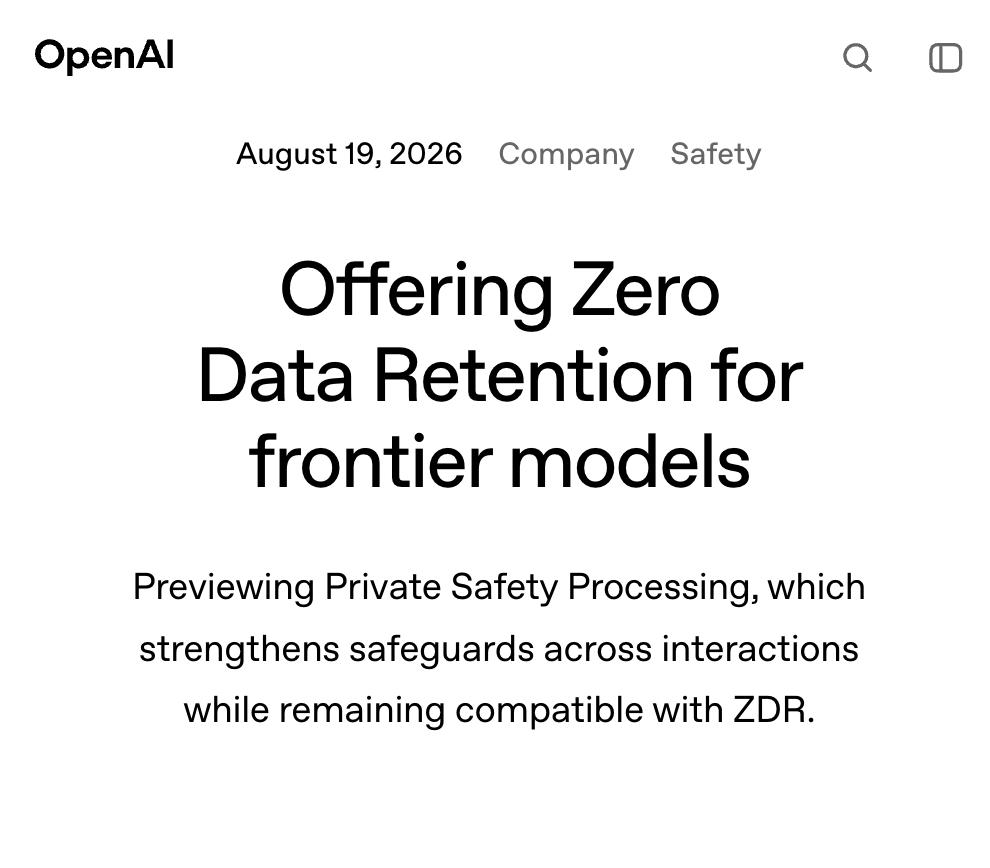
Yesterday: OpenAI started testing "private safety processing" to avoid retaining customer data
Today: Anthropic reversing course, will allow enterprise customers to keep data on THEIR OWN cloud infrastructure instead of Anthropic's
Alex Karp was right.
AN AI ENGINEER JUST DROPPED THE DOCUMENT THAT EXPLAINS WHY MOST “AUTONOMOUS” AGENTS STILL NEED A HUMAN BABYSITTER
a strong model is not enough. reliability comes from the harness around it: stopping rules, tools, memory, recovery, permissions and verification
task → loop → tools → memory → recovery → verifier → done
doordash ran 130,000 automated tasks in a month. openai had 3 engineers merge roughly 1,500 prs in 5 months using the same basic idea
better models make agents smarter. better harnesses make them safe enough to leave running without watching every step
that difference is where autonomous work actually starts. bookmark this before building your next agent
Marc Andreessen (the guy who called it when “software ate the world”) just pointed out what AI is doing to coding next.
“Everyone assumes AI coding means fewer hours… or leaving the profession. But almost everyone I know is working more hours.”
“There’s a new term in the Valley: the ‘AI vampire.’ You’re up all night AI coding because you’re so productive you can’t shut it off.”
“The top AI coders make $50M a year. They’ve found the philosopher’s stone.”
“Every company has a thousand projects they’ve wanted to build but never had the bandwidth. Now they can. This isn’t a blip—it’s going to intensify.”
PS: If this was useful, like + repost this tweet and follow @AiEvolutio58513 for the latest AI news.
See you in the next one:
JSON tool calling may be an unnecessary bottleneck for newer AI agents.
Capable models can orchestrate tools better by writing code than by emitting JSON calls.
This paper compares standard JSON calls with a code-first setup where the model writes one Python script that invokes the same tools.
Across 14 models on a 309-task BFCL v4 subset, programmatic tool calling matched or beat JSON in 11, with GPT-5.6-Sol and Terra each improving by 10.6 percentage points.
The gap gets clearer when one task needs many calls.
For Claude Sonnet 5, JSON issued every required call through a fan-out of 70, then started dropping calls; at 100 calls it fell to 0% enumeration accuracy, while Python stayed at 100%.
Sequential chains were faster for 13 of 14 models because several dependent calls can run inside one script instead of requiring another model turn after each tool result.
There is a boundary: several older GPT models got worse because they produced broken multiline Python, and the benchmark uses echo-return stubs rather than real APIs.
– arxiv. org/abs/2608.06370
Title: "The Bitter Lesson of Tool Calling"
Wow! This Changes Everything We Thought We Knew About Memory
It is a groundbreaking big deal.
TOU ARE MAKING GENERATIONAL MEMORIES RIGHT NOW IN EACH CELL!
Scientists just found that your brain doesn’t just store memories — it stores the rules for how those memories will change in the future.
A brand-new preprint from Stanford’s Greenleaf and Schnitzer labs (led by PhD student Yuxi Ke) drops a bombshell that feels like science fiction becoming reality overnight.
For decades, neuroscientists have suspected that chromatin the DNA packaging material inside every cell nucleus might somehow “store” memory-related information. But what kind of information? Content? Timing? Rules?
Now we have the answer!
Using activity-dependent genetic tagging, fear conditioning, and single-nucleus multiome sequencing in the mouse medial prefrontal cortex (the brain’s long-term memory vault), the team tracked engram neurons for a full *month* after a memory was formed.
What they discovered is electric:
- One month after encoding, engram neurons have acquired a completely new chromatin landscape.
- These chromatin changes are almost invisible at 7 days… but roar into existence by 28 days.
- At recall, these engram cells don’t just “remember” better — they rewrite their entire transcriptional response.
They preferentially fire up chromatin regulators, RNA processing machinery, and protein-turnover systems instead of simply boosting classic plasticity genes.
In other words: the chromatin doesn’t just hold the memory of the past.
It holds metaplastic instructions— rules that dictate how the neuron will respond the next time the memory is triggered.
They call it chromatin metaplasticity.
This is the “future tense of memory.”
It is a massive deal
1. Memory is not just synapses. For 70+ years we’ve been obsessed with synaptic weights. This work proves the nucleus itself is a computational device that stores history-dependent rules.
2. It explains remote memory. The chromatin signature keeps maturing for weeks after the experience, perfectly matching the time course of systems consolidation into the cortex.
3. It’s energy-efficient genius. Instead of constantly maintaining memory proteins, the cell stores a silent, writable program that only activates when needed. Nature’s version of lazy evaluation.
4. It links development to adult memory. The late chromatin state is enriched for the exact same transcription-factor motifs used in embryonic development. Your adult brain is still running developmental software to lock in lifelong memories.
5. Huge therapeutic potential. If we can read or rewrite these chromatin metaplastic rules, we might one day boost failing remote memories in Alzheimer’s… or selectively dampen traumatic ones.
This isn’t incremental. But a brand new layer of the memory code.
And it explains WHY a person can receive memory from an organ transplant.
It also explains generational traumas.
Link:
https://t.co/7yJiC7XOjy
The future of neuroscience just got a lot more exciting and a lot more nuclear.
Your chromatin is writing tomorrow’s memories today.
And we finally have the first page of the instruction manual.
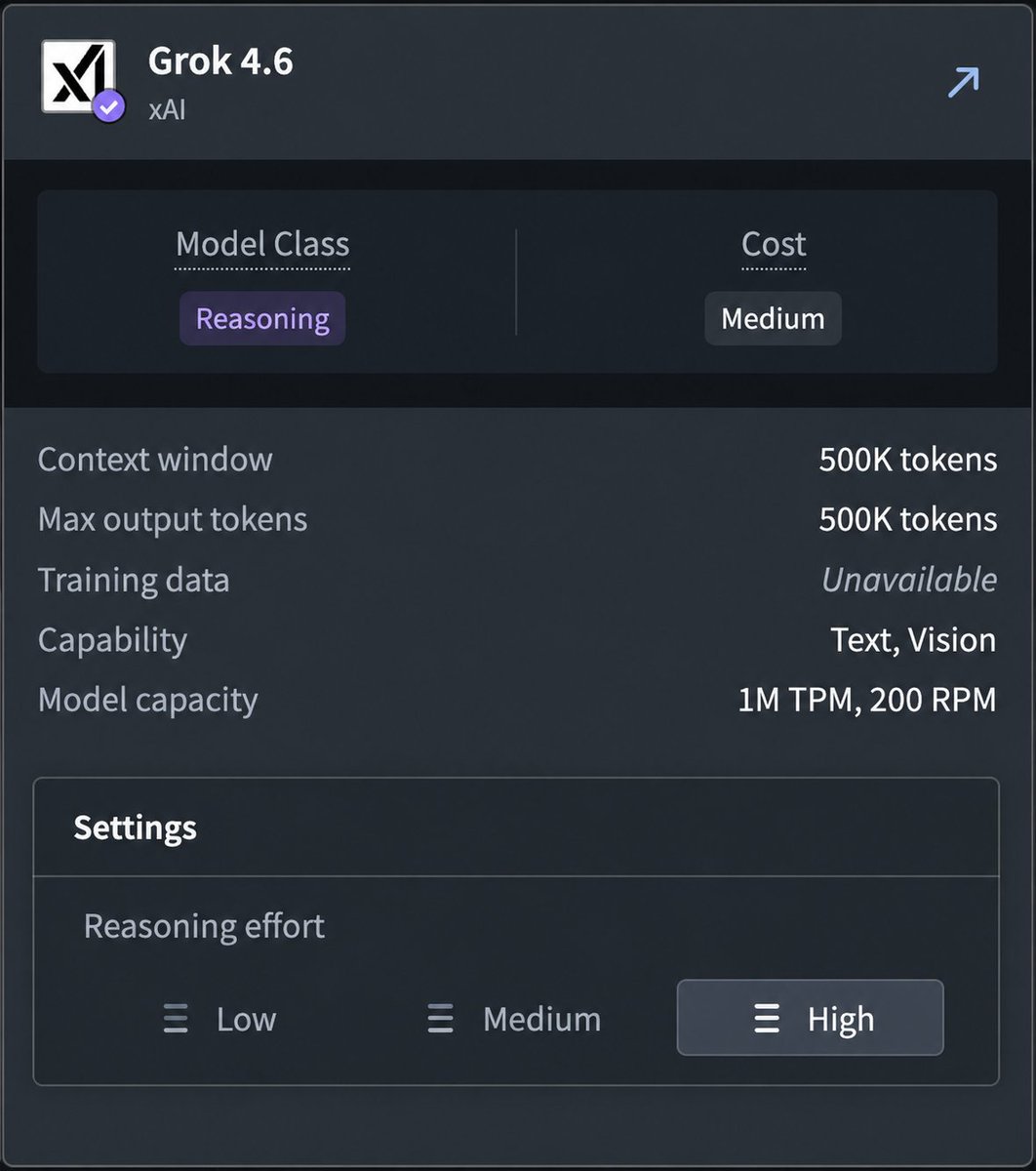
NEWS: Palantir is rolling out Grok 4.6 across its whole fleet.
Chad Wahlquist, a Forward Deployed Architect at Palantir, said the new model is "rolling out to the whole Palantir fleet" and added, "It's a good model sir!"
Palantir already offers Grok inside its AIP platform, so this extends an existing partnership with SpaceXAI.
The screenshot he shared shows Grok 4.6 with a 500K token context window and text and vision support.
Introducing Grok Bot, now in early beta.
Bots are AI teammates that do real work for you. They sign in to your tools, use them just like you do, and come back with finished work.
Palantir CEO Alex Karp says people think we’re in an AI bubble because a lot of AI just doesn’t work:
“If you just buy LLMs off the shelf and try to do any of this, it won’t work.”
“It’s not precise enough. You can’t do underwriting. You can’t do these things that are regulated.”
“People have tried things that just can never work. You buy a LLM, put it on your stack, and wonder why it’s not working.”
“What you’re going to see, especially in America, is people trying to do something like Ontology by hand.”
“Once you build a software layer to orchestrate and manage the LLMs in a language your enterprise understands, you actually can create value.”
“There’s a lot of discussion on if we’re in an AI bubble. What is the meaning of this bubble? If anything, we’re just in a lag. There’s a lot of AI, some of it works.”
“Go back to the battlefield context: everybody in the world assumed this would not work. But now it does work. Now the question is, ‘How can I get it to work for my country?’”
Far more than that.
As I’ve said publicly, bandwidth demand will increase massively due to AI & robotics. Their need for data transfer is orders of magnitude more than humans!
Even if the communications market merely doubles in size, I would expect Starlink to reach at least 25% market share outside of China (maybe one day in China too), which would be over half a trillion dollars in revenue per year.
It’s not out of the question that Starlink carries more than 50% of Internet traffic long-term, which would probably be over a trillion/year. There is no obvious impediment to that outcome so far.
James Dyson failed 5,126 times.
In a shed. For 15 years. While his wife taught art to feed the kids.
Prototype 5,127 built a global empire.
He's 79. Owns every share.
Here are 9 things he said on Founders
1. He kept every failure. Numbered them all.
9. Today he owns every share of Dyson.
No public listing. No executive directors. No outside investors telling him what to build.
He's 79. Net worth $14.8 billion.
His son Jake works in the business.
Rule 1 of Dyson: never surrender control.
Yesterday me and my friends talked about the Dead Internet Theory
If nobody asks questions anymore on Stack Overflow, and sites like Reddit are now taken over by AI reply bots to promote brands, as well as AI reply bots on here, there is no real content anymore on the internet
And then there is no fresh training data anymore
I thought about something like, how would you find out the best outdoor action camera? Before I would search :
site:https://t.co/hzXOs1G2mg best outdoor action camera
But now I just ask my AI which is the best
The problem is if nobody creates new content anymore and just asks their AI every question, the AI has nothing to train on anymore
And then I thought so what will happen? Will you get companies with giant warehouses that just buy stuff and review it with manually or with humanoid robots? Will you get humanoid robots backpacking in South East Asia to get life experience as training data? Or will we all train it by giving it access to our AI chats and user data?
I don't know but I think it's likely the web will dead in the future and AI companies will have to find training data elsewhere
@TheAliceSmith There is no such thing as “magic ground” that makes some places prosperous and some not!
If you teleported the people of Japan to anywhere else, that place would become Japan.
메타 최고AI책임자가 에이전트 떼로 엔지니어 100명 팀을 이겼다고 함. 그런데 방법을 물으니 마크다운 파일과 크론 잡이라고 답함.
Y Combinator에 나온 알렉산더 왕 얘기임. 회사는 결국 큰 피드백 루프 하나이고 그 안에 작은 루프가 박혀 있는데, 그 루프를 사람 대신 에이전트가 돌리게 만드는 데 알파가 있다는 것. 메타 내부에서 이미 그런 사례를 확인했고, 조건이 하나 붙음. 에이전트가 최적화할 올바른 평가지표를 붙여줄 때만 됨.
진행자가 기계적으로 뭐가 필요한지 캐묻자 답이 시시함. 지표 정하는 게 핵심이고 나머지는 스킬, 마크다운 파일, 크론 잡, 그리고 /goal 명령. 본인 말로 "파고들면 다 평범해서 늘 웃긴다"고 함. 조언 하나 더 얹었음. 링크드인은 무시하라고.
결국 병목은 모델이 아님. 뭘 최적화할지 정하는 사람의 판단임. 지표를 못 정하는 조직에 에이전트를 100대 붙여도 100명 팀만큼 헤맬 뿐임.
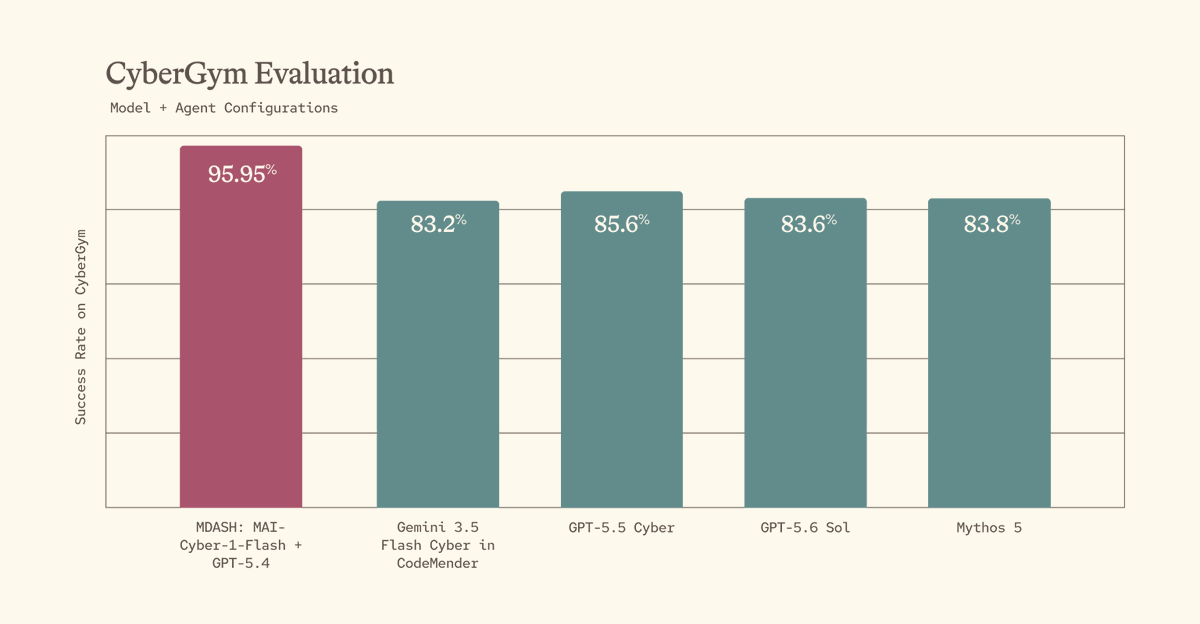
Today, we are announcing a series of updates that give customers frontier-grade security at half the cost.
MAI-Cyber-1-Flash is our first cybersecurity model, built ground up to find the most challenging vulnerabilities in complex code bases. When combined with MDASH, it delivers world-class performance at 50 percent of the cost of leading models.
We are bringing this capability to market through Project Perception, a complete agentic security offering grounded in real-world signals and security workflows. Teams of specialized agents work together to simulate attacks, detect and triage/investigate, and fix and remediate.
This is the benefit of building the harness, context/signals, and action space separate from one model family. By combining specialized models and data with the right agents, tools, security context, and harness, we can advance the frontier of cost to outcome.