A few weeks ago, I went through a rough patch—moderate URTI + LRTI (a lung infection), and around the same time I discovered an orthopedic issue: a bone infarct in my distal femur. As a medico/radiologist myself, getting a physician consult was straightforward and i did, but the combination of problems still left me anxious.
Naturally, I asked GPT for possible causes of the infarct. It generated a wide differential list with the relevant investigations. I ordered most of the tests, fed the reports back to GPT, and it helped narrow the differential further. Eventually, I learned the infarct was chronic—likely related to my past COVID infection and steroid use—but GPT had already helped me rule out urgent causes, advised immediate precautions, monitored drug interactions with my respiratory medications, and even supported the radiological interpretation confirming chronicity. Because of that, I knew no acute intervention was needed.
Throughout this period, for small but stressful issues—worsening cough, knee pain, treatment adjustments—GPT consistently guided me with practical, reliable suggestions. Many questions I might have asked a physician or orthopedician were answered well enough by AI.
I’m sharing this in the context of the increasing fear that AI will replace radiologists. As a radiologist who actively uses AI for nearly all radiological tasks, I can say this with clarity: AI will transform radiology sooner than most expect. Report generation is already far easier, and while today’s models can’t yet read videos or DICOMs natively, that capability is likely only months away. When that happens, the demand for radiologists will undeniably shift.
But my experience also showed me something bigger: no medical branch is immune. AI can propose more patient-specific oncology protocols than most medical oncologists, outline more precise stroke pathways than many neurologists, and offer tailored clinical guidance across specialties—not just textbook answers, but scenario-specific recommendations.
Technology now has a form of intelligence that surpasses what any one human can hold in their mind. Medicine will evolve accordingly.
So yes, radiology will be affected—and early. But no field of medicine, and truly no domain of human expertise, can claim to be “safe.” We’re witnessing evolution in real time.
#neetpg2025 #Radiology #neetpgcounselling
INDIA is my identity.. INDIA is identity of 1.5 billion Indians.. and no one has power to change that.. Today they have came for name, tomorrow they will come for constitution and tricolour 🇮🇳, then they will come for ur religion,then ur caste and then finally YOU.#IndiaVsBharat
Medical field will also have similar fate/doom as Engineering in India!! (A thread)
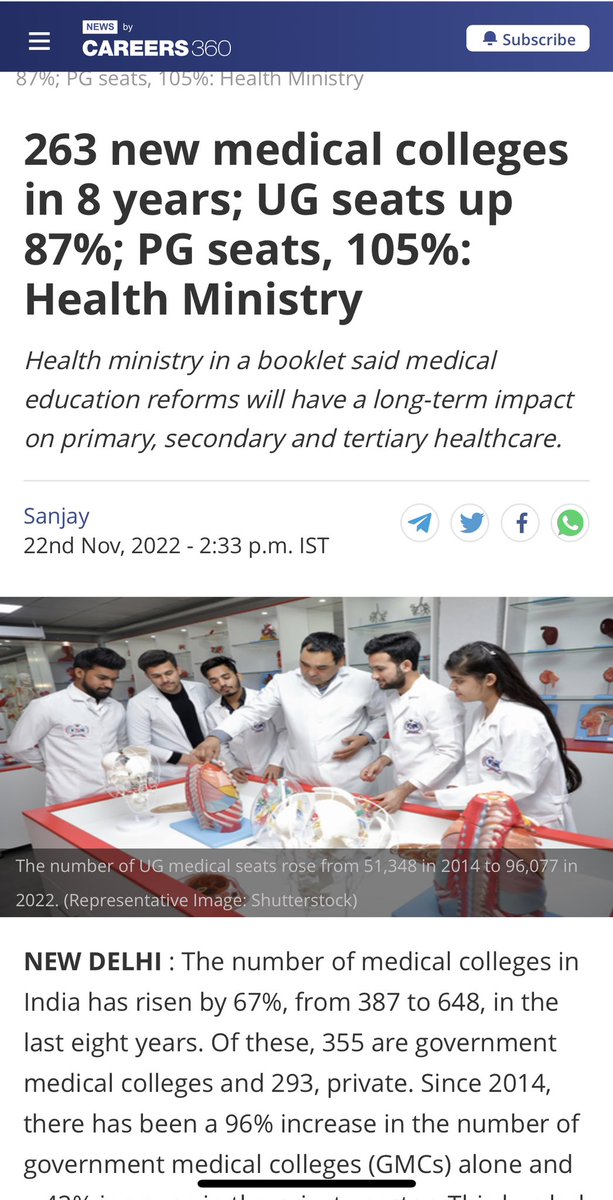
1) India’s Doctor-patient ratio is now already much better than arbitrarily choosen WHO’s number of 1:1000. There are many countries with worse ratio but better quality healthcare. #medtwitter
5/n
The upcoming role of AI (Artificial Intelligence) and robotics will only make situation worse.
Government present approach won’t solve either patient’s problem nor doctors. Someone needs to tell this to govt or otherwise one more field will also get doomed.
#doctor
Medical field will also have similar fate/doom as Engineering in India!! (A thread)
1) India’s Doctor-patient ratio is now already much better than arbitrarily choosen WHO’s number of 1:1000. There are many countries with worse ratio but better quality healthcare. #medtwitter
4/n
Mechanical engineer can do coding and aeronautical engineer can be a data analysts later on.. but a doctor after 12-13 years of his/her life invested (upto DM/Mch excluding drop and bond years) cant change the field.Thus medical field getting saturated is even more graver!
@JPNadda@ChaudhryShankar@Samir06803696 same story everywhere ,it would take a “DISASTER” for opening the eyes of government, RT If agree.. https://t.co/oizQtxTVSg