🚨 AI Just Created a Material Humans Never Imagined!
Scientists have developed a revolutionary new material that is stronger than steel, lighter than foam, and up to 5 times stronger than titanium.
The most surprising part? It was designed by artificial intelligence, not human engineers.
Using AI, researchers created entirely new microscopic structures that were later 3D-printed and tested. The results could lead to lighter airplanes, stronger buildings, and more efficient vehicles.
This breakthrough shows that AI is no longer just helping scientists—it’s starting to invent alongside them.
What could the world look like when AI designs the materials of the future?
Source: University of Toronto. AI-designed nanomaterials achieve exceptional strength and lightness. University of Toronto Engineering News.
You have not missed $HIMS at $26
You have not missed $ONDS at $13
You have not missed $SOFI at $18
You have not missed $IREN at $63
You have not missed $NOW at $124
You have not missed $NBIS at $231
Better days are ahead!👀
I’m 44 years old and used to work at JPMorgan Chase. My monthly income is $110,000.
My June advice:
$NKE (Nike) — Don’t buy
$OKLO (Oklo Inc) — Don’t buy
$ASTC (Astrotech) — Don’t buy
$ONDS (Ondas) — Buy at $10–$13
$TSLA (Tesla) — Buy at $425–$430
$MSFT (Microsoft) — Buy at $438–$445
$HOOD (Robinhood) — Buy at $85–$90
People ask, Why don’t you charge?
I’ve made enough. Sharing is my passion ,that’s why I post for fre.
President Trump has gone undefeated in the stock market…
First he called $INTC at $19 which ran +594% to $132.
Next he called $DELL at $230 which ran +88% to $433.
Now he’s telling you to buy these 2 stocks.
$PLTR at $145
$NOW at $108
Don’t miss out again…
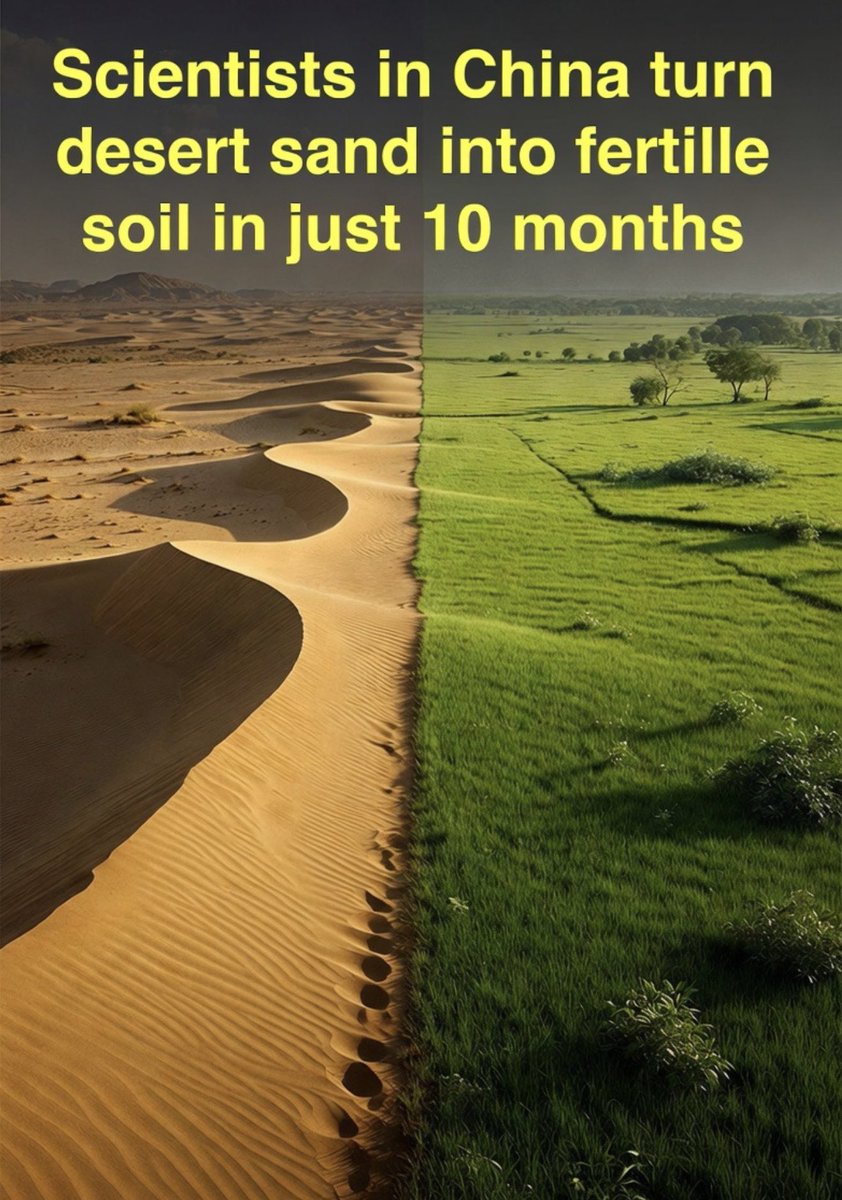
China may have discovered a quicker method to help slow the expansion of deserts. The approach focuses on biological soil crusts, which are very thin natural layers made up of microorganisms such as cyanobacteria, fungi, mosses, and other microbes that gradually form on desert surfaces. These are often described as a kind of living protective covering for sandy ground.
Under normal conditions, these crusts take many decades to develop on their own. However, researchers at the Chinese Academy of Sciences report that they were able to speed up the process by cultivating cyanobacteria in a lab and spraying them onto loose sand. Once applied, the microbes begin to spread and quickly bind sand particles together.
As they grow, they release sticky substances that act like a natural adhesive, gradually creating a stable surface layer that can withstand wind erosion and reduce the impact of dust storms. In experimental areas near the Taklamakan Desert in northwestern China, scientists observed that strong, stable crusts formed within roughly ten to sixteen months.
This is important because shifting sand makes it extremely difficult for ecosystems to recover. Wind constantly moves the surface, preventing plant roots from taking hold. Once the ground is stabilised, however, grasses and shrubs have a far better chance of growing.
The developing crust also improves soil quality. It helps retain moisture, limits water loss through evaporation, keeps nutrients close to the surface, and slowly builds up organic material that supports future plant growth. Some cyanobacteria can also absorb nitrogen from the air, naturally enriching the soil over time.
Testing showed that treated areas were far more resistant to wind erosion, with reductions of more than ninety percent in laboratory conditions. If successful on a larger scale, this method could help slow desertification, the gradual degradation of productive land into desert caused by factors such as drought, climate change, deforestation, and overgrazing.
Researchers do, however, emphasise that this is not a complete solution. The crusts can still be damaged by human or animal activity such as grazing, walking, or vehicles, and long term effectiveness will depend on weather patterns and careful land management.
The entire universe might be trapped spinning inside a black hole.
That’s what new data from the James Webb Space Telescope seems to suggest.
Researchers examined 263 faraway galaxies and discovered something startling: roughly two out of every three are rotating in the same direction. In a truly random cosmos, you’d expect a perfect 50–50 split between clockwise and counterclockwise. This strong imbalance hints that the universe itself may have been born with a net spin.
One of the ideas now getting serious attention is known as black hole cosmology. It suggests that our entire universe is nested inside a rotating black hole that belongs to a larger “parent” universe. According to some theorists, when a giant black hole forms, it doesn’t simply collapse forever into a singularity. Instead, it can “bounce,” triggering a rapid expansion that creates a new universe on the inner side of its event horizon.
If the parent black hole was spinning, it could have transferred that angular momentum to everything inside—including all the galaxies we see today. That inherited twist might explain why so many distant galaxies appear to prefer the same rotational direction from our vantage point.
The same model could also account for the universe’s ongoing expansion and its remarkable large-scale uniformity. Rather than starting from an infinitely dense singularity, the Big Bang may have been a cosmic rebound—a sudden reversal that flung space, time, and matter outward from the heart of a black hole.
Of course, other explanations haven’t been ruled out. Our own Milky Way’s rotation, or subtle observational biases, could be skewing the picture. But if larger surveys confirm this galaxy-spin alignment, it would suggest the universe has a deep, hidden handedness—and that its origin story is far stranger than we ever imagined.
["The distribution of galaxy rotation in JWST Advanced Deep Extragalactic Survey." Monthly Notices of the Royal Astronomical Society, 2025]
"Lahaina Noon," is a trippy phenomenon that happens twice a year in Hawaii, where all objects lose their shadows
It begins in Hawaii TODAY,
starting on the Big Island
EARNINGS AND EVENTS CALENDAR FOR MAY 13, 2026
Get ready for ANOTHER premarket economic data dump with our @ttvresearch daily calendar for Wednesday, May 13!
@tradertvlive $SPY $QQQ $BABA $NBIS $CSCO $USAR $ABBV $AMGN $SYK $AMD $INTC $ROKU $TMUS $VZ #PowerHour
An NVIDIA-powered farming machine uses AI and precision lasers to destroy weeds in milliseconds without herbicides, offering a potential step toward chemical-free agriculture.
Your tattoo isn’t just decorative ink: it’s a permanent trigger that keeps your immune system locked in a lifelong cycle of chronic inflammation.
As soon as the ink is injected into your skin, your body recognizes the pigment particles as foreign invaders. Immune cells called macrophages immediately swarm the area and attempt to swallow them up. But because they can’t actually break down the ink, the macrophages eventually die, releasing the pigment back into the surrounding tissue — only for a new wave of macrophages to arrive and repeat the process.
This endless cycle is what keeps the tattoo permanently visible, while also maintaining a state of ongoing, low-level inflammation in the skin.
Over time, some of these ink particles migrate through the lymphatic system and accumulate in the lymph nodes, placing constant stress on the body’s defense mechanisms. Emerging research suggests this internal ink buildup may interfere with normal immune function, potentially reducing the effectiveness of certain vaccines, including mRNA types. Additionally, many tattoo inks contain heavy metals like nickel and cobalt. Combined with the chronic inflammation, this has been linked to a modestly elevated risk of lymphoma and skin cancer.
While tattoos remain a powerful form of self-expression, they represent a complex, decades-long biological conflict between your immune system and foreign substances embedded in your skin.
[Nielsen, C., Jerkeman, M., & Jöud, A. S. (2024). Tattoos as a risk factor for systemic lymphoma: A population-based case-control study. eClinicalMedicine]
This is how cork is harvested,
The Quercus suber (the cork oak) is the primary source of cork used for many products including wine bottle stoppers
Bark can be stripped without permanent damage and is regenerated about 12 times during the tree’s life
A man spends 50 years teaching at MIT.
He knows his time is running out.
So he records one last lecture — everything he knows, distilled into a single hour.
He died 5 months later.
This is that lecture.
The most important hour you'll watch this week. 👇
Bookmark it for later
Nvidia CEO Jensen Huang just revealed the ‘Five Layer’ AI Model.
These 5 layers include;
1. Energy - $BE $OKLO $VRT
2. Compute - $NBIS $IREN $CIFR
3. Photonics - $AAOI $LITE $SIVE
4. Memory - $MU $SNDK $STX
5. Chips - $NVDA $AMD $AVGO
All of these stocks will explode in 2026 & 2027 as AI continued to expand.
(This list isn’t exhaustive, just some of my favourites).
Scientists in China have achieved a major breakthrough by keeping a so-called “quantum cat” state stable for about 23 minutes (1,400 seconds), far longer than ever before. This “cat” doesn’t mean a real animal, it comes from Schrödinger’s cat and is a way of describing a system that can exist in two states at the same time, known as quantum superposition.
To make this happen, researchers cooled around 10,000 ytterbium atoms to near absolute zero and held them in place using lasers. Normally, these kinds of quantum states are extremely fragile and collapse almost instantly because of tiny disturbances from the environment. To prevent that, the team used special methods to shield the atoms, essentially creating a protected “quiet zone” where outside noise couldn’t interfere, allowing the state to last much longer than usual.
This is important because being able to keep quantum states stable opens the door to better technology, such as more precise atomic clocks, highly sensitive sensors, and improved navigation systems. It also brings scientists closer to building reliable quantum computers and gives them a new way to test the limits of physics and explore forces that are still not fully understood.


![Rainmaker1973's tweet photo. The entire universe might be trapped spinning inside a black hole.
That’s what new data from the James Webb Space Telescope seems to suggest.
Researchers examined 263 faraway galaxies and discovered something startling: roughly two out of every three are rotating in the same direction. In a truly random cosmos, you’d expect a perfect 50–50 split between clockwise and counterclockwise. This strong imbalance hints that the universe itself may have been born with a net spin.
One of the ideas now getting serious attention is known as black hole cosmology. It suggests that our entire universe is nested inside a rotating black hole that belongs to a larger “parent” universe. According to some theorists, when a giant black hole forms, it doesn’t simply collapse forever into a singularity. Instead, it can “bounce,” triggering a rapid expansion that creates a new universe on the inner side of its event horizon.
If the parent black hole was spinning, it could have transferred that angular momentum to everything inside—including all the galaxies we see today. That inherited twist might explain why so many distant galaxies appear to prefer the same rotational direction from our vantage point.
The same model could also account for the universe’s ongoing expansion and its remarkable large-scale uniformity. Rather than starting from an infinitely dense singularity, the Big Bang may have been a cosmic rebound—a sudden reversal that flung space, time, and matter outward from the heart of a black hole.
Of course, other explanations haven’t been ruled out. Our own Milky Way’s rotation, or subtle observational biases, could be skewing the picture. But if larger surveys confirm this galaxy-spin alignment, it would suggest the universe has a deep, hidden handedness—and that its origin story is far stranger than we ever imagined.
["The distribution of galaxy rotation in JWST Advanced Deep Extragalactic Survey." Monthly Notices of the Royal Astronomical Society, 2025]](https://pbs.twimg.com/media/HIvrNrTWUAEXQ3i.png)


![Rainmaker1973's tweet photo. Your tattoo isn’t just decorative ink: it’s a permanent trigger that keeps your immune system locked in a lifelong cycle of chronic inflammation.
As soon as the ink is injected into your skin, your body recognizes the pigment particles as foreign invaders. Immune cells called macrophages immediately swarm the area and attempt to swallow them up. But because they can’t actually break down the ink, the macrophages eventually die, releasing the pigment back into the surrounding tissue — only for a new wave of macrophages to arrive and repeat the process.
This endless cycle is what keeps the tattoo permanently visible, while also maintaining a state of ongoing, low-level inflammation in the skin.
Over time, some of these ink particles migrate through the lymphatic system and accumulate in the lymph nodes, placing constant stress on the body’s defense mechanisms. Emerging research suggests this internal ink buildup may interfere with normal immune function, potentially reducing the effectiveness of certain vaccines, including mRNA types. Additionally, many tattoo inks contain heavy metals like nickel and cobalt. Combined with the chronic inflammation, this has been linked to a modestly elevated risk of lymphoma and skin cancer.
While tattoos remain a powerful form of self-expression, they represent a complex, decades-long biological conflict between your immune system and foreign substances embedded in your skin.
[Nielsen, C., Jerkeman, M., & Jöud, A. S. (2024). Tattoos as a risk factor for systemic lymphoma: A population-based case-control study. eClinicalMedicine]](https://pbs.twimg.com/media/HHfNpsmXYAAlrGO.jpg)