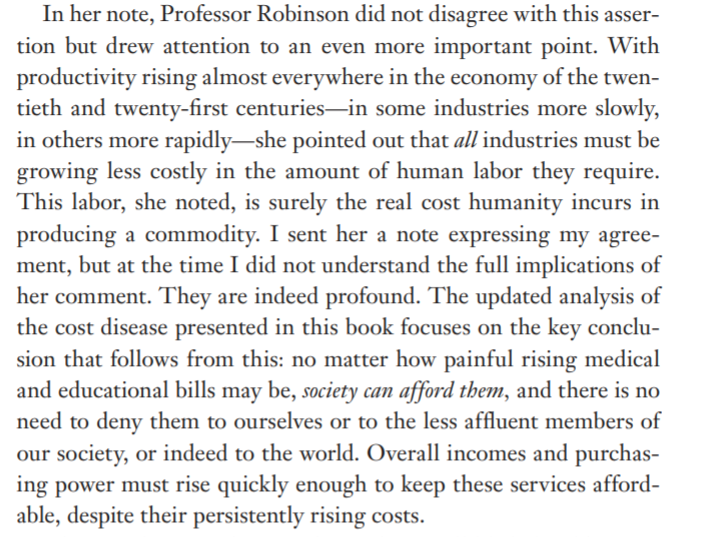
@StatisticUrban The funny thing is it isn't really a disease, as Baumol himself came to realize. It's like "oh no, we're richer and more productive and wages track productivity"
.@LuizaJarovsky “So I was grading people on their ability to use ChatGPT.”
There is no point in resisting the use of AI in the process of creation of intellectual ideas. We must instead, teach our students how to use it effectively.
Here is the assignment I gave my second year PhD class:
Your assignment for the course is to write a research paper using AI. The paper should be a minimum of 15 pages and a maximum of 30 pages including bibliography. Appendixes (if needed) can be additional. The paper must be formatted for submission to a journal.
At each step of the production of the paper, keep a diary on a word processor of your choice. Document which AI you use at each step and importantly: what prompts you gave it. Typical steps would include:
1Choice of a topic. Is my idea a good one? Has it been done before?
2Literature Review. Check for hallucinations. READ the main papers yourself. Do NOT rely on the AI. Which AI did you use.
3Structure of the paper. Make an outline. Discuss it with one or more Ais. Document your prompts and the AI response.
4Draft the paper. Go back and forth suggesting possible improvements.
5Discuss possible journals that the paper could be submitted to. How should your paper be refined to hit a particular journal?
6When the paper is complete: Send it to a different AI and ask for referee reports. How can the paper be improved in light of the reports? Take up the suggestions.
You will NOT be graded on the quality of the paper. You WILL be graded on the quality of the diary and how well you responded to and interacted with the AI.
This: [The] grade distributions … did not collapse at all. On a 100-point scale, they remained almost as dispersed as in the old-fashioned in-class exams. That is important evidence that the assignments were still differentiating among students, even when AI was available.
Yes. Again, I never said it cannot be done that way. Before AI, there were already students who took only easy classes. That is not going to change. I explicitly said that nothing is bulletproof.
The point is to design assignments that satisfy the following condition: students who want to learn should be able to augment themselves with AI, do more sophisticated work than before, remain in command of the process, and train for the real world. That world will demand, at least for the foreseeable future, that they know how to think, but also how to do things quickly and efficiently, which means knowing how to use AI well.
In fact, the grade distributions on these assignments did not collapse at all. On a 100-point scale, they remained almost as dispersed as in the old-fashioned in-class exams. That is important evidence that the assignments were still differentiating among students, even when AI was available.
This was not my experience this semester.
I followed @tylercowen idea of teaching 1/3 AI, so students become proficient with it and learn to use it well, to augment their learning rather than simply substitute for it, and 2/3 the standard material of the course.
In Development Economics, for example, a 400-level class where econometrics is a prerequisite, students are often not yet well prepared in the methods used in research. Several students told me that having AI teach them specific methods, and specific applications, was extremely useful.
The assignments were all designed to be done with AI, and they became more difficult than before. Students complained that they took too much time. But in the end, I think it is very useful for them to learn to think and work with AI as a tool at their side.
My undergraduate teaching leans more on reflection of AI use than emphasizing integration of it, but I am left to wonder, with my own class’s grade distribution and @SFGaliani’s: What is causing the dispersion in grades? What learning am I promoting? What work am I rewarding?
@PHLAirport horrible service today at Economy Parking Red Lot Shelter 8. I’ve been waiting for a half hour now. A bus was full and leafing when I walked up and another came by only dropping people off.
At some point in TurboTax 2023's development, somebody did a find-replace of "tick" for "checkmark." Which is great, since only Commonwealth countries call a checkmark a tick.
But now you can make a donation in New York for "Lyme and Checkmark-Borne Diseases."
@emollick Very interesting, but this might tell more about the ability to learn than to reason. As the similarities show I am afraid this is probably one of the top "what if" scenarios online. Participating in "what if" historic discussion used to be my hobby in usenet groups.
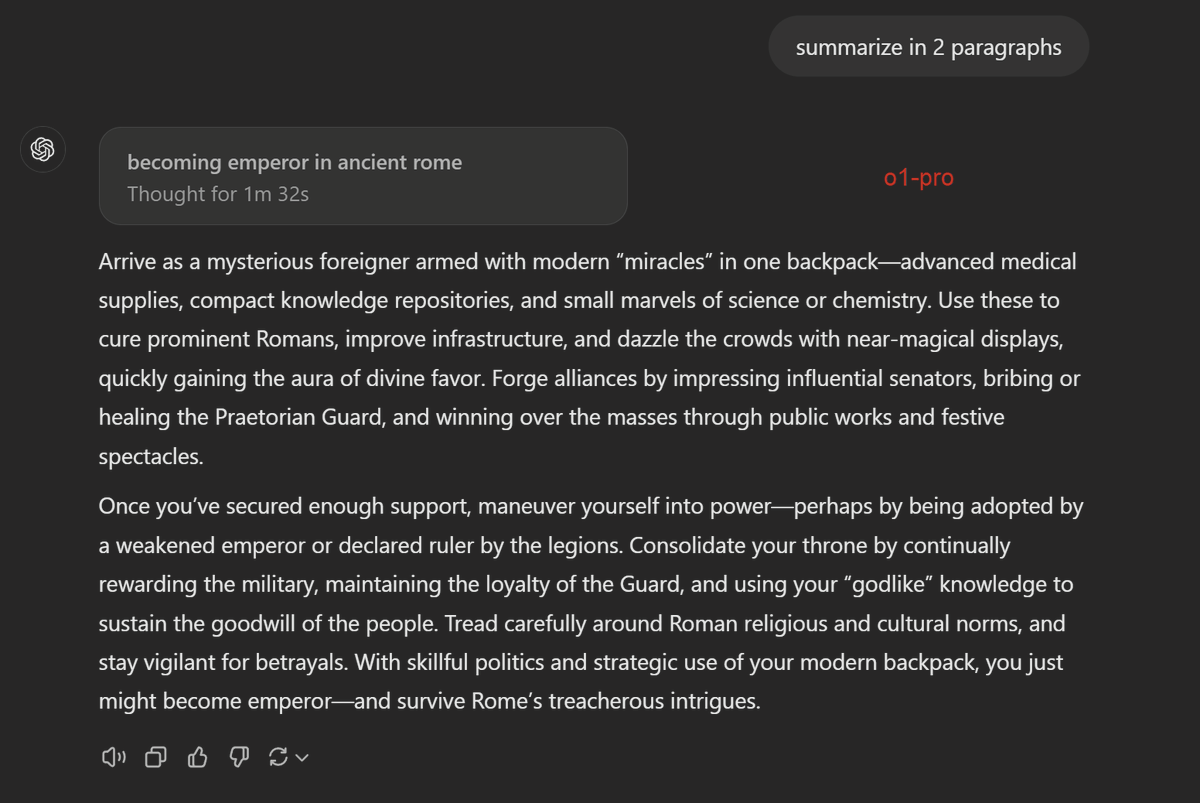
"Hey DeepSeek, Claude, o1-pro, Gemini 2.0 Flash Thinking: I am time travelling back to Ancient Rome and want to become emperor. i can bring one backpack with me from today (no weapons). How do I do it?"
Here are summaries full (o1-pro thought for 4.5 minutes!) in next post.
That's too broad a take. Depends - which humanities, and where. (in/out of academia) I can think of:
Arts - performing arts are embracing generative models, as they embrace any tools thrown their way. The way usually embracing happens - old established will shy away, new upstarts use new tools to make space for themselves under the sun.
Philosophy, religion - have plenty to say, and plenty are saying.
Writing - fiction, science fiction. Enough said. Most ideas we entertain now started there. Fertile grounds. Could say - they have done very well.
Linguistics - sadly they were gripped by a cult, in-toto with a cult leader. But incoming young minds there will adapt. Funeral by funeral there, the advance.
Law - they should be able to advance much. Not thinking here of the silly censorship laws. I'm in the UK. Most laws seem to be poor in conception, drafting, execution - just poor all around!? Lawyers have occupied the commanding heights of society, the results are now in - and they are uniformly bad! Even in their supposed area of expertise - law! - these people seem as competent as a monkey doing my daily programming. Law is code, it is the Operating System of society. Plenty of low hanging fruit in law it seems. Should be able to improve a lot there.
...
This looks like an interesting event. I tried to log in to the site, but got the message that my account has been disabled. Also that I should contact the system administrator, but I can't find that person on the NABE web site. Any ideas?
Tune in today at 1pm ET for a free public webinar! Get insights on potential Trump admin #tariff plans and their impacts on trade, growth, and businesses. You won't want to miss it!
🔗Register here: https://t.co/K3S01ikLvR
It’s nice to stream the various sources set up by @WatchLSN, but during live games at Kirby, the audio of the reporting from the floor is not synced with the video. Regardless whether the problem is due to @LafCol, @ESPNPlus, or some other link in the chain: Can it be fixed?
Great work coming out of @CompPolicyInt, and I'm looking forward taking my students through cases in the new book from Kwoka, Valletti, and White. Yet the publisher's Contact Us page has a captcha that I can't seem to get to work in Safari or Chrome. https://t.co/sWL98O3e5H
When I was working on my Everglades book, I fell down a fascinating rabbit hole researching Jimmy Carter’s politically suicidal but totally righteous effort to kill a whole bunch of useless porkbarrel water projects. It might have doomed his presidency! A quick 🧵 1
… a major impact, reducing enrollment by 33% and differentially excluding young, healthy, and economically disadvantaged people. … [A]dverse selection – a classic feature of insurance markets – undermines ordeals’ standard rationale of excluding low-value individuals …