Floor796 is a huge, ongoing animated pixel-art scene: it depicts the “796th floor” of a massive fictional space station, populated by thousands of characters, creatures, and references drawn from games, memes, anime, movies, TV shows, and general pop-culture
It’s a creative project started as a hobby by a single artist (@Floor_796) around 2018, and the site has been regularly updated ever since, seven years in the making.
We made contact with the author and onboarded him, now he has access to all creator fees and has claimed $15k in fees so far
You will find relevant links to the project under this tweet
CA: DvD2LH2Z5JYRuPuTp83HMRcsB1n5vXeCMUakW69Kpump
Video: anichadsenpai on tiktok
Can’t believe we brought 3 of us into a dream world—"Deep Confusion"
—— walk, interact, reshape, reload in real-time. Real 4D humans streaming inside a generated world via @theworldlabs in one render.
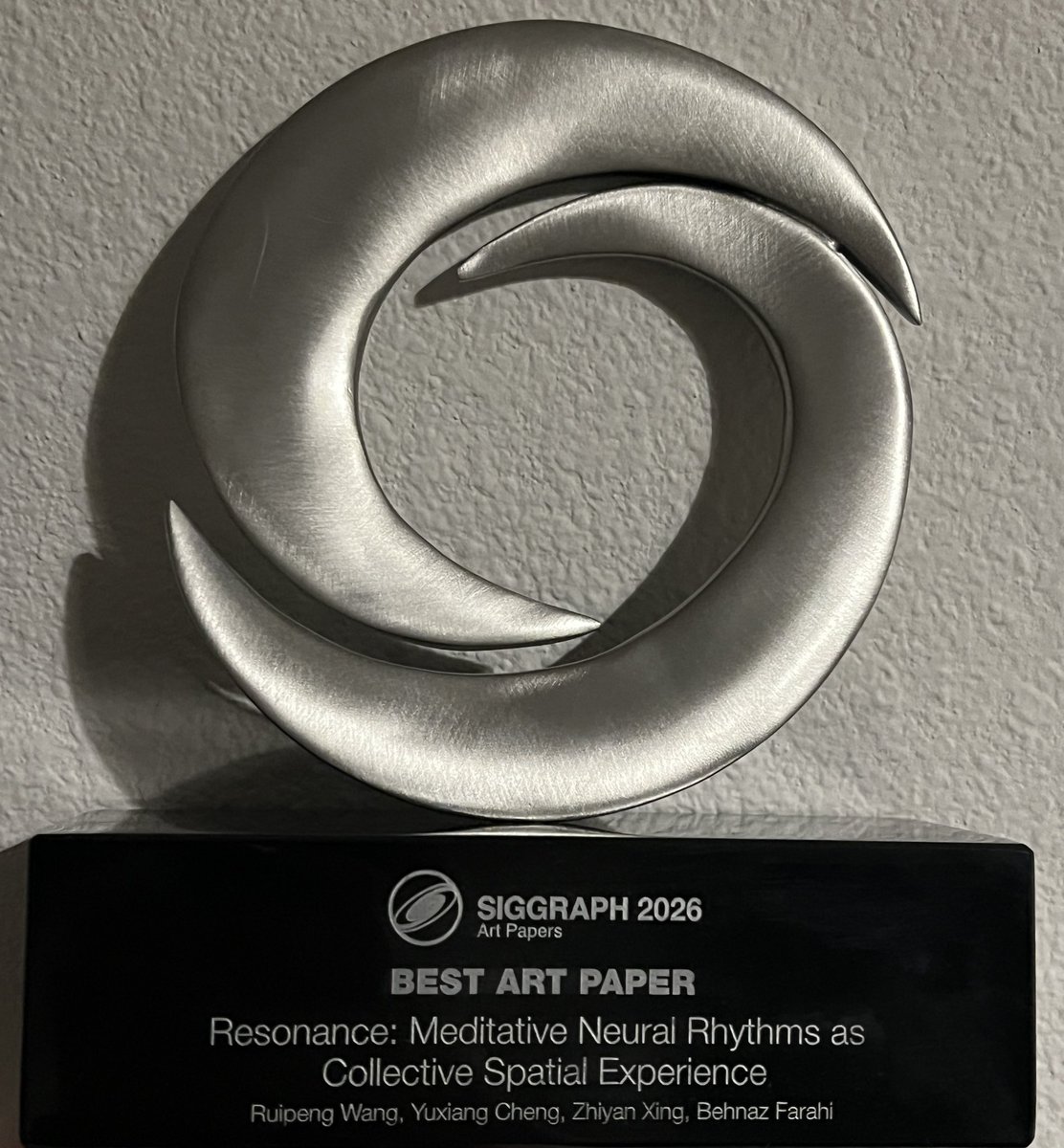
Built and captured all in 30 hours with @Yiiisabel @rui_peng_wang@sbh_studio, using #Spark #Marble from #worldlabs, at the @SensAIHackademy hackathon during @siggraph 2026 in LA.
#3DGS #4DGS
Continual learning is widely discussed right now, but mostly as improving on the job or avoiding catastrophic forgetting. But it has a different, difficult, and already urgent form:
Given nothing but a corpus of documents, how should AI systems develop expertise in a new, unfamiliar domain? We call this problem Machine Studying.
Huge credit to the OAI team for solving the unit distance problem with 5.5 - it is now my go to example that models can in fact pull together disparate ideas into new discoveries.
As with all 4 minute miles, we had to try and cross it too! Turns out mythos solves it with a cute, simple proof. This implies some serious overhang in discoveries!
🎉 After one year of teamwork, we are excited to release our 3D foundation model — LingBot-Map!
Unlike DA3/VGGT, LingBot-Map is a purely autoregressive model for streaming 3D reconstruction ⚡
It achieves ~20 FPS on 518×378 resolution over sequences exceeding 10,000 frames — and beyond 🚀
Two key insights behind LingBot-Map:
🔑 Keep SLAM's structural wisdom: build Geometric Context Attention with long-context modeling while maintaining a compact streaming state
🔑 Make everything end-to-end learnable — no optimization, no post-processing
Let's check out our demos 👇
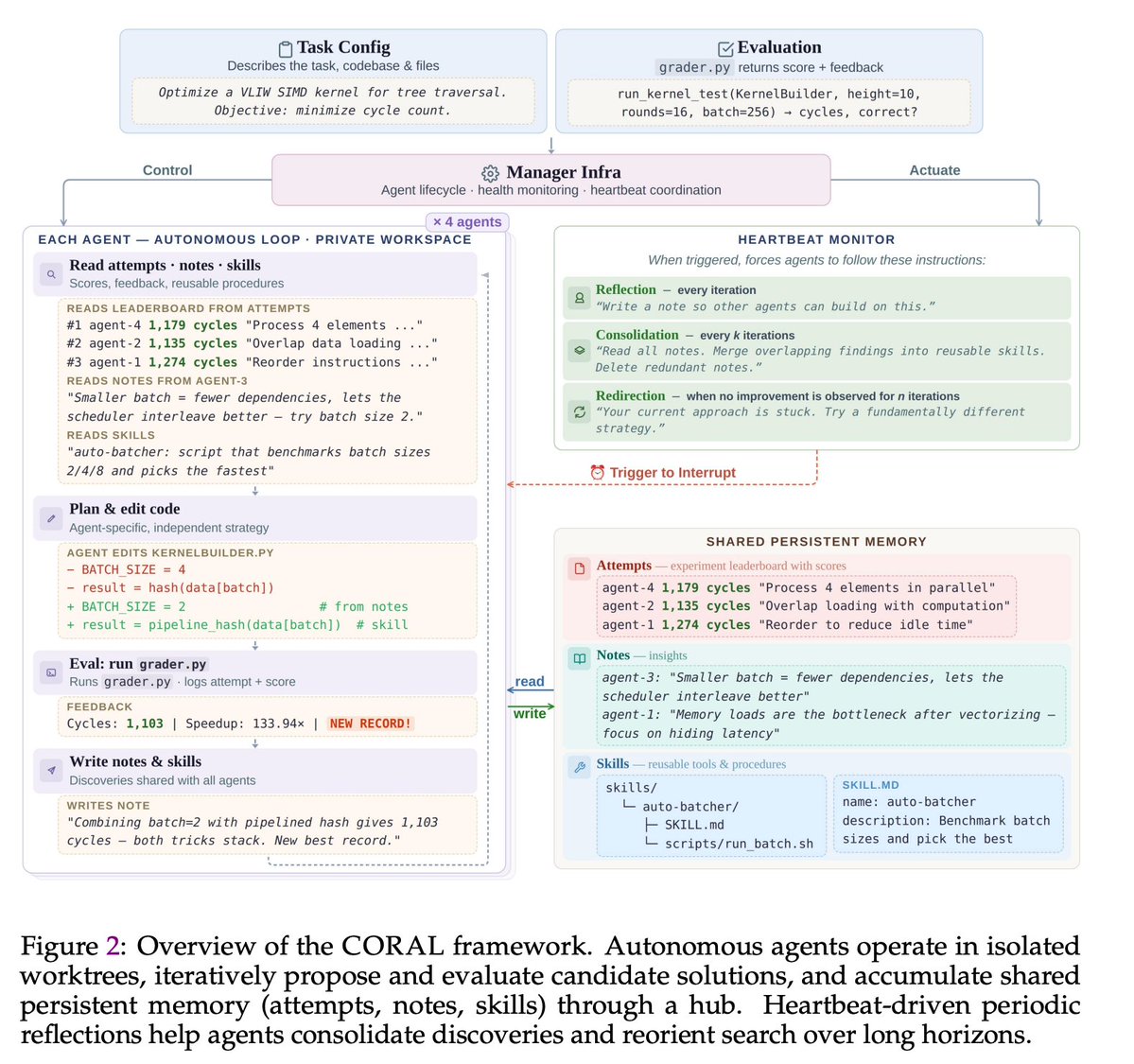
🚀 The era of autonomous multi-agent discovery has begun.
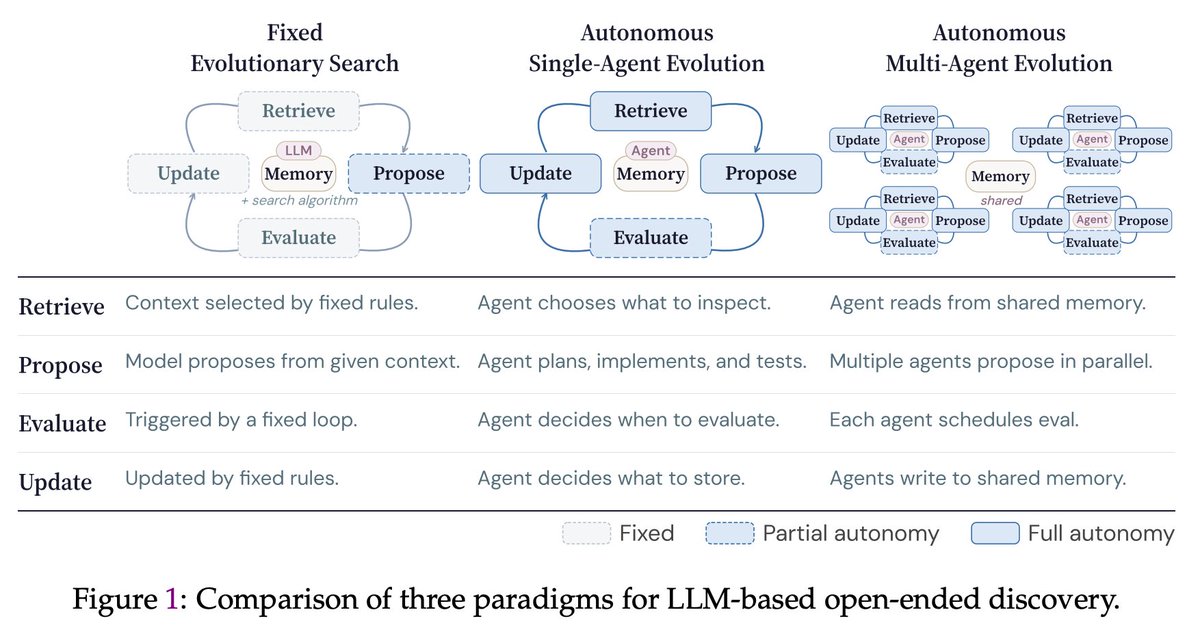
Most “self-evolving” scientific discovery frameworks are still tightly constrained:
LLMs often just perform one-step mutations inside fixed evolutionary search loops.
But that is not real autonomy.
Agents still cannot truly decide:
🔍 what to explore
🧠 what knowledge to store
♻️ which past attempts to reuse
🧪 when to test
With CORAL, we ask:
❓ What happens if we give agents much more autonomy to explore the scientific frontier?
💡 Our answer:
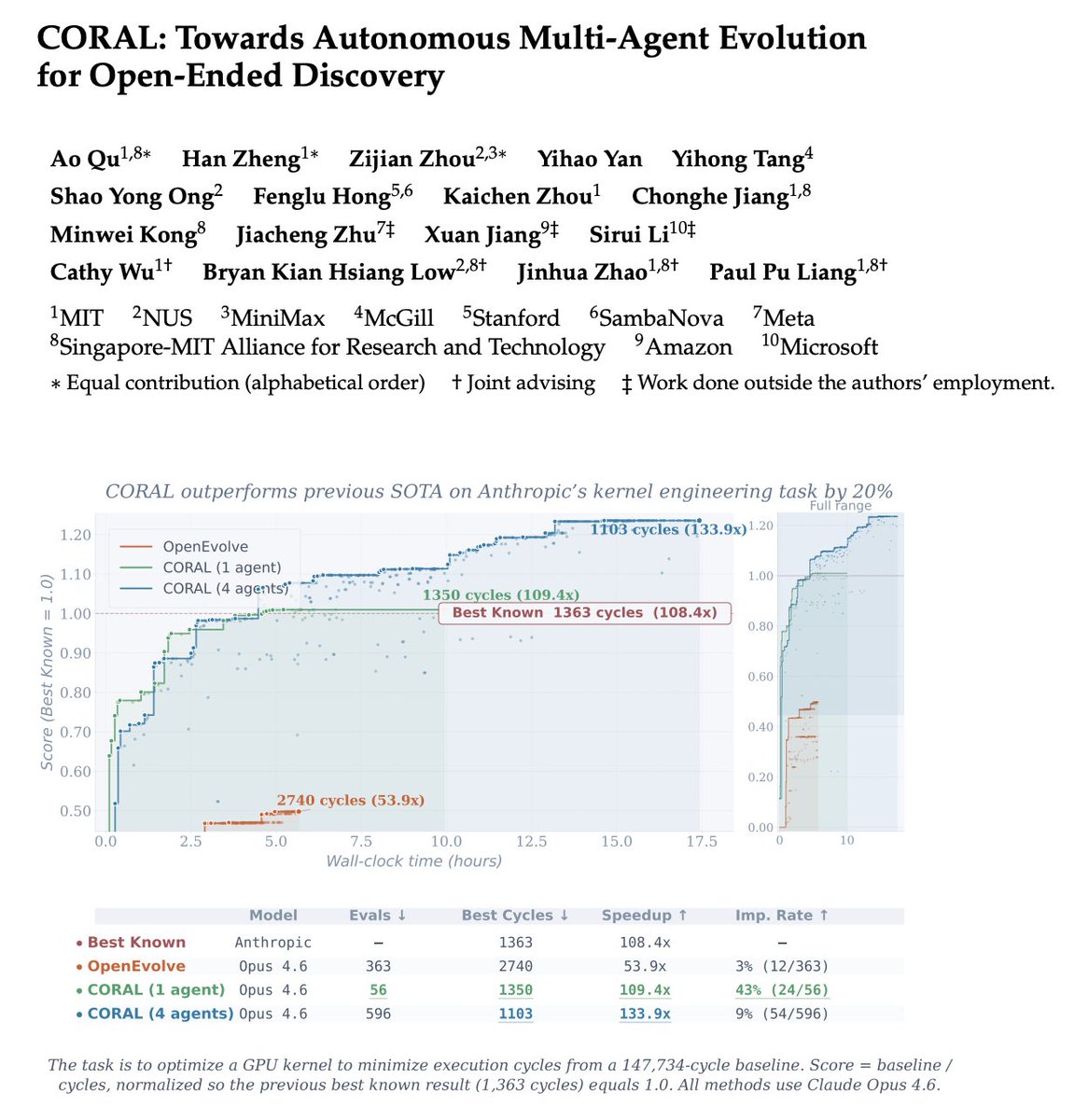
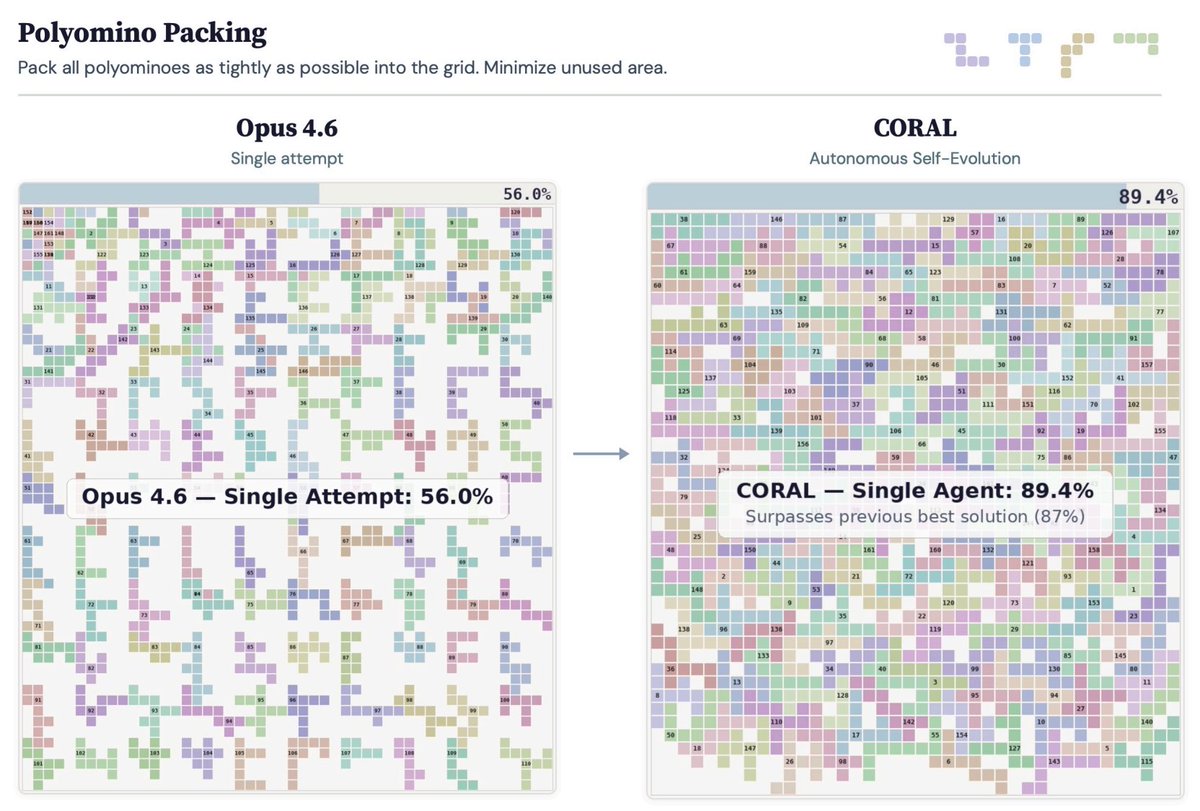
A single autonomous agent already outperforms fixed evolutionary search.
But the bigger leap comes when multiple autonomous agents form a research community:
🤝 They explore different directions
🧠 accumulate reusable knowledge and skills
💬 communicate with each other
🌍 and push the frontier together
We introduce CORAL, the first framework for autonomous multi-agent evolution for open-ended discovery.
🥇 Across 10+ tasks in algorithmic discovery, system optimization, and kernel engineering from Frontier-CS, ADRS, AlphaEvolve, etc, CORAL achieves SOTA and improves search efficiency by 3–10× over prior fixed evolutionary-search frameworks.
🔬 Why does autonomy help?
Our analysis shows two main reasons:
🧪 Local verification: agents run local tests before expensive evaluations, which is especially powerful for coding tasks.
♻️ Knowledge reuse: on knowledge-intensive tasks like polyominoes and kernel engineering, agents create and reuse knowledge artifacts at far higher rates than on simple tuning/search tasks like circle packing.
✨ Even more exciting:
Over 50% of multi-agent breakthroughs come from building on other agents’ discoveries.
Multi-agent exploration is also far more diverse than single-agent search.
We believe CORAL opens up an exciting new space for automated discovery systems.
📬 If you are interested in collaborating, let’s talk.
📄 Paper: https://t.co/rbbLbkyihL
💻 Code: https://t.co/5fCTnqDzct
💡AlphaXiv: https://t.co/MK6rVpVc5A
#agentic #llms #selfevolvingagent #multiagent #autoresearch #alphaevolve
🤯BREAKING: Alibaba just proved that AI Coding isn't taking your job, it's just writing the legacy code that will keep you employed fixing it for the next decade. 🤣
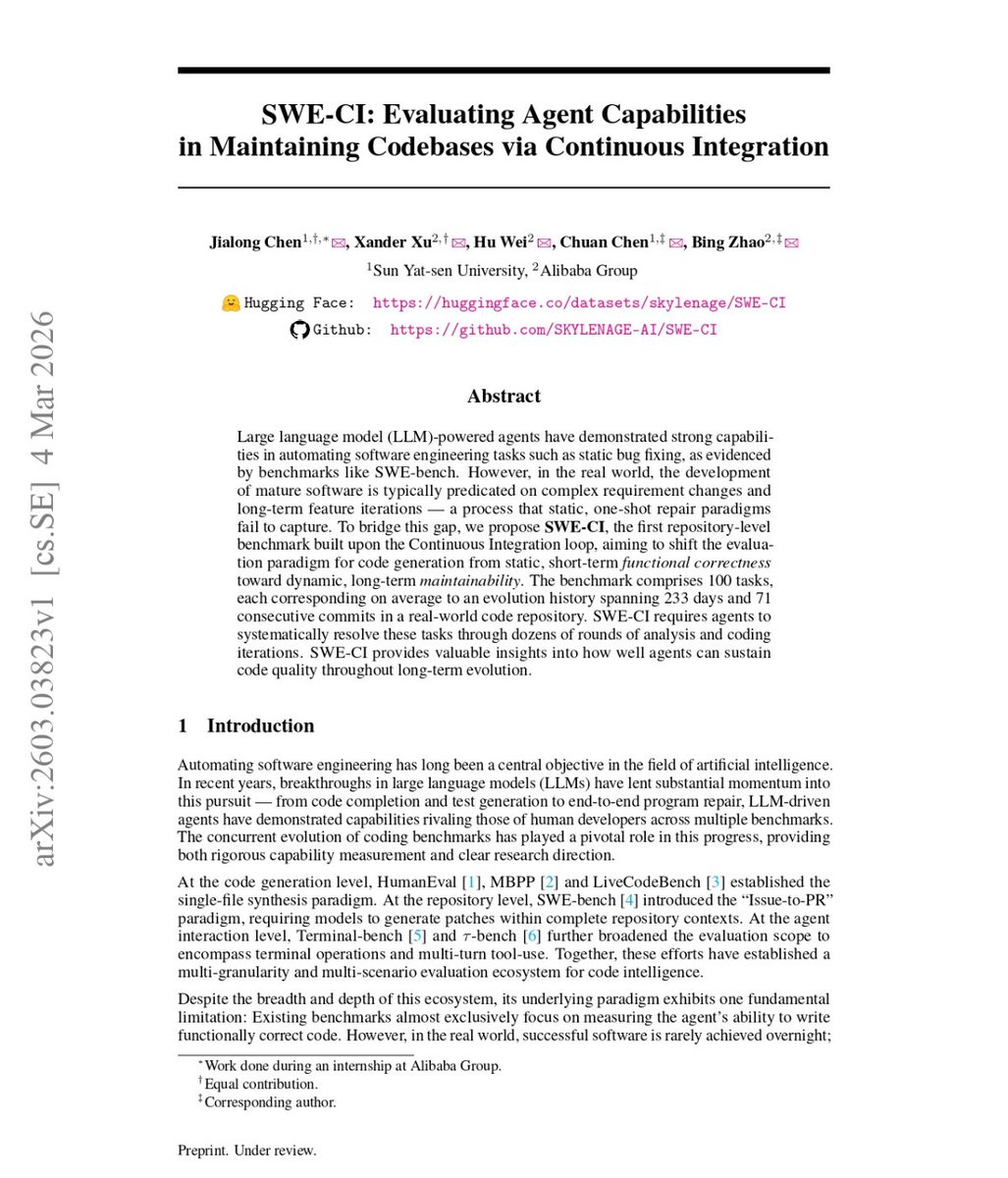
Passing a coding test once is easy. Maintaining that code for 8 months without it exploding? Apparently, it’s nearly impossible for AI.
Alibaba tested 18 AI agents on 100 real codebases over 233-day cycles. They didn't just look for "quick fixes"—they looked for long-term survival.
The results were a bloodbath:
75% of models broke previously working code during maintenance.
Only Claude Opus 4.5/4.6 maintained a >50% zero-regression rate.
Every other model accumulated technical debt that compounded until the codebase collapsed.
We’ve been using "snapshot" benchmarks like HumanEval that only ask "Does it work right now?"
The new SWE-CI benchmark asks: "Does it still work after 8 months of evolution?"
Most AI agents are "Quick-Fix Artists." They write brittle code that passes tests today but becomes a maintenance nightmare tomorrow. They aren't building software; they're building a house of cards.
The narrative just got honest: Most models can write code. Almost none can maintain it.
Spatial Organism: Breathing
Featured as a one-month showcase in the public art program co-curated by night_lights_denver denvertheatredistrict and youthdigitalgroup
Date: October 1-30, 2025
Location: Public LED screen, 1072 15th St, Denver, CO
Mind ~ Water (Mind control water, and in turn, water regulates the brain)
What if water waves could mirror brain waves to mediate emotion?
Personal Research at MIT Media Lab by myself, Ruipeng Wang @rui_peng_wang
The tide of openness in AI is receding – and with it, the foundation of scientific progress. Universities must reclaim AI research for the public good with a new model for team science. https://t.co/nta0toKuUq
Very excited to share @theworldlabs ‘s latest research work RTFM!! It’s a real-time, persistent, and 3D consistent generative World Model running on *a single* H100 GPU! Blog and live demo are available below! 🤩
Human3R: Everyone Everywhere All at Once
Note: I recorded the video from the interactive demo on their project page (linked in the comment below).
Abstract (excerpt):
Human3R jointly recovers global multi-person SMPL-X bodies ("everyone"), dense 3D scenes ("everywhere"), and camera trajectories in a single forward pass ("all-at-once").
Our method builds upon the 4D online reconstruction model CUT3R and uses parameter-efficient visual prompt tuning to preserve CUT3R's rich spatiotemporal priors while enabling direct readout of multiple SMPL-X bodies.
Human3R is a unified model that eliminates heavy dependencies and iterative refinement. After being trained on the relatively small-scale synthetic dataset BEDLAM for just one day on one GPU, it achieves superior performance with remarkable efficiency: it reconstructs multiple humans in a one-shot manner, along with 3D scenes, in one stage, at real-time speed (15 FPS) with a low memory footprint (8 GB).
Something we discovered by accident: what happens if we start Genie 3 from a video and a completely unrelated prompt? Turns out the model really, really wants to make it work, to the point where it emulates itself.
The prompt in this one is about a trex on a tropical island.
🚫🕶️ I've been building an XR app for a real-world ad blocker using Snap @Spectacles. It uses Gemini to detect and block ads in the environment.
It’s still early and experimental, but it’s exciting to imagine a future where you control the physical content you see.