A case of NWS may have been detected in South Texas. The sample is now at USDA's National Veterinary Services Laboratories (NVSL) in Ames, lowa for confirmatory testing. We will provide updates the moment results are available.
We have already activated personnel on the ground and are working with local partners.
What you can expect from us is transparency, candor, and most important — action.
https://t.co/MrhuQr9UbN
The unfolding history of artificial intelligence has now arrived at what may be its most dangerous moment. There are two barely controlled AI races, one between around five American companies—@Anthropic, @GoogleDeepMind, @Meta, @OpenAI, and @xai lead the field—and the other between the two geopolitical superpowers: the United States and China, with its own competing companies. The leadership of the competitors in this race is, to say the least, of mixed quality. 1/10
@deanwball@beffjezos AI potentially leading to grave harm or power centralization are two plausible outcomes. Just because they are somewhat mutually exclusively doesn’t mean you can’t be against both.
@kitdobyns Totally agree - ‘AGI’ is nebulous and by the time we get it might be too late anyway. So the intermediate goals and benchmarks might be the only way to track progress and properly prepare.
Finally, a big name has the courage to tell it: we are nowhere near AGI.
Demis Hassabis, CEO of Google DeepMind and Nobel laureate for AlphaFold, put it neat and clear:
"Today's systems are nowhere near [AGI]. Doesn't matter how many Erdős problems you solve… I think it's far, far from what a true invention, or someone like Ramanujan, would have been able to do."
This is the elephant in the room that many AI enthusiasts prefer not to see, or are actively trying to hide.
Erdős problems are well defined, often combinatorial, on finite spaces. They are exactly the kind of problems on which current AI can achieve spectacular performance with a lot of compute and knowledge.
A neural network can search a huge graph of possibilities. It can recombine existing knowledge at unprecedented scale. It can discover surprising solutions inside an already defined conceptual space.
But true invention is something else.
True invention is not only solving a problem.
It is inventing new objects, new dimensions, new connections. It is inventing new problems.
From resolving to inventing there is a discontinuity that we don't know how to bridge.
We are making extraordinary tools.
But we are nowhere close to AGI.
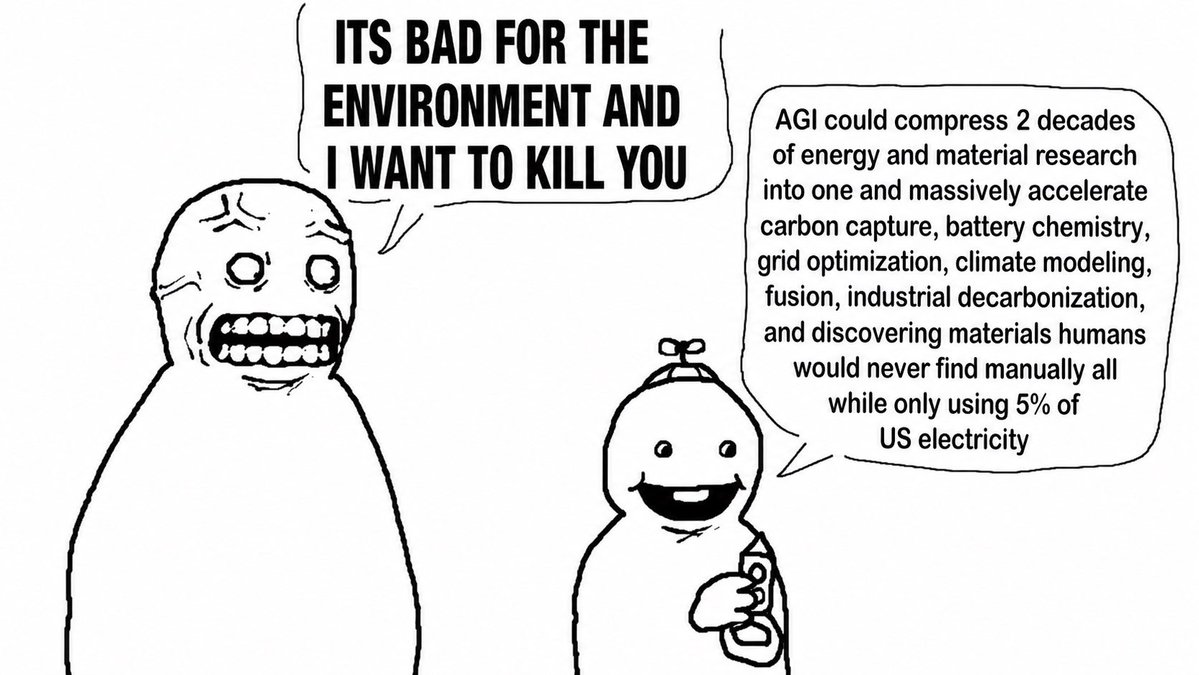
Many of those things - carbon capture, battery chemistry, grid optimization, industrial decarbonization - we already know how to do. The bottleneck isn’t intelligence. It’s will power.
Amon Göth in Schindler’s List (1993) may be one of the most terrifying villains in film history.
What makes him so frightening is not intelligence, power, or theatrical evil — but cruelty without reason.
In the haunting “Balcony Hunt” scene, Göth casually shoots prisoners from his balcony as if human life means nothing. One moment calm, the next violently unpredictable, he turns fear into something constant.
Amon Göth is terrifying because he doesn’t feel like a movie villain.
He feels real.
Bad take from the Pope. Tech revolutions tend to eliminate some jobs while creating others. If we cling onto jobs, we’d still be plowing fields by hand out of fear of disruption.
I speedran an AI futures scenario analysis. On one axis is public acceptance, on the other is AI's impact. With assigned probabilities. Pretty simplistic but I found it a valuable exercise.







![ValerioCapraro's tweet photo. Finally, a big name has the courage to tell it: we are nowhere near AGI.
Demis Hassabis, CEO of Google DeepMind and Nobel laureate for AlphaFold, put it neat and clear:
"Today's systems are nowhere near [AGI]. Doesn't matter how many Erdős problems you solve… I think it's far, far from what a true invention, or someone like Ramanujan, would have been able to do."
This is the elephant in the room that many AI enthusiasts prefer not to see, or are actively trying to hide.
Erdős problems are well defined, often combinatorial, on finite spaces. They are exactly the kind of problems on which current AI can achieve spectacular performance with a lot of compute and knowledge.
A neural network can search a huge graph of possibilities. It can recombine existing knowledge at unprecedented scale. It can discover surprising solutions inside an already defined conceptual space.
But true invention is something else.
True invention is not only solving a problem.
It is inventing new objects, new dimensions, new connections. It is inventing new problems.
From resolving to inventing there is a discontinuity that we don't know how to bridge.
We are making extraordinary tools.
But we are nowhere close to AGI.](https://pbs.twimg.com/media/HJKS-JdWkAAZOdT.jpg)