Over the past decade, the real driver of progress in quantum computing has shifted from raw qubit count to error correction effectiveness/efficiency.
Research in this area has been accelerating w/ three new papers this month, potentially pulling Q-Day timelines forward.
🧵
The Mythos attack on HAWK, and its subsequent removal from NIST's Additional Digital Signatures process this morning, is net good.
This is what the process is for. We trust a scheme when people have spent years trying to break it and failed, and it doesn't matter whether that comes from human cryptanalysts or an AI.
What has changed is how much of it we can now do. Schemes now get attacked harder and earlier. The ones that survive will be better because of it.
Kudos to the HAWK team for the great work and excellent ideas.
Threshold signing and ML-DSA long read.
Threshold signatures let a group share one key. Nobody holds the whole thing, and any subset you agree on (2 of 3, 3 of 5, whatever you set) can sign together. The verifier just sees a normal signature and can't tell it came from a group.
We've had this for Schnorr and ECDSA (with lots of bugs!) for years and a lot of systems rely heavily on this feature, custody being one of the biggest.
ML-DSA signing is linear in the secret, which is the same property that makes threshold Schnorr and BLS easy. So you might expect threshold ML-DSA to be easy too, but rejection sampling makes things more complicated.
ML-DSA keeps its signatures small by trying an attempt, keeping it if it's small enough, and binning it if not. The binned attempts are the ones that would leak your key. On your own that's fine: you check in private, bin the bad ones, and nobody sees them. Once you split the key across a few people and it's no longer that easy. The check is on the combined signature, so everyone has to reveal their piece before anyone can run it, but the binned attempts get seen by each participant in the process.
An interesting solution was proposed by Sofía Celi, Rafael del Pino, Thomas Espitau, Guilhem Niot and Thomas Prest, for up to six signers*.
Linked below is a full write up of threshold signing & ML-DSA covering; what a signature is, why linear signing splits so easily, why ECDSA is harder, what rejection sampling is doing in ML-DSA, and each step the research use to get around the problems. No lattice background needed.
I also played with D3 JS for some rejection loop animations.
It's a long read, enjoy.
Feedback welcome :)
*this is a research paper NOT production code to use. A lot of work before that is the case.
The offense attacking cryptography is highly coordinated, well funded, and rapidly advancing. We need the defense to keep pace.
The latest from Project Eleven CEO & Co-Founder @apruden08 in @CoinDesk ⬇️
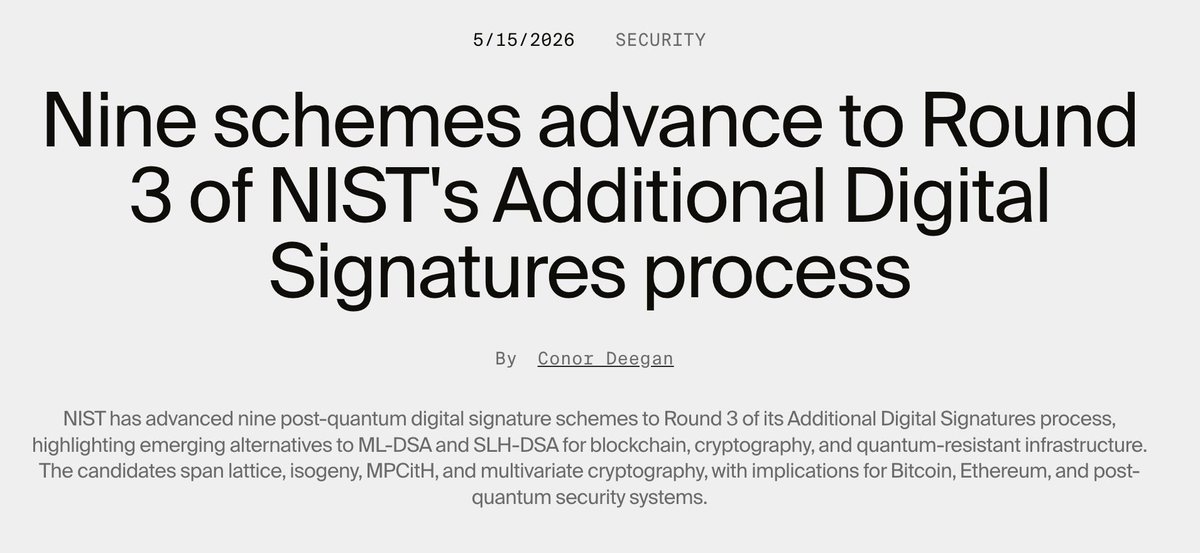
🚨 NIST announced the third-round candidates of the Additional Digital Signatures process. 9 schemes move forward and 5 do not.
Moving forward:
- SQIsign
- HAWK
- FAEST
- MQOM
- SDitH
- UOV
- MAYO
- QR-UOV
- SNOVA
Read @conordeegan's full analysis on our blog (link below)!
Super proud of the team on this one. Having an open-source, MIT-licensed reference implementation that's been audited (twice) is rare, and as a security company that's the bar I think we should hold ourselves to.
As more and more AI code and AI applications get shipped, security is degrading at a rapid rate. High quality reference implementations to build on top of are becoming a security necessity.
Wow. If this is true, UAE leaving OPEC could have long-term implications for global oil supply.
Near-term impact is likely muted given the ongoing Iran conflict and supply disruptions.
But zoom out: UAE is the 3rd largest producer. More independence = more supply flexibility = more pricing volatility post-conflict.
https://t.co/9DmLcX2cW2
Project Eleven Awards 1 BTC Q-Day Prize for Largest Quantum Attack on Elliptic Curve Cryptography to Date
Researcher breaks 15-bit ECC key on publicly accessible quantum hardware in a 512x jump from the previous public demonstration.
Project Eleven today awarded the Q-Day Prize, a one Bitcoin bounty, to Giancarlo Lelli for breaking a 15-bit elliptic curve key on a publicly accessible quantum computer. The result is the largest public demonstration to date of the attack class that threatens Bitcoin, Ethereum, and over $2.5 trillion in ECC-secured digital assets.
"The resource requirements for this type of attack keep dropping, and the barrier to running it in practice is dropping with them," said @apruden08, CEO of Project Eleven. "The winning submission came from an independent researcher working on cloud-accessible hardware. No national lab, no private chip. It shows that tangible progress is possible and highlights the urgency to migrate to post-quantum cryptography sooner rather than later. Google just committed to being quantum-secure by 2029. The window to get ahead of this is closing.”
Lelli derived a private key from its public key across a search space of 32,767 using a variant of Shor’s algorithm. Shor's targets the Elliptic Curve Discrete Logarithm Problem (ECDLP), the math underlying the digital signature schemes securing Bitcoin, Ethereum, and most blockchains.
Quantum attacks on ECC have moved from theory to practice over the last seven months. Steve Tippeconnic's 6-bit demonstration in September 2025 was the first public break on quantum hardware. Lelli's 15-bit result extends it by a factor of 512.
Theoretical resource estimates for a full 256-bit attack, the scale Bitcoin operates at, have fallen sharply over the same period. Google's April 2026 whitepaper put the requirement at under 500,000 physical qubits. A subsequent paper from Caltech and Oratomic brought that figure as low as 10,000 qubits in a neutral-atom architecture.
Lelli's result is the practical counterpart to those optimizations. The distance from 15 bits to 256 bits is large, but the gap is increasingly viewed as an engineering problem and not a fundamental physics problem.
Roughly 6.9 million Bitcoin sit in wallets whose public keys are visible on-chain, exposing them to quantum attack. All blockchains using ECC share similar risks with vulnerable assets.
Project Eleven is developing its next challenge, focused on the intersection of frontier AI models and quantum cryptanalysis.
@aleximm Prediction markets (IMO) is interesting because they let everyone have an opinion that actually gets priced.
Whether that leads to better predictions or just noisier ones is still unsettled. But for the first time, the crowd appears to have a seat at the table.
At NIST today for the workshop on blockchain and distributed ledger technologies. Focus is architecture, interoperability, security issues, and further standards work.
PQC brings a lot of trade-offs around size and scaling. That will push some systems toward newer cryptography to make deployment workable - things like ZK and more bespoke schemes. Adding standards means there are more secure and scrutinised ways to do this safely versus each system rolling their own.