I recommend a few pages of Proust's magnum opus 'In Search of Lost Time' daily to wash away any and all influence of LLMs' mediocre prose-styling from your palate
While the writing style of LLMs is still as recognizable as ever, a new trend is that humans have started organically writing like them, too (which makes sense: of course you would end up imitating the style you are constantly reading). That makes telling the difference between humans and clankers a bit more challenging.
I always liked this anecdote:
> After Hilbert was told that a student in his class had dropped mathematics in order to become a poet, he is reported to have said "Good - he did not have enough imagination to become a mathematician"
Turns out poetry is harder 😭
Bro they even got the name of their own technique wrong?! The post calls it subquadratic sparse attn in one place and subquadratic selective attn in another 😭
That you have to swizzle the input matrices to a tensor core in some godforsaken way was just described to me as the leakiest abstraction in the world, as it is the floorplan of the chip leaking into the high-level programming model. Ha!
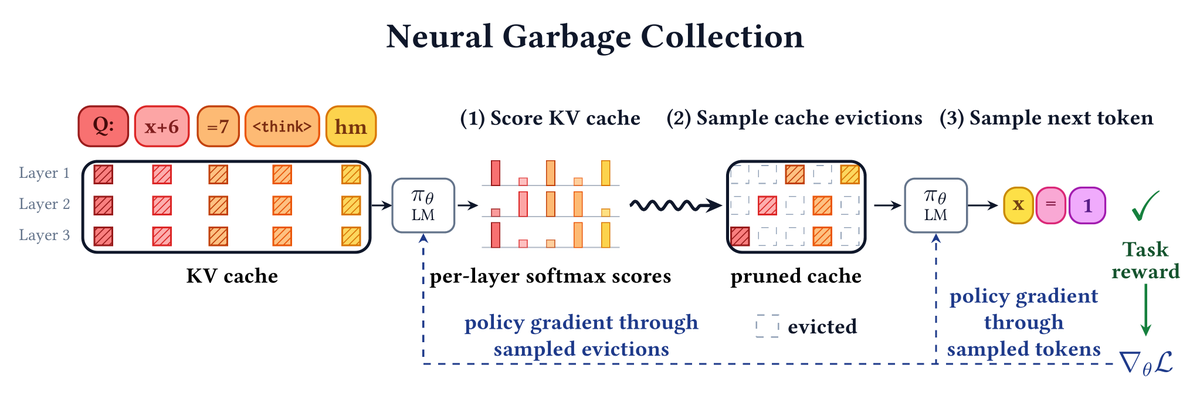
Can a language model learn, end-to-end, what to keep in its own KV cache and what to throw away? Can it learn to forget while it learns to reason?
Deep learning's central lesson: capability emerges from end-to-end optimization, not heuristics/strong inductive biases. But for efficiency, we rely heavily on hand-designed approaches.
🗑️ Introducing Neural Garbage Collection (NGC): we train a language model to jointly reason and manage its own KV cache, using reinforcement learning with outcome-based task reward alone. No SFT, no proxy objectives, no summarization in natural language.
New paper with @jubayer_hamid, Emily Fox, and @noahdgoodman!
@allgarbled I wrote about this sometime ago! But I assumed it was a PhD thing as opposed to an SF / Bay area thing, but it very well could be: https://t.co/fjwf14GtWn
You cannot think your way to a perfect design. Only building and testing, over many iterations, can reveal the flaws in your mental model and provide the feedback you need to create the best design possible.
Unfortunately, this is completely true. The amount of slop being produced with alacrity boggles the mind. And we simply don't have the human expertise or incentive structures in place to combat it