Stanford's Courses on AI & ML (FREE):
❯ CS221 - AI
❯ CS229 - ML
❯ CS229M - ML Theory
❯ CS230 - DL
❯ CS234 - RL
❯ CS236 - Deep Generative Models
❯ CS336 - LLM from Scratch
❯ CS224N - NLP with DL
Course links inside:
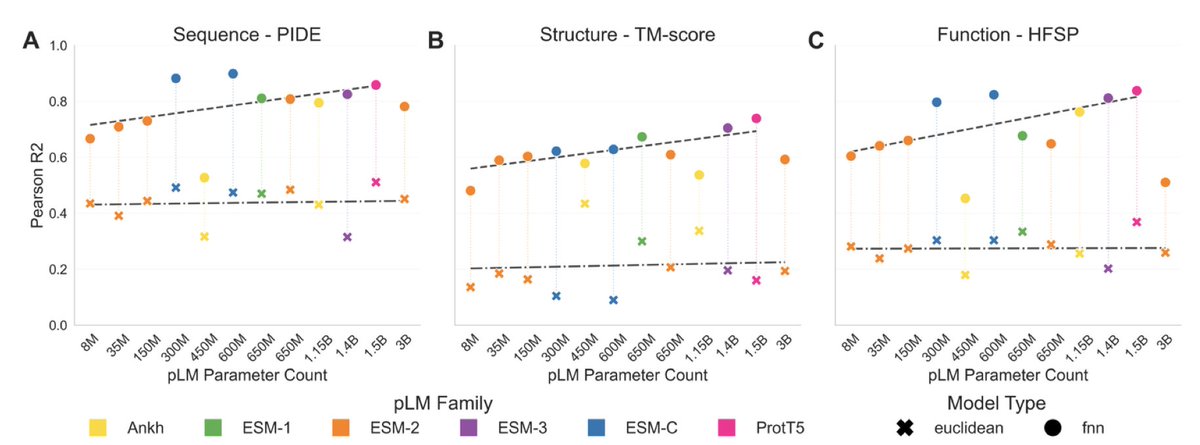
Which pLM to choose? A benchmark study on protein language models reveals optimal model selection strategies for biological analyses.
1. Mid-scale protein language models (pLMs) perform as well as larger models in capturing inherent biological information, challenging the notion that bigger is always better. This size-performance paradox suggests that smaller models can efficiently provide general insights without the computational overhead of larger ones.
2. The study finds that larger pLMs store more extractable biological information, which can be unlocked through supervised learning. This capacity dividend indicates that larger models are advantageous when fine-tuning for specific tasks, but not for out-of-the-box use.
3. Task-specific training reshapes the embedding space of pLMs, optimizing them for targeted applications but reducing their versatility. This highlights the trade-off between specialization and generalizability in protein representation learning.
4. The research underscores the importance of model selection based on specific research needs. Smaller foundation models are recommended for immediate biological insights, while larger models are suitable for fine-tuning to achieve maximal performance.
5. The authors suggest that future progress in protein language modeling should focus on improving data quality and diversity, rather than solely increasing model size. This could lead to more robust and generalizable pLMs.
📜Paper: https://t.co/FNye0lyOIL
💻Code: https://t.co/yIAr7IZE6D
#ProteinLanguageModels #Bioinformatics #ModelSelection #ComputationalBiology #AIinBiology
BREAKING NEWS
The 2025 #NobelPrize in Physiology or Medicine has been awarded to Mary E. Brunkow, Fred Ramsdell and Shimon Sakaguchi “for their discoveries concerning peripheral immune tolerance.”
BREAKING NEWS
The Royal Swedish Academy of Sciences has decided to award the 2025 #NobelPrize in Physics to John Clarke, Michel H. Devoret and John M. Martinis “for the discovery of macroscopic quantum mechanical tunnelling and energy quantisation in an electric circuit.”
Had a great time presenting my @novonordisk work at #TideTalks! Shared insights on in silico design of peptide inhibitors for Protease. Big thanks to the organizers for an inspiring event full of energy and brilliant minds!
#peptides#CADD#TideTalks#compchem
🧬La-Proteina🧬
The first generative model demonstrating accurate co-design of fully atomistic protein structures (sequence + side-chains + backbone) at scale, up to 800 residues, with state-of-the-art atomistic motif scaffolding performance - has just made its code open-source!
Learn more 🧵
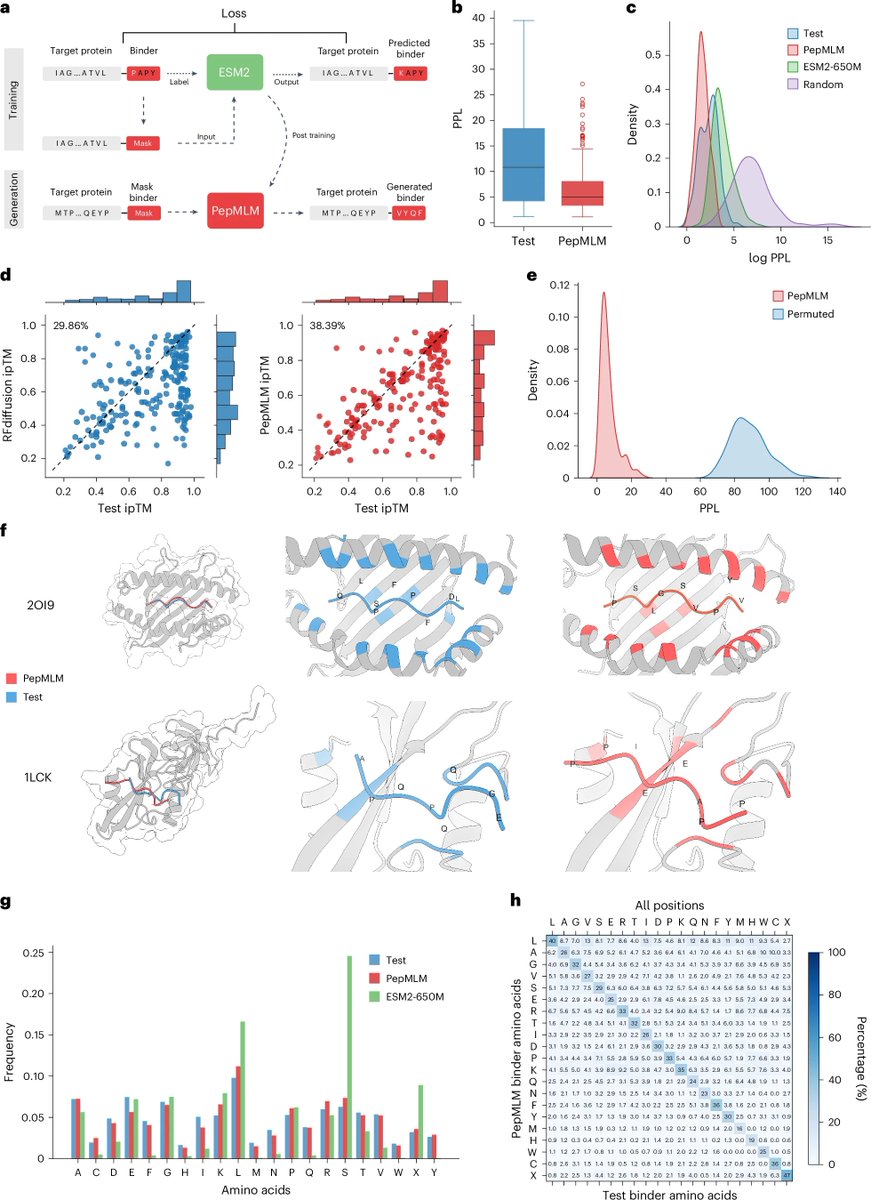
Happy to announce that PepMLM is now published in Nature Biotechnology @NatureBiotech after 2.5 years (in the pre-RFDiffusion era 🥲)
A brief recap: We simply concatenate the target protein sequence with the peptide binder sequence, mask the whole binder region, and fine-tune ESM-2 for binder generation. The approach is straightforward, and we learnt a lot through the process of development, iteration, and validation. The model works decently well.
In this version, we show that PepMLM-designed peptides can bind and degrade a range of human, disease-related, and viral targets:
- Human receptors: NCAM1, AMHR2
- Intracellular disease proteins: MSH3, mutant Huntingtin, MESH1
- Viral phosphoproteins: Nipah virus, Hendra virus, human metapneumovirus
Heartfelt thanks to our collaborators, to Pranam (@pranamanam), and to everyone at the Chatterjee Lab🫶.
Link: https://t.co/0KKUv2vqrG
HuggingFace: https://t.co/QP8Qead5z3
PocketSCP: A Method for Spatiotemporal Topological Visualization and Analysis of Protein Pocket Dynamics
https://t.co/XunJ0ek0X4
#JCIM Vol65 Issue10 #Bioinformatics
Please RT!
I have 2 postdoctoral positions in my lab @BRFAA_IIBEAA to work on MD sims for protein allostery, cryptic pocket identification, CADD/FEP. Knowledge in coarse-grained MD is a plus.
More info: https://t.co/N4nEbXAK2h.
Send me an email with your CV if interested!
If you want to know more about #FeNNix-Bio1, the first foundation model able to perform accurate - long timescale- condensed phase molecular simulations of biological systems at quantum accuracy, join me in incoming live presentations:
• @nvidia#GTC25 (Paris) (https://t.co/r3pfvGaHJo), Thursday June 12th
• "Data-driven, low-dimensional, and generative models for molecular and materials discovery and design" @cecamEvents workshop (https://t.co/xovMqHepHd), @UChicago Center in Paris, Tuesday June 17th.
• #Watoc 2025 (Oslo) (https://t.co/Or2pYcr1zN), Monday June 23rd
and visit @qubit_pharma's booths at #GTC and #Vivatech (10-14 june)!!!
FeNNix-Bio1 is NOT another docking tool and allows you to perform real chemically accurate (< 1kcal/mol) predictions (including true binding free energies!) accross chemical space while offering lightning fast acceleration (i.e. force field speed!) over real ab initio molecular dynamics. It is grounded solely on synthetic quantum chemistry data.
Discover the power of #GPU-accelerated accurate atomistic simulations beyond Density Functional Theory (DFT) quantum accuracy by checking the papers:
- A Foundation Model for Accurate Atomistic Simulations in Drug Design: https://t.co/JGz0Hk2NId
- Pushing the Accuracy Limit of Foundation Neural Network Models with Quantum Monte Carlo Forces and Path Integrals:
https://t.co/GN6JOFPy0P
Sorbonne Université / CNRS
Qubit Pharmaceuticals
@Genci_fr AI Factory France @EuroHPC_JU@argonne
#machinelearning #neuralnetwork #foundationmodel #ArtificialIntelligence #biophysics #drugdesign #hpc #supercomputing