I love git and I love AI. I'm putting them both together and giving a talk tomorrow at @sydjs on how I use AI and let my agents run wild on git worktrees. This is a revival of my talk from last month about how I use AI.
this basically shows all my workflows and reasoning behind them.
i would love to learn how you folks work compared to that. as i said, i'm a caveman and i'd be super happy to learn how to become better. post below.
I think I might move the /teach skill to a new repo
It's not really about engineering, and it deserves a bigger treatment:
- 100 example prompts you can use with /teach
- Guides and docs on the underlying principles behind it
/teach now recommends primary source reading in every lesson
The goal isn't to keep you shackled to the agent, it's to get you confident enough to read the sources for yourself
Steps to become a senior programmer:
1. Install my /teach skill
npx skills add mattpocock/skills --skill teach
2. Create a new working directory on your laptop
mkdir junior-to-senior
cd junior-to-senior
3. Kick off your coding agent in the directory
claude
4. Copy this prompt
/teach me how to be a great strategic programmer. My opinion is that AI is eating 'tactical, on-the-ground' programming. The day-to-day work of a developer involves not only coding, but also planning, QA, codebase design, and much more. I'm interested in learning the strategic skills - that, in a previous era, would take me from junior to senior - but in this era are table stakes.
5. Paste it into the coding agent
Below is an example of what the first output will look like. I used Opus 4.8, medium effort.
6. Continue working with the agent until you're a senior
Introducing Claude Fable 5: a Mythos-class model that we’ve made safe for general use.
Its capabilities exceed those of any model we’ve ever made generally available.
how to be good at your job
- realize this one thing is actually made up of two separate things
- realize instead of solving the direct problem you can solve a broader problem
- instead of implementing thing, implement other thing that makes it easier to implement thing
One of the new, buzzy jobs in Silicon Valley is the AI Forward Deployed Engineer (FDE), an engineer who is embedded within a client organization to help customize solutions, such as building and tuning agentic workflows that suit the client’s particular needs. I’ve heard from people who are wondering anew about the FDE career path since OpenAI and Anthropic started building new teams to place FDEs within client organizations.
The rise of FDEs for AI workloads is one way AI is creating new jobs (and why the jobpolcalypse narrative of upcoming job market collapse is false -- there will be many AI and non-AI jobs). However, I believe there will be far more AI Engineer jobs than FDEs, as I explain below.
The FDE role was pioneered about two decades ago by Palantir, which sent engineers to government locations to work on secure, air-gapped networks. In addition to having good technical skills, FDEs need communication skills and sometimes business skills. For example, they may need to speak with clients to understand their needs, formulate a strategy to prioritize projects, explain complex technology, and respectfully push back if a client asks for something unrealistic. They’re enjoying a resurgence because of the amount of work involved in taking an off-the-shelf LLM and building it into a custom agentic workflow that fits particular business needs.
However, I believe the number of AI Engineer jobs will be far larger. A company might accept a few FDEs to be embedded within its organization. But most companies will want far more of their own employees working on their projects. While my organizations do hire FDEs, we hire far more AI Engineers! Also, a common client concern is that it is hard to find vendor-neutral FDEs — they are, after all, there to deeply integrate a particular vendor’s product into a company. In this moment when it’s hard to predict which AI service will be the best one in a year’s time, optionality (the ability to pick whatever vendor turns out to fit best in the future) is very valuable. In contrast, letting FDEs tightly bind a company’s processes significantly reduces optionality.
Right now, I see surging demand for AI Engineers who can build software applications using AI software components (like LLM prompting, agentic frameworks, evals, etc.) and effectively use AI coding agents (like Claude Code, Codex, Antigravity CLI, and OpenCode). As the AI Engineer role matures, I expect it to fragment into more specialized roles, like the generic Software Engineer role from decades ago fragmented into frontend, backend, mobile, data engineering, devops, and so on.
What will be the future, specialized AI engineering roles? I don’t know. Perhaps there will be AI FDEs, LLMOps Engineers, Evals Engineers, AI Data Engineers, Harness Engineers, and other roles we don’t have names for yet. But for now, I see a lot of AI engineers who are generalists create a lot of value. Skilled AI Engineers are in very high demand! As our field continues to mature over the coming decade, I look forward to new specializations within AI Engineering that create even more job opportunities.
[Original text: The Batch newsletter]
💡Recent insight: gaslighting @claudeai seems to improve code quality >90% of the time.
“You overengineered this, there is a simpler way”
“There is a smaller delta that buys us most of the benefits”
“There is a more elegant way”
“This is not architecturally coherent”
…before I even read its code. 😆
Introducing Impeccable 3.5, the best way to design in production: iterate on real UI with your AI agent, in the codebase you actually ship.
Turns out many popular design skills, including Impeccable and Anthropic's frontend-design, weren't actually very good at...design (the workflow was valuable, but the output didn't magically make LLMs like GPT great designers). We measured it across thousands of generations: 74% of pages used the cream AI-default background, 76% reached for extreme letter-spacing, 90%+ failed the contrast floor.
So we started fixing slop systematically, specific to each model. The skill now compiles rules for the exact defects each model makes, instead of shipping one generic file to everyone. The biggest jump is in GPT-5.5 and Codex.
Also new:
◆ It now knows the difference between a new project and an existing one. Existing codebase, it reads your design system and preserves your identity. Greenfield, it seeds a fresh palette from 129 hand-curated anchors so every cold start doesn't drift to the same safe colors.
◆ Live Mode is now in beta, and works at two scales. Type a direction into the new Steer bar, or speak it, and the agent reads the whole page and edits it in place. Or pick a single element, steer it with a sub-command, live-edit any copy, and accept the variant straight back to source. Insert mode scaffolds brand-new elements between the ones already there. Recovery survives HMR, hidden heroes, and dev-tool overlays.
◆ A rebuilt anti-pattern detector. Torn off jsdom and onto a real CSS cascade resolver: roughly 20x faster, dependency-free, and now small enough to run inline inside the skill, not just the CLI and extension. 14 new rules, 41 total.
◆ The skill keeps itself current, checking once a day and offering to update. Plus /impeccable init and a bare /impeccable that reads your repo and tells you the next move.
Free, open source. Claude Code, Codex, Cursor, and more.
https://t.co/Q5dmE5wB7X
Amusing: I'm hearing that at several tech companies, a more frequent topic on internal knowledge sharing sessions is about efficient AI usage.
Cannot really remember topics like "techniques for faster CI/CD" or "how to speed up builds" being THIS widely discussed in the past!
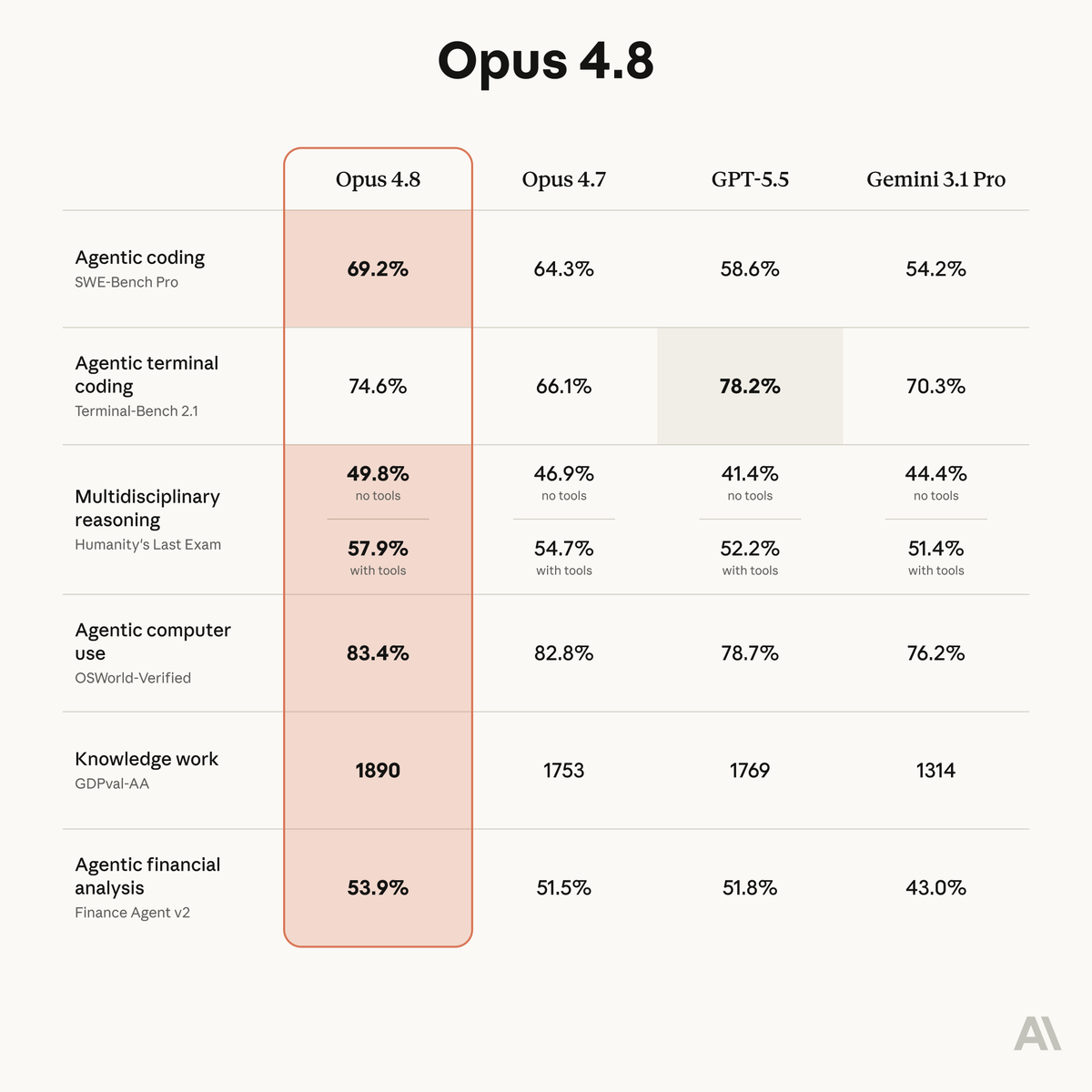
Introducing Claude Opus 4.8: it builds on Opus 4.7 with sharper judgment, more honesty about its own progress, and the ability to work independently for longer than its predecessors.
Available today at the same price.
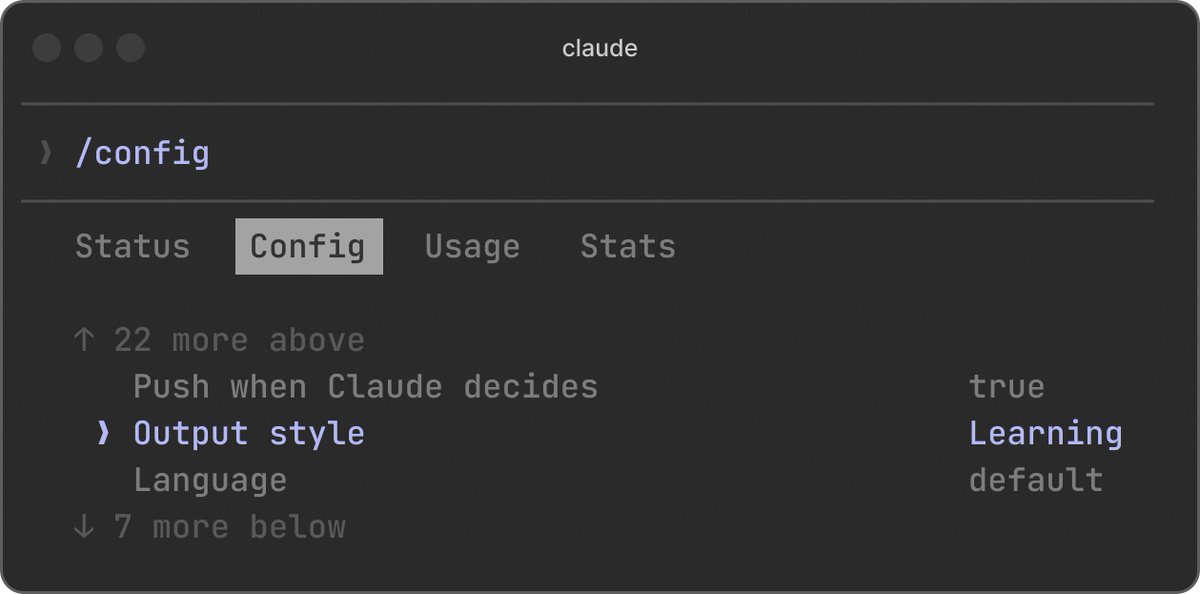
💯 this is why I really like Learning mode in Claude Code
I personally use this for all my side projects and it keeps me so much sharper, great if you want to use Claude Code but still stay hands-on!
/config → Output style → Learning
Personal update: I've joined Anthropic. I think the next few years at the frontier of LLMs will be especially formative. I am very excited to join the team here and get back to R&D. I remain deeply passionate about education and plan to resume my work on it in time.








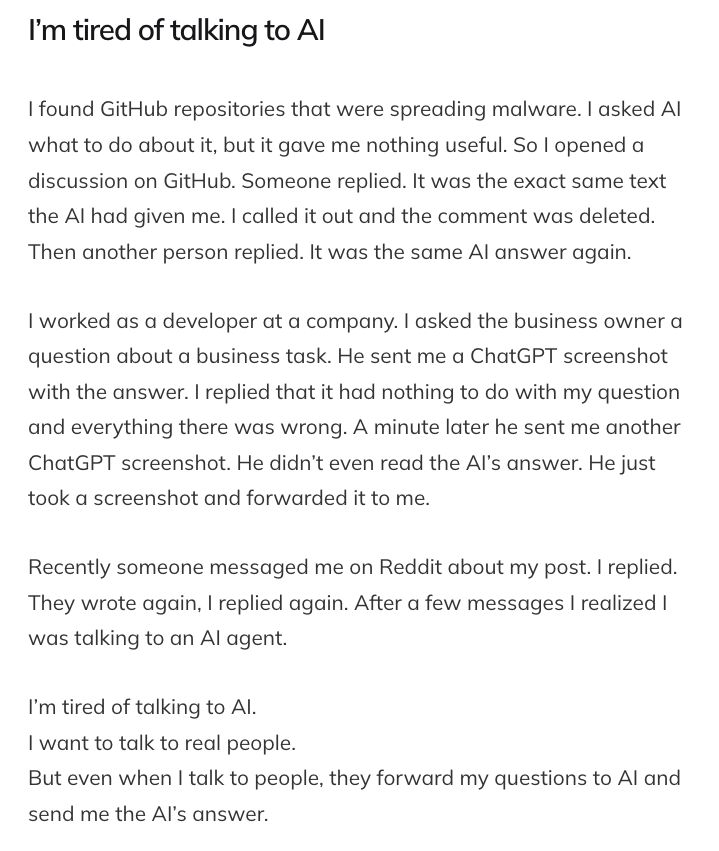
![AndrewYNg's tweet photo. One of the new, buzzy jobs in Silicon Valley is the AI Forward Deployed Engineer (FDE), an engineer who is embedded within a client organization to help customize solutions, such as building and tuning agentic workflows that suit the client’s particular needs. I’ve heard from people who are wondering anew about the FDE career path since OpenAI and Anthropic started building new teams to place FDEs within client organizations.
The rise of FDEs for AI workloads is one way AI is creating new jobs (and why the jobpolcalypse narrative of upcoming job market collapse is false -- there will be many AI and non-AI jobs). However, I believe there will be far more AI Engineer jobs than FDEs, as I explain below.
The FDE role was pioneered about two decades ago by Palantir, which sent engineers to government locations to work on secure, air-gapped networks. In addition to having good technical skills, FDEs need communication skills and sometimes business skills. For example, they may need to speak with clients to understand their needs, formulate a strategy to prioritize projects, explain complex technology, and respectfully push back if a client asks for something unrealistic. They’re enjoying a resurgence because of the amount of work involved in taking an off-the-shelf LLM and building it into a custom agentic workflow that fits particular business needs.
However, I believe the number of AI Engineer jobs will be far larger. A company might accept a few FDEs to be embedded within its organization. But most companies will want far more of their own employees working on their projects. While my organizations do hire FDEs, we hire far more AI Engineers! Also, a common client concern is that it is hard to find vendor-neutral FDEs — they are, after all, there to deeply integrate a particular vendor’s product into a company. In this moment when it’s hard to predict which AI service will be the best one in a year’s time, optionality (the ability to pick whatever vendor turns out to fit best in the future) is very valuable. In contrast, letting FDEs tightly bind a company’s processes significantly reduces optionality.
Right now, I see surging demand for AI Engineers who can build software applications using AI software components (like LLM prompting, agentic frameworks, evals, etc.) and effectively use AI coding agents (like Claude Code, Codex, Antigravity CLI, and OpenCode). As the AI Engineer role matures, I expect it to fragment into more specialized roles, like the generic Software Engineer role from decades ago fragmented into frontend, backend, mobile, data engineering, devops, and so on.
What will be the future, specialized AI engineering roles? I don’t know. Perhaps there will be AI FDEs, LLMOps Engineers, Evals Engineers, AI Data Engineers, Harness Engineers, and other roles we don’t have names for yet. But for now, I see a lot of AI engineers who are generalists create a lot of value. Skilled AI Engineers are in very high demand! As our field continues to mature over the coming decade, I look forward to new specializations within AI Engineering that create even more job opportunities.
[Original text: The Batch newsletter]](https://pbs.twimg.com/media/HJvWmCHagAAnTxQ.jpg)