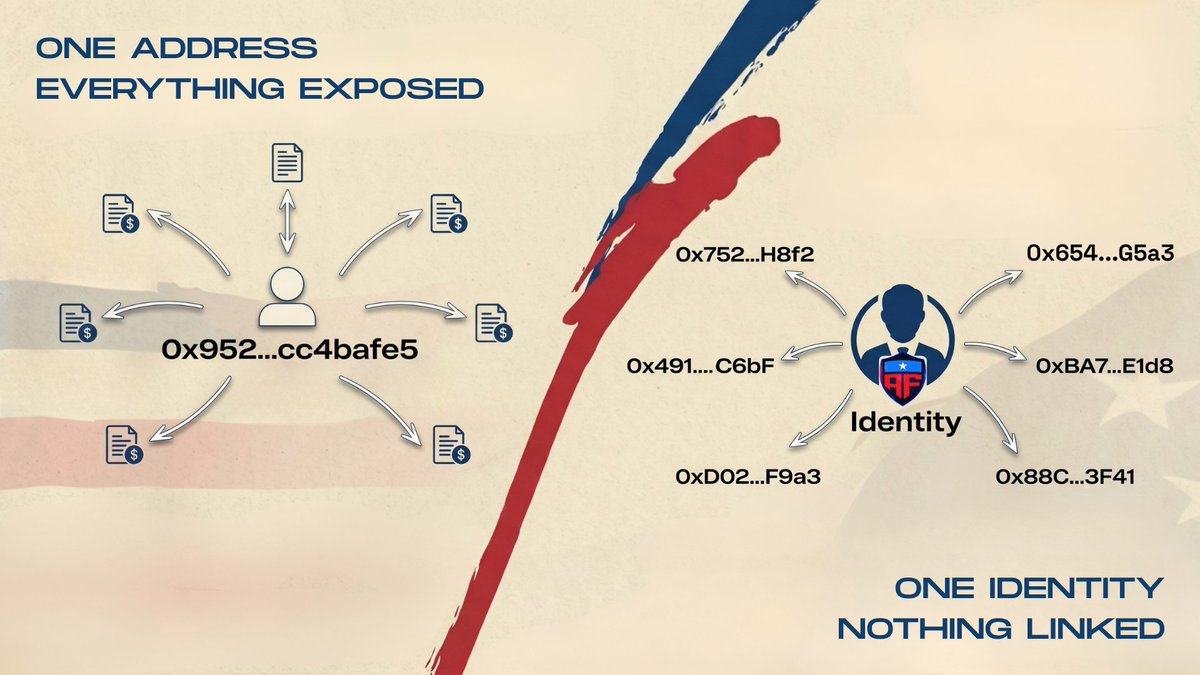
Hear from our CEO @MehowHacks who made crypto private, quantum-proof, compliant, and actually usable without mixers at @proofoftalk on June 2nd.
Register for the workshop with the link below.
Tornado Cash was sanctioned in 2022.
Four years later, the compliant privacy alternative is still missing.
What moved in: readability tools that publish your entire financial history (ENS), and privacy tools that put users on regulators' radar.
Neither works for someone who needs both privacy and a clean compliance record.
The gap is still open.
What "privacy by default" actually means in practice:
— Your wallet generates a new address for every transaction automatically
— Your balance is never visible to people you haven't transacted with
— Your transaction history can't be traced back to a single permanent identifier
— Compliance is built in, not bolted on afterward
None of this requires a separate privacy coin. None of it requires a mixer.
None of it requires the user to do anything differently than they do today.
That's what "default" means. It just works. Invisibly.
🏺 Tessa Hunt and the Golden Sands is LIVE — exclusively at Jackpotter! 🔥
The 10 random users will each receive 10 Free Spins
RT + Tag a friend + Jackpotter Username to enter!
Be the first to spin! 👇 🎮
https://t.co/hvsWtC4zgS
Smart contract security has always been asymmetric.
Defenders need to find and fix every vulnerability.
Attackers need just one.
AI coding agents didn't create that asymmetry.
They industrialized it.
The industry kept betting on better audits.
The attack side just got a machine that never sleeps.
Decentralization is the most overused word in crypto.
Most "decentralized" identity systems can still see:
— Who you registered as
— Which wallet that name maps to
— Every transaction tied to that wallet
That's not decentralization. That's a directory service with a marketing budget.
The bar should be: once a name is registered, the issuer has no way to see who you're transacting with, what you're sending, or what your balance is.
What happens at registration and what happens after it are two different questions.
Most systems fail both. The better ones at least solve the second.
There's an attack vector most of crypto isn't tracking yet.
AI recommendation poisoning.
An attacker embeds hidden prompt instructions in a webpage.
An AI agent reads the page during its normal workflow.
The agent's memory gets silently altered, and from that point, every recommendation it makes is skewed toward whoever planted the instructions.
Microsoft documented 50 live examples across 31 companies in 14 industries in 60 days of research.
If your portfolio decisions or due diligence run through an AI assistant, assume the inputs can be manipulated.
The recommendation is only as trustworthy as what the agent read to make it.
Why isn't more institutional capital on-chain yet?
Exposure. Not regulation.
Every wallet address is a permanent public identifier, and every transaction lands on the same ledger.
Trading strategies, supplier relationships, treasury movements, anyone with a block explorer can read all of it.
No CFO signs off on broadcasting that data live.
Until on-chain transactions match the discretion of traditional banking rails, institutional liquidity stays in crypto-native venues.
The privacy gap is the adoption gap.
Arbitrum holds $16B in TVL, that’s 40% of the entire L2 market. Variational, USDai, GMX. The deepest DeFi stack in the L2 world.
Every position on it is completely visible: your size, entry, counterparty. Anyone with a block explorer can see exactly what you're doing before you do it.
Not anymore. AmericanFortress™ beta is live on Arbitrum. Now you can send to @name, hide your balance, and stay compliant. No mixer.
@arbitrum x @AmericanFort_io