This is funny in and of itself. But it becomes even funnier when you know that Russia has been working on a successor, the A-100, for years now. Only 1 prototype testbed has been completed so far.
🤡 The Russians have announced that they will resume the production of the A-50
The resumption of production is due to the need for these aircraft of the Air and Space Forces of the Russian Federation, as well as due to the interest of foreign countries.
I disagree with this analysis, which contradicts me, so I think it’s necessary to come back to it. The author opens with “all evidence available point to the opposite”, yet he doesn’t cite a single piece of evidence.
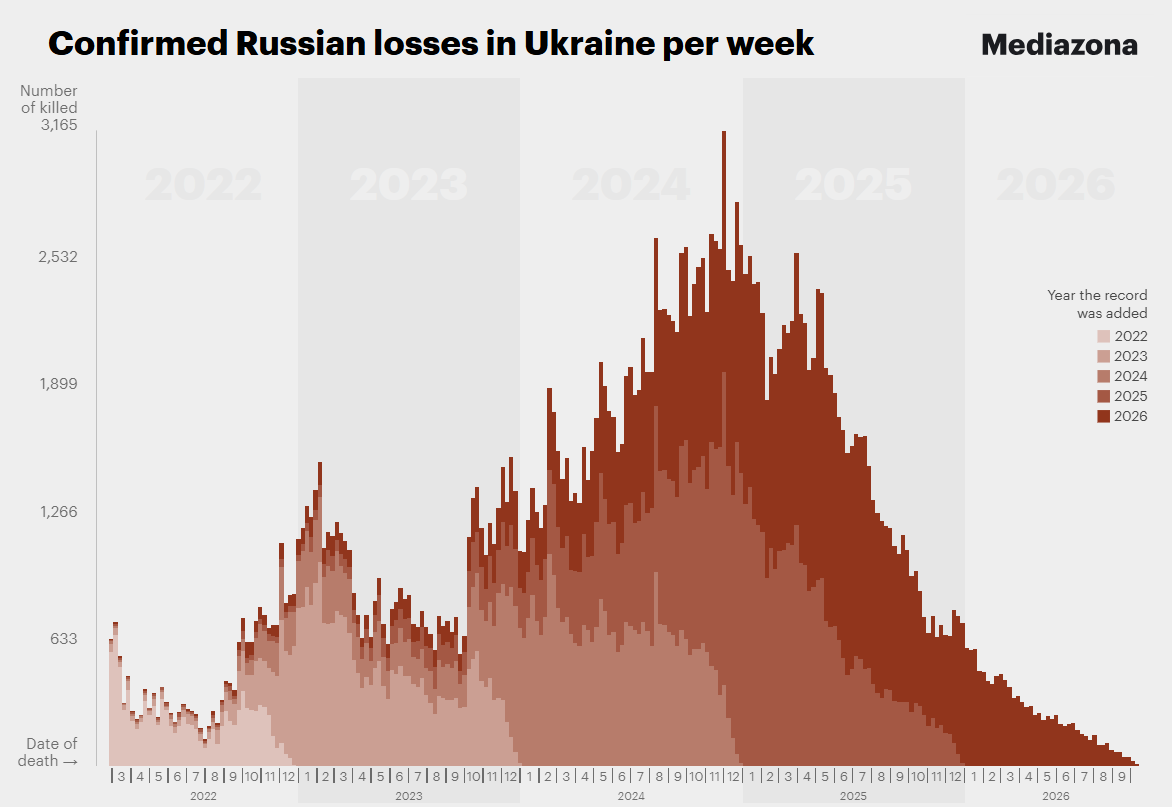
🔶Saying that the drop in Russian armored vehicle losses proves Russia is losing fewer men is not only wrong, it’s actually a lie. First, armor has been sidelined since early 2024, which explains the drop. Second, Mediazona’s data (which is nearly complete up to early 2024) shows that losses are lower during periods of mechanized assaults (autumn 2023) than during periods of limited armor use (summer 2024).
Moreover, the author deliberately leaves out that while far fewer armored vehicles are being destroyed (because they’re used less), strikes on unarmored vehicles have exploded. We’re talking about 3,000 to 4,000 vehicles hit per week. These vehicles are barely counted, and they are struck daily 10, 20, 30 or even 50 km from the front. The human losses from these strikes are fairly high, since the vehicles are unprotected and can’t withstand drone attacks. To see this, you’d need to do a minimum of research and actually watch the videos. Strikes on unarmored vehicles also happen very far from the front: mid-range strikes alone have hit more than 2,000 confirmed vehicles since the start of the year, often more than 50 km from the front.
The author will probably bring out his usual line that these strikes have no impact and that vehicles can easily be replaced by buying them on the famous big used-car market in Central Asia. That’s one more thing he deliberately leaves out: the cost of the vehicles hit, the goods, ammunition and soldiers that never reach the front, the wounded and killed in these strikes (judging by the videos, this happens very regularly), and the knock-on effect on Russian logistics, which is far from negligible.
🔶Claiming that Mediazona proves there are fewer losses is also wrong. Mediazona takes time to update its list of losses and holds back part of its data, so as not to reveal weaknesses in the Russian government that would push it to shut down the information channels being used. Mediazona’s data is broadly complete up to the end of 2023, and as we’ve seen, entries are still regularly being added for 2024, two years ago. The chart showing the year each entry was added makes it very clear how much longer it now takes to record losses. As for the claim that no OSINT data shows any change in losses: well, that’s easy to say when you don’t do any OSINT yourself, have no contacts on the ground, and therefore bring no additional data.
🔶The 2026 attrition ratio is not more favorable than 2025’s. That’s false, and there is no “more balanced attrition approach.” This ignores Ukraine’s advantage in drone strikes (the kill zone is deeper) and Russia’s manpower problems, which force it to concentrate the offensive on certain areas. The infiltration strategy itself proves that attrition is not under Russian control. Does Russia have the advantage in artillery? No. It fires more, but at shorter range and with less accuracy, against Ukrainians who move less and stay camouflaged in their positions. Losses from artillery are minimal. The Ukrainians fire less, but further and more accurately, against a larger number of Russian troops. The Russians do have the advantage in airstrikes, but losses are mainly caused by drones, not KABs.
🔶The next point is less problematic. The rest is mostly a change of subject: why bring up deep strikes (which I never disputed) when the topic was first and foremost the front? Fine, it does tie back to attrition, but in doing so the author quietly admits that Russia is failing on the front and is focusing on a deep-strike campaign in the hope of making Ukraine give in.
I struggle to understand the author’s obsession with everything that’s negative for Ukraine and positive for Russia. For a “military theorist”, it’s a shame not to cover the whole picture, especially since he always finds a rational explanation for the Russian plan (“no, actually, if Russia isn’t advancing, it’s because it chose an attrition strategy”. Very funny 😊).
@The_Davos_Man Just think about how often Bush is still being cited with his claims about supposed WMDs in Iraq and also the still common distrust of the US Intelligence community in the wake of the NSA scandal under Obama. All still present even among pro-US Germans.
@copesint Trying to dunk on Mechanix is wild. Before we received better standard-issue gloves a few years ago, virtually the entire German Armed Forces used Mechanix.
@Rebel44CZ@DannyDev2hqx@onetallorfour@Anderson10x3 Last comment from me.
1. If you think NATO would nuke Russia over this, the answer is no.
2. Even if it were to be idiotic, doesn't mean Russia won't do it.
3. Even unused, this capability can be leveraged via hidden or open threats to EU governments or inciting public fear.
The German government has concluded that Russia was responsible for the hybrid attack at Leipzig Airport on August 4.
After consultations in the National Security Council and Federal Cabinet, Berlin says intelligence from German and partner services, combined with police investigations and the pattern of the operation, establishes Russian responsibility.
German authorities say the operation involved a drone configuration, various components, explosives and ignition technology previously seen in other Russian hybrid operations connected to Russia’s war against Ukraine.
The equipment and coordination were described as professional, requiring significant technical expertise and organizational effort. The people who carried out the final stage are described as low-level agents while intelligence indicates that individuals involved acted on behalf of Russian state authorities.
Berlin says Leipzig fits a wider pattern of Russian hybrid operations across Europe involving espionage, surveillance, sabotage, disinformation and preparations for attacks.
Germany does not consider Leipzig an isolated incident. The government expects Germany to remain a target of further Russian hybrid attacks and says there is a willingness to use such operations to cause even greater damage.
But Berlin says the attack confirms the high threat level Germany had already identified. In June, Germany raised its assessment from an “abstract threat” to a “high threat” and increased security measures.
The government also made one message very clear:
"We are not at war, but we are the daily target of hybrid warfare."
Berlin says Russia’s actions are part of a broader campaign of destabilization, disinformation, threats, sabotage and aggression against Europe.
Germany says it does not want relations with Russia to deteriorate further and still wants an end to the war in Ukraine, a restoration of peace in Europe and eventually a constructive relationship with Moscow.
But Berlin says Russia has shown no willingness to change course.
Germany will therefore respond:
🇷🇺 The Russian General Consulate in Bonn will close on September 18.
This is one of Russia’s remaining diplomatic missions in Germany. Russia currently has one embassy and one active general consulate in the country. Germany previously ordered the closure of four of Russia’s five consulates in May 2023 after Moscow restricted the number of German diplomatic and cultural personnel allowed to operate in Russia.
🇷🇺 The agreement concerning the Russian House in Berlin will be terminated.
The Russisches Haus is a large Russian state-run cultural center on Friedrichstraße, operated by
Rossotrudnichestvo, an agency under Russia’s Foreign Ministry that has been sanctioned by the EU since 2022.
The institution has faced years of criticism over Kremlin propaganda and Russian influence operations. But this year, French authorities went further, describing the Russian House in a French Interior Ministry document as a cover used by Russian intelligence services. The French assessment also said the institution was intended to influence the Russian diaspora and promote support for Moscow’s policies.
🇪🇺 Germany will propose new EU sanctions against Russian individuals connected to hybrid attacks.
🛂 Entry controls for Russian citizens will be tightened.
🚢 Germany will increase pressure on Russia’s so-called shadow fleet.
Germany will further strengthen its intelligence capabilities and add personnel.
🇩🇪 Germany will continue strengthening its defence capabilities through NATO.
🇺🇦 Germany will continue its civilian and military support for Ukraine.
The Russian ambassador is also being summoned to the German Foreign Ministry, with the meeting taking place as the government made the announcement.
Berlin says it is coordinating closely with NATO and EU partners and has secured their solidarity.
The German government’s message is that Leipzig is part of a wider Russian hybrid threat against Germany and Europe and that Berlin intends to strengthen its security, support Ukraine and respond decisively to further attacks.
Germany says it will not be intimidated or divided by Russia’s attacks.
@Rebel44CZ@DannyDev2hqx@onetallorfour@Anderson10x3 Disagree with the first statement. First of, a credible threat of this kind could be used for coercion outside of war.
And on the outset of a war, it would be a powerful first blow. There would also be debate among NATO nations whether it really constitutes a nuclear attack.
WATCH: CNN gained first-ever media access to a Ukrainian Patriot launcher, sitting idle in a cornfield near Kyiv with all 16 tubes empty.
It hasn't fired in roughly 10 weeks.
Its chief engineer:
Ballistic missiles are flying over your head and you are not able to do anything with it, and behind you, there are civilians.
He blamed the global interceptor shortage on the Iran war:
We were very shocked by how many missiles they launched — the very missiles that we could use against Russian ballistic missiles.
Source: CNN
@VADave649 Inaccurate to say it failed. It was fighting in an environment and under circumstances it was never designed for (full auto firing in AFG climate). This is more to blame on the lack of sufficient heavy support weapons at the time. The G36 is a good rifle and I'll die on that hill