The most dangerous phase of your career happens right after you achieve basic financial comfort. When you are no longer desperate, your hunger vanishes, and complacency takes over. Most people get trapped in a moderate lifestyle because it is safe enough to stop fighting.
🚨 Anthropic's CEO: "software engineering will be fully automated in 12 months."
two types of people right now:
type 1: opens Claude, types something, gets an answer, closes the tab. thinks they're using AI.
type 2: knows the hidden features, settings, and shortcuts. runs Claude like a power tool.
type 1 gets surprised in 12 months.
type 2 built the advantage already.
bookmark this. read it today.
Announcing Raj Shamani X Emergent Challenge for business owners
Most Indian businesses don’t have a software problem. They have a “no software fits how we work” problem. So they run on WhatsApp, Excel, calls, memory and jugaad.
Join the challenge here: https://t.co/ziwB6YHn0f
@IndianTechGuide I asked 5 of my friends living in Taiwan, USA , Germany and UK. No one is interested in coming back.
I asked them why?
They said it's not about incentives , it's about the system and governance which is still not fit
Someone scraped 25,000 comments across YouTube, Facebook, Instagram, TikTok, X, and Reddit to find which AI tools are actually making people money or saving time.
Not opinions. Real usage data from real people.
Here are the 12 that showed up the most 🧵
Top 10 resources to learn API design (practical, for people shipping code):
1) Book: Designing Web APIs (Jin, Sahni, Shevat). Solid patterns: pagination, versioning, errors, idempotency.
2) Book: API Design Patterns (JJ Geewax). Teaches resource modeling and naming with lots of real examples.
3) Book: Build APIs You Won’t Hate (Phil Sturgeon). Opinionated, focused on the stuff clients actually feel.
4) Microsoft REST API Guidelines. Clear rules for consistency, filtering, long-running ops, and breaking changes.
5) Google AIP (API Improvement Proposals). Best place to learn what “boring and consistent” looks like at scale.
6) OpenAPI Specification + Swagger Editor. Write the contract first; generate clients; catch edge cases early.
7) Postman blog + public collections. Good for examples of auth flows, testing, and documenting APIs for teams.
8) Stripe API docs. Study the ergonomics: error shape, idempotency keys, expand, pagination, changelog discipline.
9) GitHub REST + GraphQL docs. Good contrast between styles; also shows rate limits, previews, and deprecation.
10) Practice project: build a tiny API and ship it. Example: tasks API with auth, idempotent POST, cursor pagination, rate limits, and a versioned /v1. Add OpenAPI, contract tests, and a breaking change migration plan
Do school marks really tell us how much someone can achieve?
For Pawan Kumar Chandana, a score of 51 in Mathematics certainly didn't.
Years later, the former ISRO scientist would go on to co-found Skyroot Aerospace, India's first space-tech unicorn, and help lead the launch of Vikram-S, the country's first privately developed rocket.
Born into a middle-class family in Hyderabad, Chandana wasn't always seen as a future space entrepreneur.
While Mathematics was a challenge in school, his preparation for engineering entrance exams sparked a deeper interest in science and technology.
That curiosity eventually took him to IIT Kharagpur, where he earned a dual degree in Mechanical Engineering.
In 2012, he joined ISRO and spent nearly six years working on major programmes including GSLV Mk-III, the S-200 solid rocket booster, and the Small Satellite Launch Vehicle.
But in 2018, he chose to leave the security of a government career and build a private space company alongside fellow engineer Naga Bharath Daka.
Today, Skyroot is valued at over $1 billion and is preparing for the orbital launch of Vikram-1.
@PawanKChandana | @SkyrootA
#SpaceTech #Innovation #Entrepreneurship #ISRO #Skyroot
[Pawan Kumar Chandana, Skyroot Aerospace, India's first space-tech unicorn, Vikram-S]
Anthropic engineer: "You're not supposed to prompt Claude. You're supposed to build a system that prompts itself."
Loops.
Most builders are doing this wrong:
No memory file, so every loop starts from zero.
No sub-agent split, so one agent tries to do everything.
No stop condition, so loops run forever and bill you in your sleep.
Most builders are missing at least two of the three.
Watch the video first.
Then read this - everything you need to know about Loops in 2026, in one place.
Bookmark this before it gets buried.
Best YouTube Channels To Learn AI in 2026 (No BS). Save it.
1. Fundamentals – 3Blue1Brown
2. Deep Learning – Andrej Karpathy
3. AI Research – Yannic Kilcher
4. Practical AI – AssemblyAI
5. LLMs – AI Explained
6. ML Theory – StatQuest
7. Papers Simplified – Two Minute Papers
8. GenAI – Matthew Berman
9. AI Agents – Nicholas Renotte
10. Applied ML – Krish Naik
11. PyTorch – Aladdin Persson
12. Math for ML – Serrano Academy
13. Industry Insights – Lex Fridman
14. Real-world AI – DeepLearningAI
i built a job dashboard for yc companies powered by @supermemory to make finding founders & landing calls 10x faster.
→ 1,371 ranked YC roles from the last 2 years
→ T1 / T2 / T3 by reply probability
→ AI search ranks by meaning
→ 2,496 founders · 2,436 with LinkedIn · 1,235 with X · 853 with comp listed
→ outreach notes saved per company, close the tab, the dashboard remembers what you sent
without supermemory this is a sortable spreadsheet. with it, the search ranks by meaning and the dashboard remembers every founder i've touched.
stack: @claudeai code + @supermemory + @perplexity_ai API + @firecrawl + @MiniMax_AI 2.7 + @UnipileAPI for messaging
comment for access
Google just mass-confirmed what the smartest Claude Code users figured out months ago.
The best way to give AI a memory is a folder of markdown files. That's it. No database. No fancy system. Just text files in a folder.
Google Cloud published it as an official open spec called the Open Knowledge Format. Here's what it actually is:
A directory of markdown files. Each file is one concept. A small YAML header at the top with one required field: type.
Files link to each other with normal markdown links. That's the entire spec.
If you've been using CLAUDE.md to give Claude Code memory, you already built this.
If you've been using Obsidian or a notes folder to feed context to your AI, you already built this.
Google didn't invent anything new. They looked at what was already working and said: "yes, this is the standard now."
The state of the art for giving an agent a brain is a folder of text files you could open in Notepad.
A trillion-dollar platform team just shipped that conclusion as an open spec.
I'm sorry but...
India is far away from USA in the AI race.
And no, Indian VCs are too distracted to solve this.
To build a SaaS today,
Hosting - AWS/GCP (American)
Analytics - PostHog (American)
Error tracking - Sentry (American)
CDN - Cloudflare, American. (American)
Authentication - Better Auth. (American)
Payments - Stripe. (American)
OTPs - Twilio (an American company sending messages to Indian phone numbers through American servers.)
Even while vibe coding, all roads lead to USA.
The default SaaS 0-1 playbook is:
pick up AWS, code using claude, stitch some APIs, ship tomorrow, get funding....
India is nowhere close,
Indian VCs are busy funding only the IITian tag
I'm not a SaaS founder,
I choose the USA/EU for my clients for a reason.
And that's not changing anytime soon.
Sorry to burst the "digital india" bubble for you again.
- Meet Ragini Das
- Head of Google for Startups India
- Indian entrepreneur, operator, and community builder
- Grew up in India with ambitions of building meaningful products and businesses
- Started her career looking for opportunities in the startup ecosystem
- Interviewed with both Google and Zomato in 2013
- Reached the final rounds at Google
- Didn't get selected
- Faced one of the biggest disappointments of her early career
- Chose not to let that rejection define her future
- Joined Zomato instead
- Spent years helping build one of India's most successful consumer-tech companies
- Learned how startups scale from zero to millions of users
- Built deep expertise in growth, operations, and community building
- While many people viewed rejection as the end...
- She treated it as redirection
- Left a successful corporate career to build something of her own
- Co-founded leap. club
- Created a professional network focused on helping women grow their careers
- Built a thriving community impacting thousands of women
- Faced the challenges of fundraising, scaling, and running a startup
- Saw leap. club eventually shut down
- Had to navigate the emotional challenge of closing a company she helped build
- Refused to give up
- Continued supporting founders and the startup ecosystem
- More than a decade after her Google rejection...
- Joined Google as Head of Google for Startups India
- Returned not as a candidate
- But as a leader
- Now helps founders across India access Google's resources, mentorship, and network
- Proved that rejection today doesn't mean rejection forever
- From Google rejection → Zomato operator → leap. club co-founder → Head of Google for Startups India
Massive inspiration for anyone who thinks one "no" can decide their future
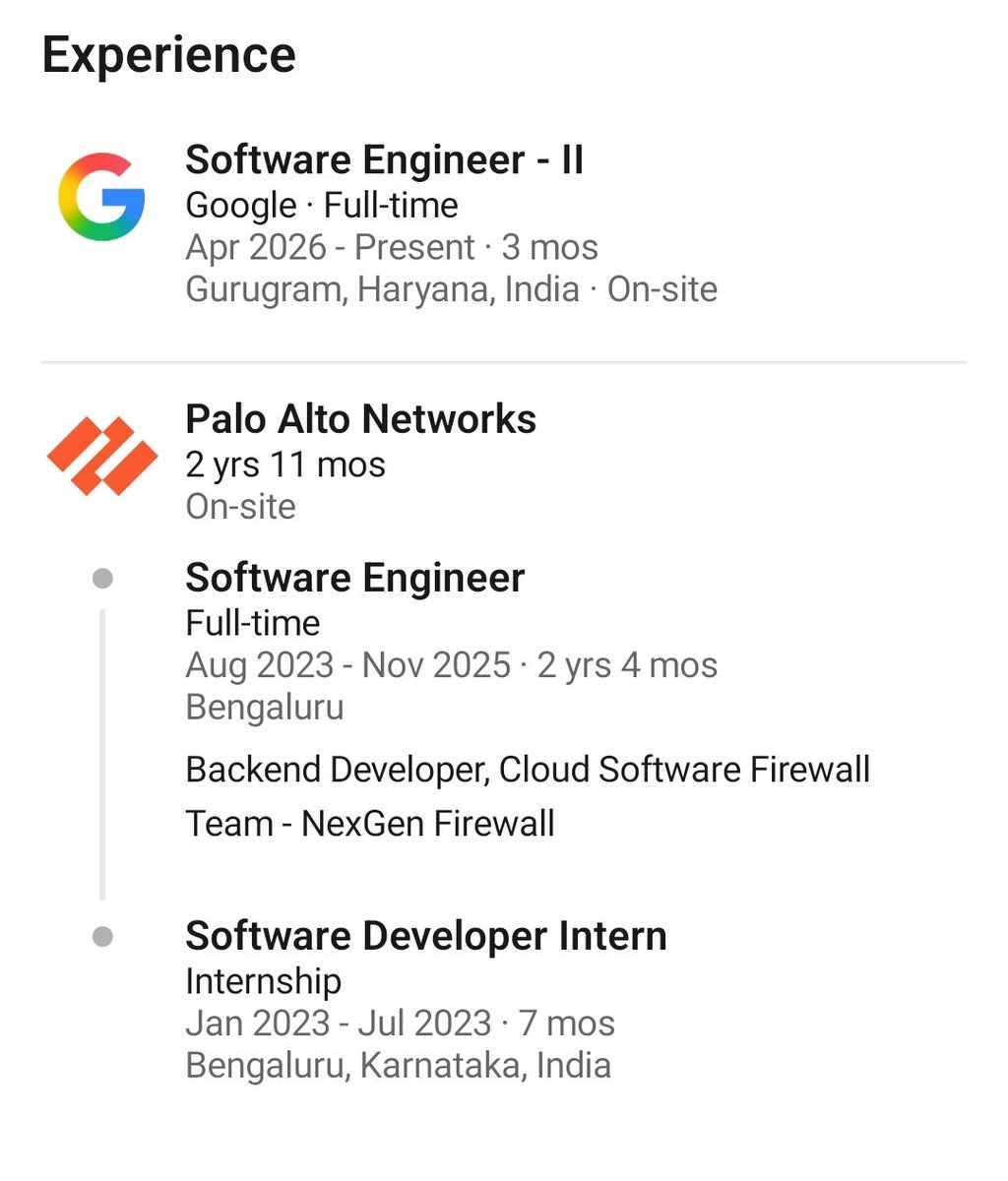
- Meet Priyanka Giri
- Software Engineer II at Google
- Grew up in India with big dreams of working at a global technology company
- Came from a non-traditional path compared to many Big Tech success stories
- Faced multiple rejections while pursuing her dream
- Watched opportunities slip away despite months of preparation
- Battled self-doubt and uncertainty along the way
- Refused to let rejection define her future
- Continued improving her problem-solving and software engineering skills
- Spent countless hours learning, practicing, and preparing for interviews
- Focused on consistency when results were not visible
- While many people stop after a few setbacks...
- She kept going
- Continued applying despite hearing "no" multiple times
- Turned every rejection into a learning opportunity
- Started her professional journey as a Software Developer Intern at Palo Alto Networks
- Converted her internship into a full-time Software Engineer role
- Spent nearly 3 years at Palo Alto Networks
- Worked as a Backend Developer on the Cloud Software Firewall Team (NextGen Firewall)
- Built expertise in backend systems, cloud infrastructure, and large-scale software development
- Leveraged that experience to crack one of the most competitive interviews in tech
- Eventually joined Google as a Software Engineer II
- Continues to build impactful products at one of the world's leading technology companies
- Shared her journey publicly to encourage others facing similar struggles
- Became proof that persistence can outperform self-doubt
- Continues to inspire aspiring engineers to trust the process
From multiple rejections → Palo Alto Networks → Google Software Engineer II
FYI-https://t.co/zjSOZgDvz4
Kotak Interview experience for SDE-I for 35 LPA
Round-1: Bar-raiser
Was taken by an external vendor & was 1.5 hours long. Was asked everything, DSA+LLD+HLD.
DSA:
Climbing Stairs
Merge Two Sorted Arrays in Place.
LLD:
Library Management, Requirements were given in hand.
Had to define Entities, Relationships between them, APIs, DB Schema, Design Pattern usage.
(No coding was expected - surprised)
HLD:
Were few questions like splay tree, indexing etc.
Round-2: CV & DSA round:
Was grilled on my CV, why's and how's for each thing i had written in my CV. Follow ups for decisions etc.
For DSA, it was a simple question: Implement a load balancer. Was given quite a few follow ups as well like how would make it thread safe, memory efficient etc.
Round-3: LLD
Was asked to design meeting scheduler.
Needed to define functional non functional requirements.
Entities, Relationships between them etc
DB Schema for them as well.
Once this was done, we moved to coding.
Was asked to code only the core method to schedule a meeting and schedule meeting in recurring fashion like each friday and stuff.
Was asked to prevent double booking as well.
We talked about DB Locking, what all fields would be involved for it etc.
Matt Pocock just open-sourced the best Claude Code skill pack I’ve seen.
It’s called mattpocock-skills v1.
A set of engineering skills you install once and Claude Code becomes a sharper coder overnight.
/codebase-design teaches it architecture. /domain-modeling sharpens your project’s language. /diagnosing-bugs hunts hard bugs. And /ask-matt is a router that picks the right skill for your situation automatically.
The wildest part: he cut token cost by 63% while making the skills better.
Free on GitHub. If you use Claude Code, install this before your next session.







![thebetterindia's tweet photo. Do school marks really tell us how much someone can achieve?
For Pawan Kumar Chandana, a score of 51 in Mathematics certainly didn't.
Years later, the former ISRO scientist would go on to co-found Skyroot Aerospace, India's first space-tech unicorn, and help lead the launch of Vikram-S, the country's first privately developed rocket.
Born into a middle-class family in Hyderabad, Chandana wasn't always seen as a future space entrepreneur.
While Mathematics was a challenge in school, his preparation for engineering entrance exams sparked a deeper interest in science and technology.
That curiosity eventually took him to IIT Kharagpur, where he earned a dual degree in Mechanical Engineering.
In 2012, he joined ISRO and spent nearly six years working on major programmes including GSLV Mk-III, the S-200 solid rocket booster, and the Small Satellite Launch Vehicle.
But in 2018, he chose to leave the security of a government career and build a private space company alongside fellow engineer Naga Bharath Daka.
Today, Skyroot is valued at over $1 billion and is preparing for the orbital launch of Vikram-1.
@PawanKChandana | @SkyrootA
#SpaceTech #Innovation #Entrepreneurship #ISRO #Skyroot
[Pawan Kumar Chandana, Skyroot Aerospace, India's first space-tech unicorn, Vikram-S]](https://pbs.twimg.com/media/HLauIDnbEAAYFbD.jpg)