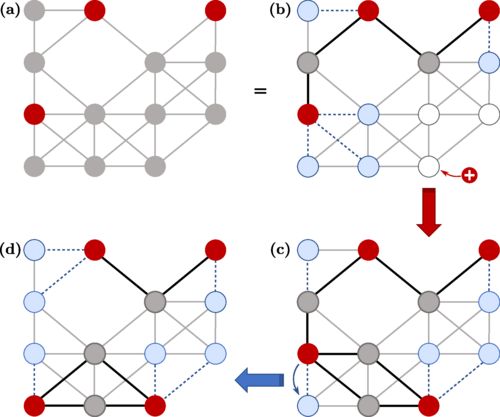
Tensor networks are becoming a vital tool in quantum computing. Originally used for simulating quantum systems, their applications now include:
- Quantum circuit synthesis
- Quantum error correction
- Quantum machine learning
Read more from Nature: https://t.co/R4x6P2yafQ
@Travis_Sch Quantum advantage, conventionally defined as a quantum computer performing a useful task that is impossible to do using classical computation alone, has already been attained: https://t.co/Pj0xxZVqZI
Attaining “large” $$ impact with quantum computers remains open, of course.
It was a privilege to work on this milestone demonstration. This result proves beyond doubt that today's quantum computers combined with exascale supercomputers can perform a valuable task that no classical computer can to achieve on its own: certified randomness expansion.
Almost exactly a year ago, we ran an ambitious experiment. The goal was to make a quantum computer do something that was impossible before and would also be practically useful.
Today, I am proud to announce the results of that work through a paper in Nature. In it, we use a quantum computer to realize the task of generating “Certified Randomness” — a special kind of randomness which comes with a ‘proof’ of randomness that can be verified by anyone.
Randomness is used everywhere — in lotteries, in jury selections, in selecting who to audit. With certified randomness, you can be confident that such sensitive decisions are made fairly, using genuine randomness, untampered by a malicious adversary. You can be sure that the security keys you use for encryption come from a truly random source. What’s more, you can now prove the integrity of your system to others.
This opens up new opportunities within cryptography. We can generally use certified randomness to augment existing entropy sources, towards making opaque decision processes more transparent, towards ever more layers of trust. We present some initial thoughts in an accompanying paper. But clearly, there is a lot more to do.
This work was made possible with a heroic collaboration between federal laboratories, universities, startups and financial institutions spread all across USA. This collaboration — which includes @jpmorgan, @QuantinuumQC , @argonne, @ORNL, @UTAustin — brought together theoretical expertise, state-of-the-art quantum computers and world’s most powerful supercomputers.
From a long list of people behind this work, I would like to specially thank my closest collaborators @ruslanquantum and @henryken_liu for being a part of this journey, as well as JPMorganChase leadership — Marco Pistoia, Lori Beer and Jamie Dimon — for creating an environment that makes breakthroughs like this possible.
https://t.co/juQhJq5Eac
@wjzeng@DulwichQuantum Note that Google’s result is not the only “beyond-classical” experiment that is robust against the new techniques. Another example is our recent work with Quantinuum: https://t.co/70iLN5m3td
There’s no reason to believe that tensor networks can keep up with hardware progress.
Study shows a quantum algorithmic speedup for the quantum approximate optimization algorithm #QAOA. Could lead to advances in logistics, telecommunications, financial modeling, materials science etc.
@JPMorgan Chase, @Argonne@Quantinuum
https://t.co/B3aBWK2Q3s
@alejomonbar Only a couple of minutes, with the runtime dominated by communication time. See Fig 5 in https://t.co/K6FZQCKbsc for details on scaling. The simulation is memory-bound, so if you have a bigger supercomputer, it’s relatively straightforward to run higher N.
We are excited to see our joint paper with @argonne and @QuantinuumQC appear in Science Advances! See our press release for more details: https://t.co/Bqwdyk0Ur5
We show that the Quantum Approximate Optimization Algorithm (QAOA) achieves a quantum speedup over state-of-the-art classical algorithms. Our results are enabled by large-scale simulation using up to 1,024 GPUs on Polaris supercomputer hosted by @argonne_lcf
The https://t.co/ryR80j8iki (@victorvalbert et al.) is incredibly useful for navigating the landscape of these fancy qLDPC codes I keep hearing about. However, I couldn't find any tools to actually tinker with these codes.
So I decided to build my own! https://t.co/pZNJJQEQiU
Register for the Chicago Quantum Recruiting Forum by tomorrow @ 12:00 pm CT to be included in the resume book! This annual event brings together the rising generation of #quantum scientists with employers/educators for an event aimed at catalyzing careers: https://t.co/ry49QTCnpz
Curious about the potential quantum holds for transforming financial strategies? Check out the #Q2BSV23 presentation with @singular_value & @ruslanquantum on their collaboration to optimize ETF arbitrage using Q-CHOP: https://t.co/vHeyB6957e.
Fresh in Quantum: Parameter Setting in Quantum Approximate Optimization of Weighted Problems by Shree Hari Sureshbabu, Dylan Herman, Ruslan Shaydulin, Joao Basso, Shouvanik Chakrabarti, Yue Sun, and Marco Pistoia https://t.co/6ctShh8zUA
Amazing to see @jpmorgan lead the investment round for @QuantinuumQC. Looking forward to continued collaboration with the leaders in quantum hardware!
https://t.co/euBHNpjgpc