The https://t.co/ryR80j8iki (@victorvalbert et al.) is incredibly useful for navigating the landscape of these fancy qLDPC codes I keep hearing about. However, I couldn't find any tools to actually tinker with these codes.
So I decided to build my own! https://t.co/pZNJJQEQiU
Even if you don't care one bit about scientific research, it's important to recognise the value of publicly funding people working on very hard problems and training bright young minds on how to solve them.
Do you think it’s a coincidence that so many successful entrepreneurs have a science background? The US didn’t become a global leader in technology and innovation by accident. It got there through decades of public investment in science, building research groups where young people could throw themselves at the toughest questions we face.
Today, 49% of US unicorn CEOs hold STEM degrees, and 70% of founding teams include at least one person with a STEM background. That pipeline of innovation was forged in universities and national labs, not in boardrooms
And when research is sustainably funded, the best international students come to US universities, and stay to build their companies (Elon Musk is one of them). Over 50% of international students in the U.S. are in STEM fields. Do you think this will continue if their research funding collapses by >70% and they can be kicked out at any time because the current government picks a fight with their University?
In the 21st century, attracting smart young people is the most valuable resource any nation can have today. In the future it will become even more critical. Scientific research is one of the strongest magnets for talent. You can ignore it, but the US is dismantling one of its most powerful engines of innovation
Anybody familiar with linear algebra over rings? I want to find the null space of a matrix whose entries are elements of a (finite) group algebra (over a finite field).
Help?
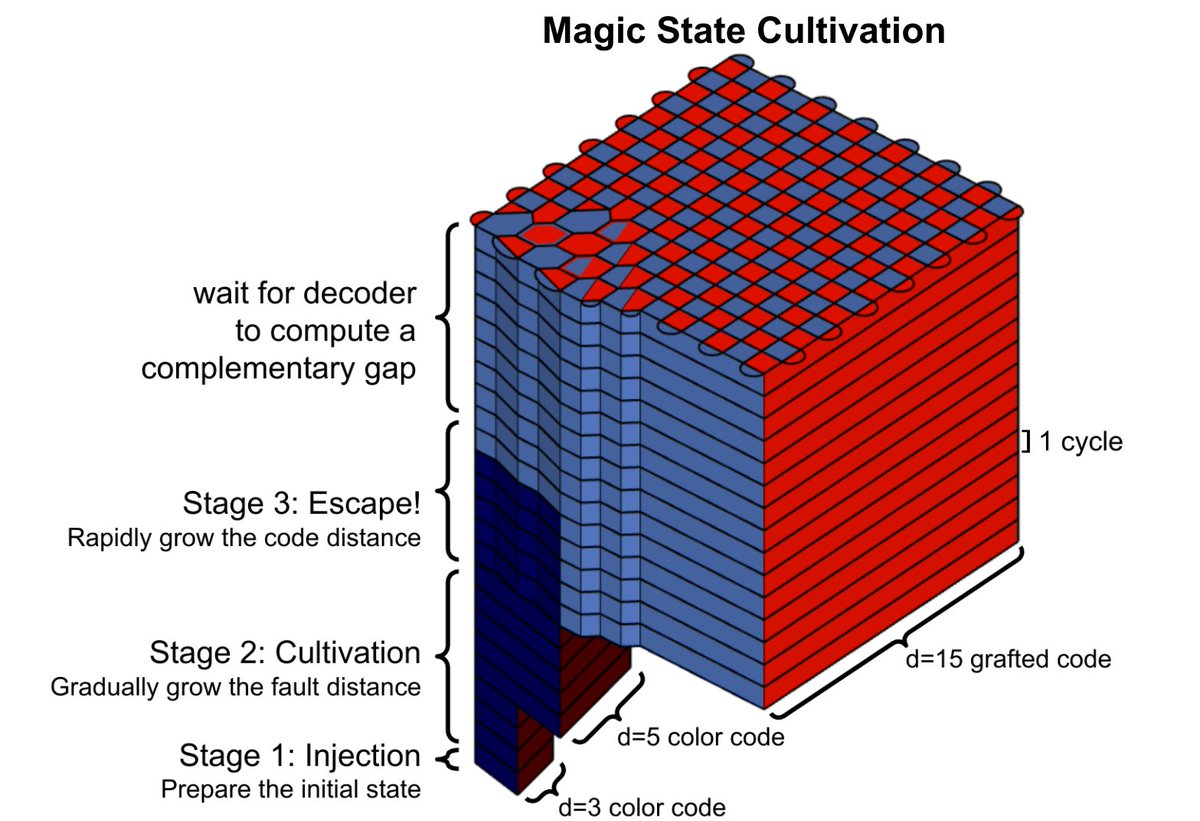
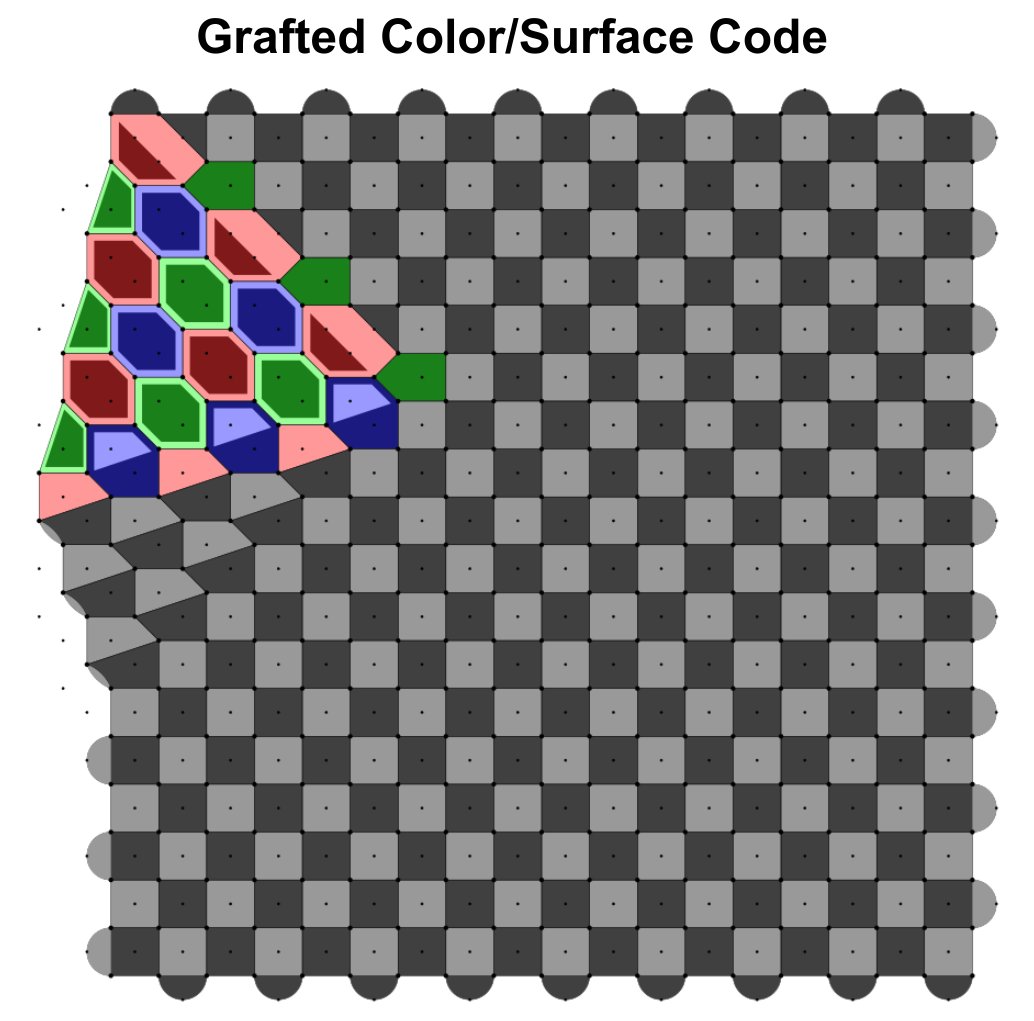
Been working on "Magic state cultivation: growing T states as cheap as CNOT gates" all year. It's finally out: https://t.co/VxQsZQJcDE
The reign of the T gate is coming to an end. It's now nearly the cost of a lattice surgery CNOT gate, and I bet there's more improvements yet.
@HyperboIeva As a kid I heard some lectures by Steven Pollock about quantum mechanics and relativity (superposition, twin paradox, etc). Sounded to me like crazy fantasy/sci-fi type stuff, but here *scientists* seemed to insist that it was *real*.
I just had to learn more and understand.
@enriqueseguraca How we think of error budgets changes depending on your proximity to hardware, but the biggest categories we typically keep in mind are SPAM (state preparation and measurement) errors, gate (in)fidelities, idling errors (such as T2 times), and (if you get exotic) crosstalk.
Today we introduce the BP+OTF decoder (https://t.co/KtMS74Q8cT), an almost-linear time decoder for quantum LDPC codes. Importantly, we aim to do so for circuit-level noise. 🧵
I'm thrilled to join Global Technology Applied Research at JPMorgan Chase today to focus full-time on quantum error correction, from fault-tolerance experiments to new code development.
Looking forward to working with @marco_pistoia, @ruslanquantum, @SivaprasadOman1, and others!
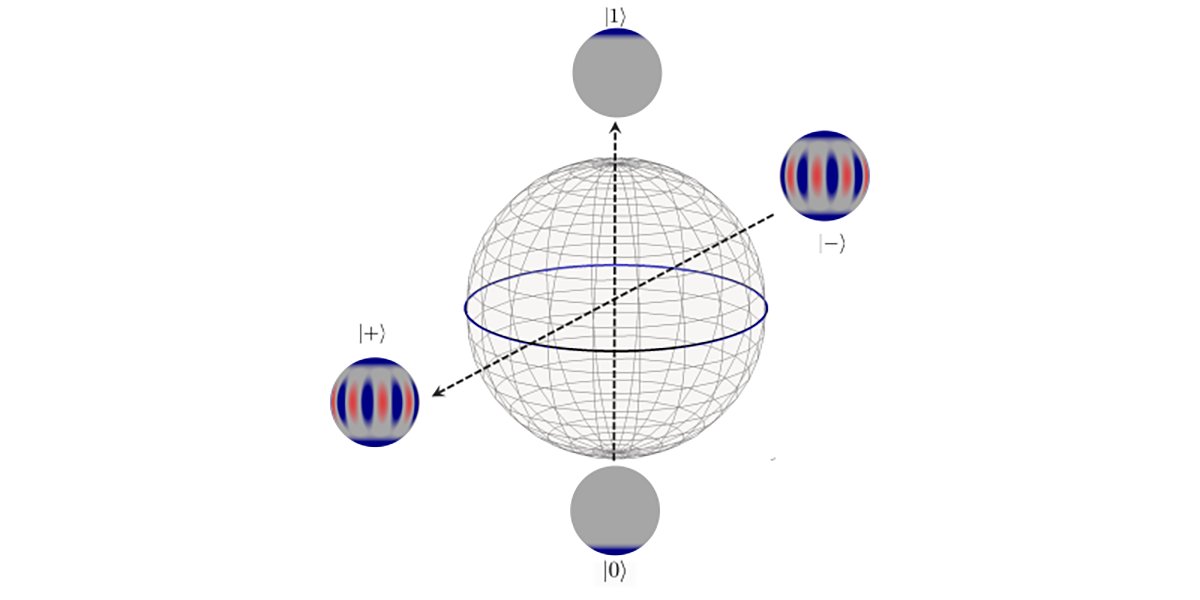
Very excited to see this in press. Led by @SivaprasadOman1 & Milad Marvian, with @Because_Vikas and @jarthurgross, we show how large spin systems can be used to reach high-threshold/low-resource fault-tolerant quantum error correction. Atomic spins are the natural platform.
New on the @arxiv: Robust Quantum Sensing with Multiparameter Decorrelation: https://t.co/4jwg00A5w4. A new adaptable method uses machine learning to design quantum sensors that filter out noise. @Particle_Perlin@CUBoulderPhys
@rocketjohnsen I don't know how one could diagnose a continuous-valued error because I'm not sure how you could have a "perfect" reference. Redundancy doesn't help either because every copy of the variable can pick up an error.
But surely somebody must have proven something about all this.
I have heard folklore that error correction is impossible in classical analog systems, but I can't seem to find a good reference for this claim. Does anybody have any good leads? Is it even correct?
@rocketjohnsen I'm thinking of error correcting codes, e.g. some way to "encode" a continuous variable and correct "errors" to it, or deviations from what value that variable "should" have.
The folklore that this doesn't work is plausible, but I'm trying to build a better understanding.