@bopanc@DrRadchenko It's worth noting that there was a back story to that "written warning." It was posted by RU Embassy in Ireland https://t.co/GAmbBNXk1W and appeared to be a direct reaction to this https://t.co/QQuXDEpS9e (back story there too), which got some coverage: https://t.co/I4QZnBC70T
🧵Alexander Kynev, currently in prison and Russia’s leading domestic policy analyst, made an important point in his last interviews before his arrest.
In his view, in the event of political upheaval in Russia five to ten years from now, systemic players will play a major role—amid a total purge of any non-systemic players.
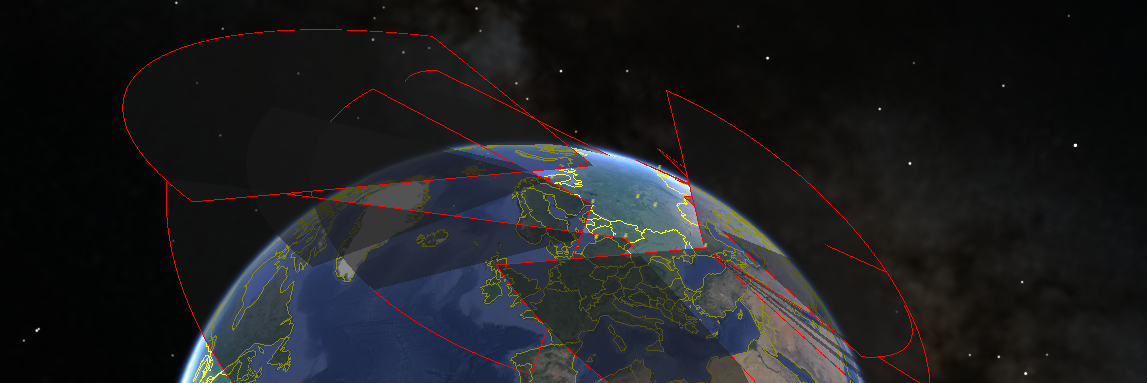
COSMOS 2581, 2582 and 2583 share one orbit plane at about 575 km. Historically we have seen these satellites perform many close approaches with each other, possibly acting as test runs for Russia. Over the past week, our orbit determination on commercial radar tracking caught another close-proximity sequence between the trio.
🔹 Before the burn: COSMOS 2582 was on course to pass COSMOS 2581 at roughly 100 m on the evening of 22 Nov (UTC).
🔹 Early on 22 Nov (UTC): 2582 performed a small and precise burn. Over the next 12 hours it shifted 2582 several kilometers along its orbit.
🔹 That evening: instead of meeting 2581, 2582 passed COSMOS 2583 at ~99 m, with maximum position uncertainties of about 25 m and 20 m for the two objects.
🔹 The next morning: 2581, which made no maneuver, drifted past 2583 at about 170 m, with uncertainties of about 20 m and 35 m.
This small maneuver changed the course of 2582 and allowed for proximity operations with both 2583 and 2581 in a short span.
The burn also left 2582 almost directly on 2581's orbit, and our current solutions predict another slow pass close approach between the two sometime tomorrow.
Seeing this trio actively maneuvering again reminds us of some recent RPO's between COSMOS 2612 and ICEYE-X36, which we also recently posted
#SpaceDomainAwareness #SSA #SpaceSafety
Une rapide réflexion sur l'"affaire" du satellite nucléaire russe.
- Spoutnik-S est un satellite radar pour faire de l'interférométrie.
- C'est la version militaire du Kondor (photo) de NPO Mach.
- Il n'y a aucun lien, direct ou indirect, avec un quelconque projet nucléaire. 1/2
Zhengqing Fang and Igor Morić, "Assessing the Impact of the Prompt Effect of a High-Altitude Nuclear Explosion on Nonmilitary LEO Satellites," Science & Global Security, 34 (2026) https://t.co/cNoF9FMIl0 LIMITED TIME FREE ACCESS
🔎 Do norms constrain nuclear threats?
UNIDIR will present findings at a side event to the Treaty on the Prohibition of Nuclear Weapons Review Conference on how States reacted to nuclear threats and how collective action could strengthen the norm.
🔗 https://t.co/s8QKEOLAUn
🇺🇳 Join our team!
UNIDIR is seeking a Head of Programme for our Space Security Programme in Geneva, leading research and dialogue on space security and supporting multilateral efforts.
🗓️ Apply by 7 December: https://t.co/PdehjamZCA
📢 Join our team!
UNIDIR is seeking 2️⃣ Graduate Professionals to join our Weapons of Mass Destruction Programme in Geneva. Gain expertise in nuclear, chemical and biological weapons policy and international security.
🗓️ Apply by 4 December: https://t.co/wEnGtlyLU5
The Zaporizhzhya Nuclear Power Plant (ZNPP) is relying on emergency diesel generators for essential nuclear safety and security functions after losing all off-site power for the 28th time during the conflict.
The plant’s connection to its sole remaining external power line, Ferosplavna-1, was lost at 5:28 local time. The IAEA team at the site is working to confirm the cause and location of the disconnection, IAEA DG @rafaelmgrossi says.
If you are curious about past nuclear detonations in space, here is a slide I put together some time ago for a presentation. The graphic is by Claude (from manually compiled data), and I must say it did a pretty good job.
To recap what US officials said about Cosmos-2553/the first Sputnik-S. Nothing "active" or "nuclear". Sources: Kirby on 15 Feb 2024 https://t.co/jdzNb8bsSb, WSJ 16 May 2024 https://t.co/ytRObYeIn8
In any event, US officials said there was no weapon on board. Maybe, just maybe, there were some radiation experiments as a secondary mission, prompting the US to (over)react the way it did. 2/
A new round of diplomatic manoeuvring over Russia’s war against Ukraine has brought Moscow’s demands for binding constraints on NATO into the negotiations. Washington is meanwhile discussing Article 5-style guarantees for Kyiv and seeking Russian agreement to European participation. Moscow is sending mixed signals, maintaining a hardline position while hinting at possible flexibility.
The central disagreement concerns what must be settled before the fighting stops. Moscow wants a comprehensive package covering territory, Ukraine’s political future and military capabilities, and European security. Its leaked non-paper largely repeats and expands the demands presented in December 2021. Understanding what these formulations require in practice is essential to assessing the scope for negotiation.
The Putin–Trump–Xi summit has added another dimension. Putin wants the format to continue, while Trump’s engagement remains volatile. Our new bulletin examines what Moscow gained from the meeting, where its negotiating position might allow adjustments and the conditions it is setting for European participation in the talks. It also considers which forms of security guarantees for Ukraine Moscow might accept and what it would expect in return.
Diplomacy is proceeding alongside escalation. Ukraine’s attacks on the Crimean Bridge affect road and rail connections and shipping between the Azov and Black seas. They also put pressure on Putin from those who regard repeated attacks on the bridge as evidence of insufficient resolve. These domestic reactions matter for how the Kremlin approaches further negotiations.
Moscow’s wider security ambitions also inform its approach to the CSTO. The organisation is intended to become part of a broader Eurasian security architecture, but its members have different priorities and understandings of collective defence. The decision to restrict Armenia’s rights while retaining its membership illustrates the political choices involved in managing these relationships.
At home, resistance to higher taxes is producing negotiations across several institutions. Banks are lobbying the Duma, electronics companies are appealing to the government and steelmakers are seeking support through the Federation Council. Some objections have found allies within the state. The bulletin assesses how much influence these channels retain as the government seeks additional revenue and businesses face mounting financial pressures.
Putin’s pardon of Valeriya Chekalina, known as Lerchek, raises a different question about access to presidential intervention. The humanitarian grounds are clear, but the speed of the decision and public accounts of influential intermediaries have prompted criticism of unequal treatment. The case matters for relations between presidential authority, the siloviki and elites looking to Putin for protection.
R.Politik Bulletin No. 20 (194) examines Moscow’s negotiating calculations abroad and the pressures shaping political decisions at home.
https://t.co/RZ6ZZWF1gx