I've never seen the market act this weird before.
The S&P 500 $SPY 3-month implied correlation just hit around 15%, the lowest ever recorded.
Meanwhile, the Nasdaq 100 $QQQ 12-month implied correlation dropped to 25.5%, another all-time low.
This is definitely not normal.
What’s going on?
Stocks within the same index aren't moving together anymore.
On the surface, the market looks strong, but underneath, the leaders are super limited.
Just a handful of mega-cap tech stocks are carrying the whole thing.
Think:
$NVDA $MSFT $AAPL $AMZN $META $GOOGL $AVGO
These names are holding the indexes up.
But plenty of other stocks are just sitting out.
That's why you really have to be picky.
Don't just buy everything in sight.
Don't assume every stock will follow $SPY and $QQQ higher.
In a market like this:
Strong leaders can keep running
Weak stocks can stay weak
Rotation is key
Stock picking matters way more
Managing risk is crucial
We've rarely seen leadership this narrow.
Now's not the time to get lazy.
Stick with strength.
Stick with revenue.
Stick with profits.
Stick with companies that actually earn their spot.
The index might look fine.
But underneath, this market is split in two. 📊🔥
🚨 The best-performing S&P 500 stocks of 2026 are not the names most people expected.
$SNDK Sandisk: +608%
Current price: $1695.00
$MU Micron: +239%
Current price: $971.02
$DELL Dell: +223%
Current price: $420.93
Everyone was watching $NVDA.
Everyone was chasing the obvious AI trade.
But the real move was hiding underneath the surface:
Memory. Storage. Servers. AI infrastructure.
That is the lesson.
AI is not just about GPUs.
AI needs HBM, DRAM, NAND storage, enterprise servers, data-center hardware, and massive infrastructure buildout.
That is why $SNDK, $MU, and $DELL exploded.
The market thought these were old hardware names.
Wrong.
$SNDK is a storage cycle + AI data demand story.
$MU is a memory / HBM / DRAM cycle story.
$DELL is an AI server and enterprise infrastructure story.
These are not boring legacy tech stocks anymore.
They are the hidden picks-and-shovels behind the AI boom.
But here is where most people make the mistake:
After a stock is already up 200%–600%, you do not blindly chase the green candle.
You wait.
You let the market cool off.
You watch for pullbacks.
You look for base formations.
You buy the strongest leaders when fear comes back.
Right now, my focus would be:
$MU — best pure memory / HBM setup
$DELL — AI server infrastructure leader
$SNDK — high-momentum storage winner, but needs pullback
$NVDA — still the AI king, but only on dips
$AVGO — custom AI chips + infrastructure
$STX / $WDC — storage cycle watchlist names
The AI trade is not over.
It is just moving beyond GPUs.
The next winners may come from the companies powering the full AI infrastructure stack. 🚀
Heads up, you need to pay attention.
The S&P 500 $SPY just hit an all-time high close and had a 9-week winning streak for the first time since 2023.
From the March 30 low, $SPY climbed +20.1%.
That means the market gained around +$11.4 TRILLION in value in just 2 months.
This isn't normal.
$SPY and $QQQ have been super strong.
Big names like $NVDA $MSFT $AAPL $AMZN $META $GOOGL led the charge.
But here's what you gotta know:
When markets move this much this quick, risks ramp up.
I'm not saying sell it all.
I'm saying be smart.
Hold onto your best winners
Don't chase stocks that are overpriced
Take some profits when things get too stretched
Stay balanced—mix growth with safer plays
Get set to buy the next solid dip
The market made folks a lot of money the last 2 months.
Now the goal is simple:
Lock in gains. Stay chill. Watch for what's next.
Don't get greedy near the top.
Don't freak out when it pulls back.
The next dip will bring the next big chance. 💪📈
The market finally hit my target.
$SPY and $QQQ are at a key spot, looking pretty tired right now.
This isn't the time to throw a big chunk of cash at stocks that have already run up too much.
Stocks like $NVDA $TSLA $PLTR $AMD $HOOD have done well, but when they get overstretched, you gotta be smart.
What's the move?
Hold onto your big winners, but take about 20% off the table
Don't buy stocks that are already overextended
Look for stocks that are bottoming out, where money might shift
They might still drop, but they could drop LESS
Mix in some defensive stocks like $COST $WMT $PG $KO $JNJ to balance things
A small -5% dip is coming soon.
But for wild stocks, be ready for -20% to -50% drops.
That's why managing risk is key.
That's why balance matters.
Growth stocks can make you rich.
But defensive stocks keep you alive.
You NEED to stay safe.
Please, I'm begging you.
Don't panic.
Don't chase.
Lock in your gains.
Get ready for what's next. 💪📉
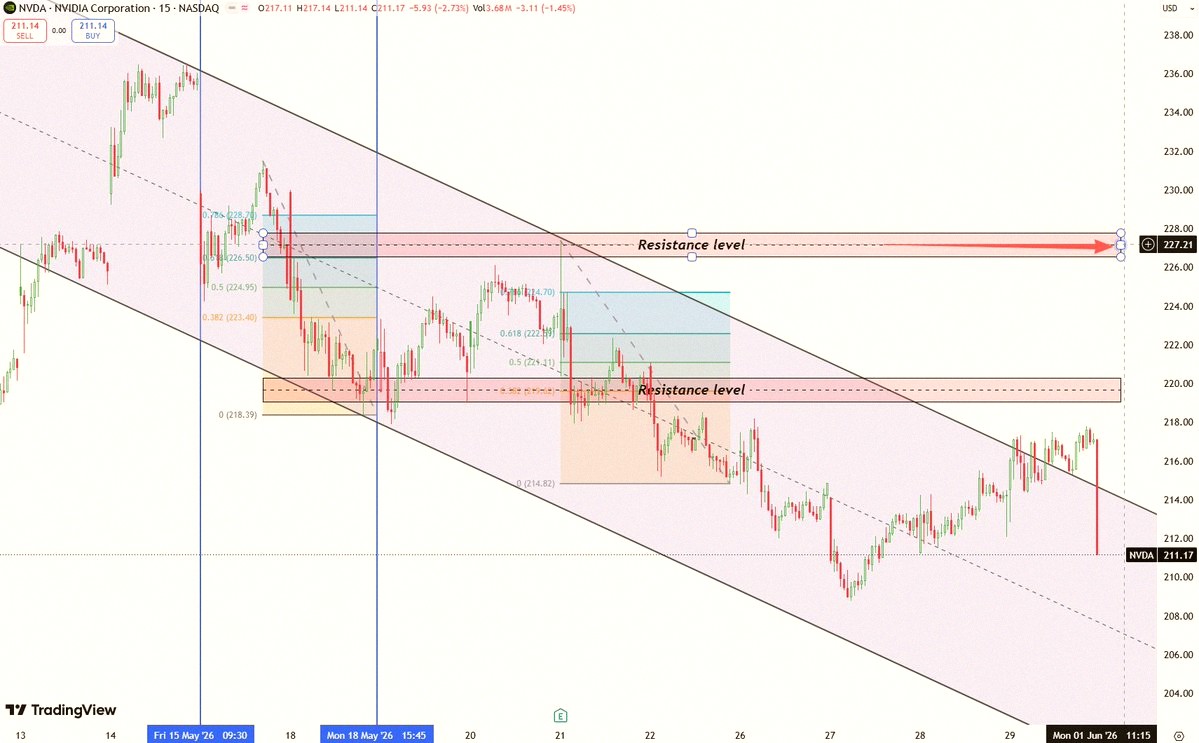
$NVDA is sitting at a key technical level right now.
Technically, the stock got rejected around $227, which is pretty close to the 61.8% Fibonacci resistance. Since then, it’s pulled back and closed near $211.17.
This drop might be from profit-taking after a big rally, some cooling in the semiconductor space, AI stocks digesting valuations, and overall weaker market sentiment. $NDAQ
But long-term, the trend is still bullish. The main story behind $NVDA hasn’t changed: AI demand, data center growth, semiconductor strength, and strong institutional interest are all still backing the long-term trend.
Short-term, it all comes down to whether it can hold support. If $NVDA stabilizes and volume picks up, it could try to push toward resistance again. But if support breaks, we might see more downside.
Overall: short-term dip, but long-term bullish structure is still intact.
$NVDA is sitting at a crucial technical level right now.
Technically, the stock got rejected around $227, which is pretty close to the 61.8% Fibonacci resistance zone. Since then, it’s dropped and closed near $211.17.
This dip might be due to folks taking profits after a big run, some cooling in the semiconductor space, AI stocks settling down, and the overall market being less risk-hungry.
But longer term, the bullish setup is still there. The main story for $NVDA hasn’t changed: demand for AI computing, data center growth, strong semiconductors, and heavy institutional interest are still backing the trend.
Short term, it all comes down to whether it can hold this support area. If it stabilizes and volume picks up, we might see another run toward resistance. But if key support breaks, we could see more downside.
Bottom line: short-term pullback, long-term bullish structure is still intact.
The market should not ignore this. 🚨📊
$SPY and $QQQ are both showing bearish divergence on the daily timeframe.
This does not kill the bull market.
But it does tell us the market is getting tired.
When indexes keep making new highs while momentum weakens, you do not chase blindly.
You protect profits.
The next move could be sideways chop, consolidation, or a dip before the trend continues.
The weakest area will likely be the stocks that already went too far too fast.
Parabolic AI names.
Overextended technology.
Crowded momentum trades.
The better opportunities may come from base formations, laggards, healthcare, utilities, software, and clean Stage 2 setups.
My plan:
Trim, not exit.
Protect profits, not panic.
Stay balanced, not emotional.
Buy the best names when the dip comes.
The next pullback could be where serious money is made. 💪🔥
The market should pay attention to the space sector. 🚨📊
Blue Origin’s New Glenn failure creates a real timing problem for Amazon $AMZN and Project Kuiper.
Kuiper needs satellites in orbit.
Satellites need reliable launch capacity.
Launch delays give Starlink and SpaceX more time to extend their lead.
That is why this matters beyond Blue Origin.
Public space names like $RKLB , $ASTS , $RDW and $LUNR could see more attention as investors look for companies with real execution in satellites, launch, lunar infrastructure and space communications.
SpaceX may still be the leader.
But every Blue Origin setback makes the rest of the space market more interesting. 🚀🔥
People are underestimating how big this actually is. 🚨
$DELL didn't just post strong numbers.
It proved AI infrastructure demand is going through the roof.
AI server revenue jumped 757% year-over-year.
That one stat says it all.
The AI boom isn't just about $NVDA anymore.
It's spreading into servers, storage, networking, data centers, and enterprise setups.
Dell is right in the middle of that wave.
They raised full-year guidance.
Q2 guidance came in better than expected.
Cash flow is solid.
AI server outlook got even higher.
The takeaway is obvious:
AI infrastructure spending isn't slowing down.
$DELL is now one of the best ways to see that demand in real numbers. 📊🚀
This is bigger than people think. 🚨
$SIVE is not moving because of hype.
It is moving because AI infrastructure is creating a new supply chain bottleneck.
The market already understands GPUs.
But it is still early in understanding photonics.
$NVDA wants far more InP laser capacity for future AI cluster networking.
The problem is that the supply chain may not be able to scale fast enough.
That means companies sitting inside this bottleneck could become much more important.
$SIVE makes the exact type of lasers needed for 1.6T+ transceivers and CPO programs.
If AI networking demand keeps accelerating, this could become a very real shortage story.
This is why the $SIVE thesis looks stronger than ever. 📊🚀