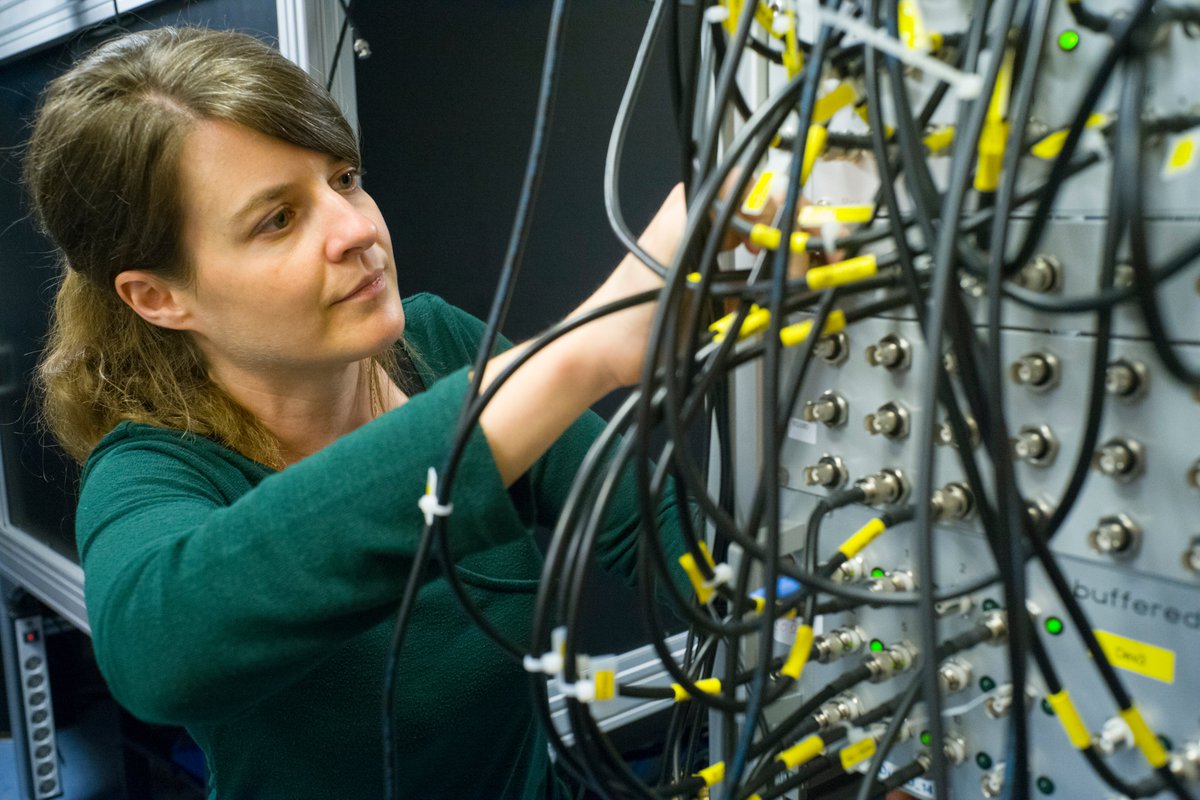
Behind #MCQSTAdventCalendar🎄🚪door #19: Meet Monika Aidelsburger, quantum optics professor at @LMU_Muenchen. Her group works on quantum simulation experiments with ultracold atoms in optical lattices. Read on to see why her research is so fascinating.
➡️https://t.co/2Hfc7jhjrH
Behind #MCQSTAdventCalendar🎄🚪 Door #11:
Meet Michael Förg, a postdoc at spin-off project Qlibri, where he and his team are developing the world's most sensitive absorption microscope.
➡️ https://t.co/THTX0pEBjq
Well , who would have thought oocytes look like planets with the right clearing :) Image by our very own Arturo, chosen as EMBL picture of the week @LabBoke@CRGenomica
Learn more about 'smart' microscopy and the computational algorithms being developed to create 'self-driving' microscopes in this month's Technology Feature. https://t.co/Q6iCxUDsfS
We are looking to recruit a theory / dry lab post-doc to join our interdisciplinary team. Please forward to anyone who might be interested!
"Postdoctoral position: Inferring Complex Causality in Aging"
https://t.co/SocpvzxfhR
Praying mantises are one of the only invertebrates that can see in 3D. Neuroscientist Jenny Read is using tiny 3D glasses to test their depth perception, while Ronny Rosner uncovers the nerve cells responsible for this so-called stereoscopic vision. #SfN19
Researchers injected CRISPR–gold (a new version of CRISPR–Cas9) into two brain areas in mice and found that the system edited genes in several major cell types #ResearchHighlight https://t.co/94ZdNPYRWU
Red blood cells normally spend their time ferrying oxygen throughout the body. But now they’ve proved useful in a drastically different role - producing plastics #ResearchHighlight https://t.co/EfrtAZEbfc