Lately I've been wondering whether empathy is something we're born with or something we're quietly trained into (or out of).
Psychologically, some people feel others instinctively; others learn it through pain, privilege, absence, or example.
But empathy isn't just personal but rather political, social, structural.
Our moral compass is shaped by what we're rewarded for, what we're allowed to ignore, and who systems teach us to see as "deserving."
When empathy exists, it softens power.
When it doesn't, rules replace conscience.
I keep thinking: if morals can be conditioned, can empathy be taught in schools, institutions, governance?
And if some lack it, is it a failure of character... or of the systems that raised them?
Maybe the future isn't about smarter laws, but deeper humans.
Came across this quote by Napoleon Bonaparte: “History is a set of lies agreed upon,” which essentially means power decides memory, and consensus does not necessarily mean truth.
Being a recent graduate myself, I know how deeply campus life and student experience shape who you become not just as a professional, but as a person.
Grateful and excited to be part of D Y Patil University at a moment where ideas, energy, and opportunity intersect. #Education is one of the few spaces that truly shapes lives and long-term trajectories, and contributing to that feels incredibly meaningful.
Looking forward to bringing my global experiences back home, learning every day, and carrying the legacy forward.
Even far into the sea, Mumbai's waters are grey and filthy. Shoes, unopened bread packets, plastic, trash everywhere. even a floating animal. It was disgusting and heartbreaking what I saw on the way to Mandwa on a speed boat.
How is this still normal?
How is there no large-scale tech, no real solution to clean and filter our seas?
#Mumbai is a coastal city with so much potential, yet we treat our water body like a dumping ground.
We fly to Amalfi, Bali, Goa for "blue waters" while ignoring what we have at home.
I don't understand how does a global coastal metropolis still lack scalable technology.
Why shouldn't Mumbai's sea be crystal clear?
Real ways to make a city truly aesthetic:
• Tree-lined and shaded streets
• A balanced, context-driven colour palette
• Minimal, warm, functional lighting (not decorative glare)
• Reduced billboard + poster clutter
• Unified signage and street furniture
• Clean, continuous footpaths
• Native greenery + pocket parks
• Coherent building facades and materials
• Designated areas for public art, not random placement
• Traffic-calmed zones for slower, safer, quieter streets
• Underground wiring to reduce visual chaos
• A professional urban design & aesthetics review board for all interventions
I’ve noticed a growing trend in Indian cities where ‘beautification’ is adding decorative lighting. This raises an important question: are we prioritising spectacle over spatial quality? Every other street now carries some face or political message, disrupting streetscape. We’ve got the very concept of urban aesthetics wrong. Cities need trained urban designers and aesthetic specialists. The visual environment of a city shapes how citizens experience space and relate to one another, defining urban experience.
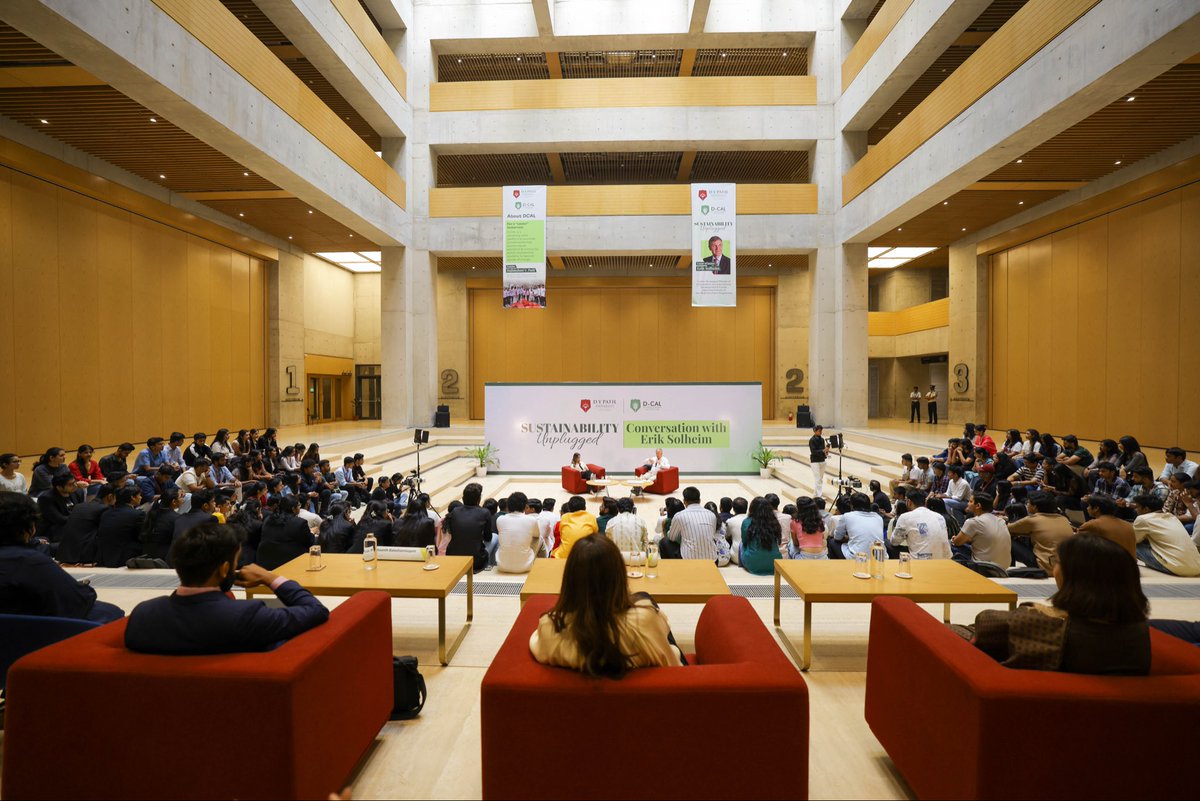
It was an absolute honour to host @ErikSolheim former UNEP Executive Director and Minister of International Development & Environment of Norway at D Y Patil University. Discussed key topics like Green Energy, Energy Transition, Geopolitics, Climate & Circularity & Carbon Market. Super insightful session!
Universities in India remain sites of certification rather than innovation. Our higher education institutes need a structural shift towards original research, critical reading, and academic publishing.
Globally, Oxford helped develop a COVID-19 vaccine, Stanford birthed Google, and MIT shaped the digital economy.
The Pahalgam Attack is a heartbreaking display of inhuman cruelty. Targeting innocent tourists in a land known for its calm and beauty is pure cowardice. Heart goes out to those who lost their lives and their families, I pray for the quick recovery of the injured.
It’s disturbing that in the 21st century, we’re still losing innocent lives to terrorism. Acts like these should outrage the world. Combating terrorism requires not just national will, but a united and uncompromising global response. Humanity deserves better.
Ever since I read @elonmusk 's biography by Walter Isaacson I've been completely in awe and intrigued by his life, vision and personality. He started off with the idea of securing the future of the human civilisation by becoming a multi-planetary species. A far fetched vision at the time, his ambition and hardwork led him to build @spacex And now as the Space X capsule has docked at the International Space Station, paving the way for astronauts Butch Wilmore and Sunita Williams to come home, he has once again proven himself as a visionary. The man doesn't just talk. He builds, he innovates, he saves lives. A genius, and an absolute hero. So much to learn from him.
Wishing the crew a safe journey back to 🌍
Article 11 of the WHO FCTC requires bold health warnings on all tobacco products, with WHO tracking these globally (COP3). If smoking gets a warning, why not carbon? Every high-emission product, service, or activity exceeding harmful CO₂ thresholds should be labeled too just like ‘smoking kills.’