“Hot-state dependency: A condition in which a system's ability to function depends on organizational relationships, accumulated state, or operational knowledge that exists only in its current running configuration and cannot be reliably reconstructed following interruption.”
Our society is like this.
I'm about to propose a term for a dangerous failure mode that every software engineer should be thinking about today. And another for its consequences.
Hot-state dependency: A condition in which a system's ability to function depends on organizational relationships, accumulated state, or operational knowledge that exists only in its current running configuration and cannot be reliably reconstructed following interruption.
Yes, I'm thinking about the Microsoft cloud outage that's going on right now. It could be recoverable, still most likely is, but it could also be the harbinger of a new category of systemic disaster.
Heat death: What happens when a system with hot-state dependency crashes and can't be recovered.
The obvious next question is: how do you engineer systems so as not to have any hot-state dependencies?
I don't have a complete answer to this. But I can think of a necessary part of the answer that I don't think we're taking seriously enough: unitary, replayable modification logs analous to version-control change histories.
It should be impossible - it should be an invariant of your system design - to change the state of the system without leaving a sequenced record of the change that can be audited by human and replayed in a future restart sequence.
This doesn't solve the whole problem. In particular, in a cloud-service infrastructure you don't have the option of resetting all your physical wiring changes and hardware deployments to a zero state and then replaying them.
But I guarantee you that in any sufficiently large or complex software system, you will eventually develop a hot-state dependency purely on the software level if you don't have replayable logs. So that's the minimum you have to do. The absolute dead bare minimum.
We haven't known this before because it took some time for our systems to evolve into the complexity regime where heat death is a critical risk.
But we are here, and the time is now. Be appropriately warned.
@WSJ@WSJopinion You sort of set him up, didn’t you, by creating the impression that senior government officials anonymously provided information about spying, when in fact the info came from a lobbyist at a competing AI company?
By the way, don't be surprised when it turns out that LLMs can build better world models than a specialized world model. The next step after that will be LLMs reverse-engineering the physical world, and that's when the real fun begins.
if SpaceX achieves a double catch, it will be one of the single most important moments in the history of rocketry and mark a new era of humanity’s access to space. tune the fuck in! don’t miss it
One of the weirdest things about working at SpaceXSI.
Your definition of an ambitious project gets recalibrated pretty quickly.
I spend my days building @bot.
Meanwhile, another team is attempting to recover an entire orbital rocket for the first time in history.
Two months in and it still feels surreal 🤯
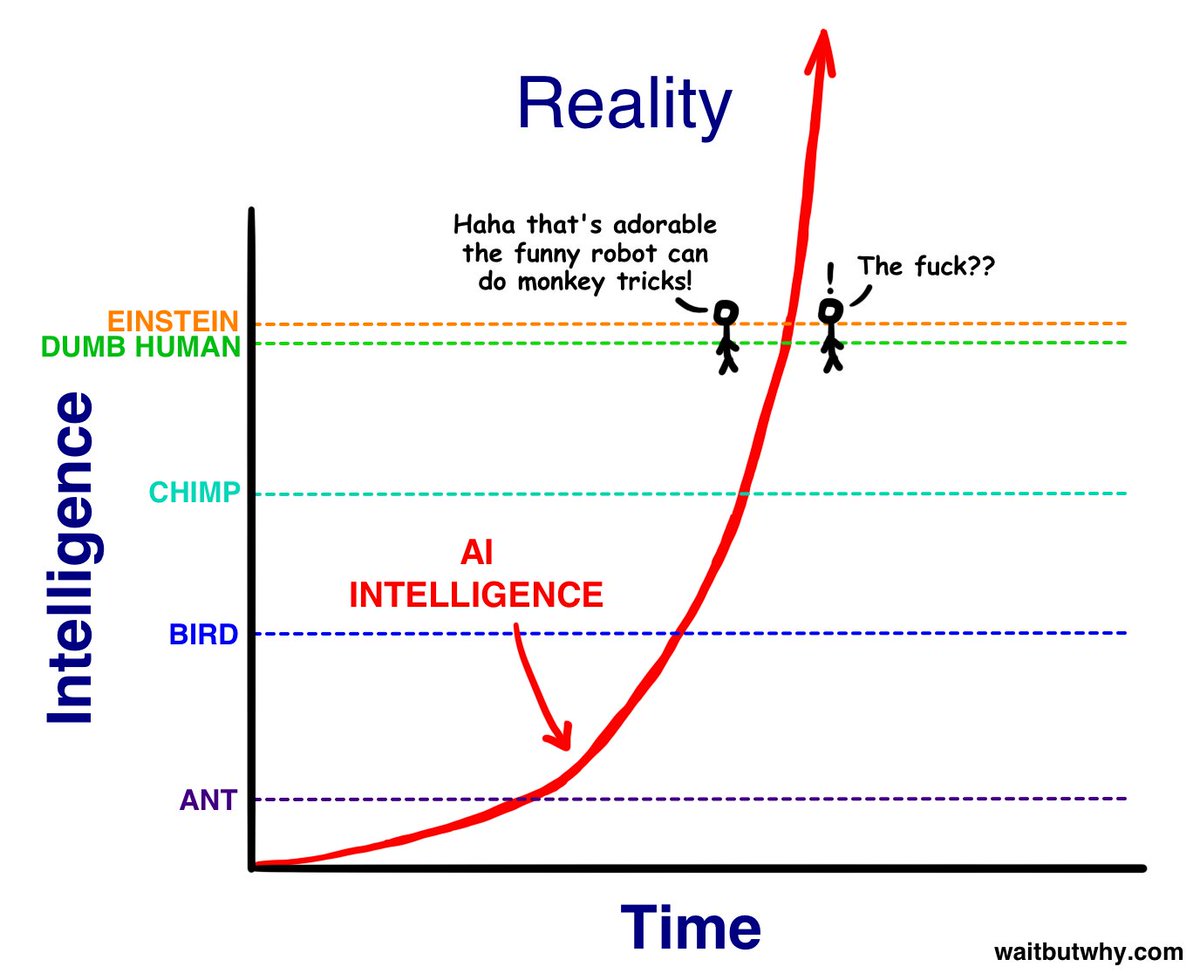
Anthropic reported a similar sudden and unusual jump in robotics capabilities with Fable 5.2. As the general intelligence of frontier models scales up, it is increasingly surpassing specialized training. This will ultimately generalize to every sphere of human ability.
Bot is fresh bc it's your everything agent. It does everything knowledge work, it does everything regular life. You don't need one tool for life and one tool for work, @bot handles all of it.
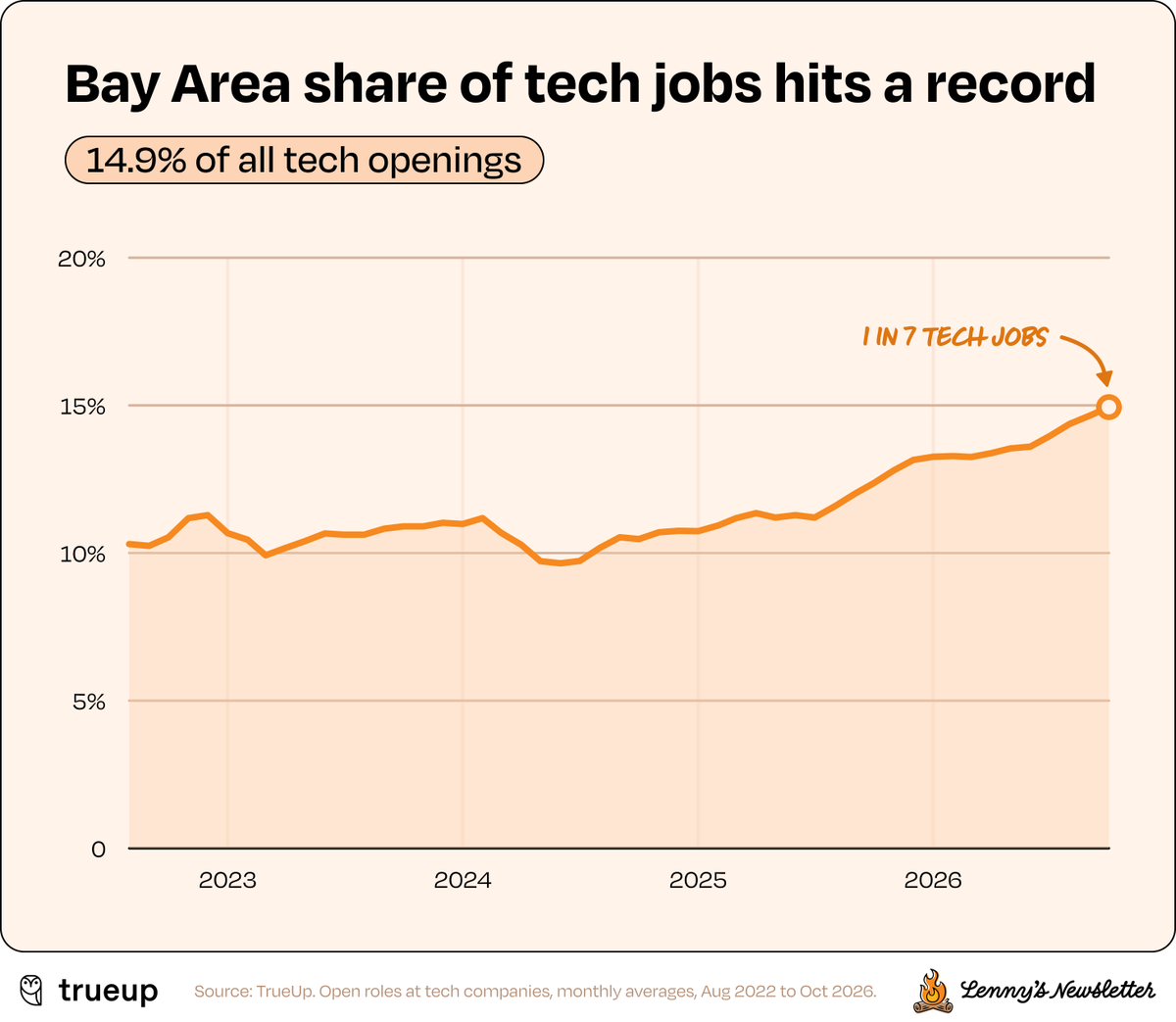
Tech jobs are concentrating in the Bay Area
15% of all open tech roles are now in the Bay Area, about one in seven and a record high.
It’s even more concentrated for product roles. One in four open PM and design roles is in the Bay Area, and one in five engineering roles. All three are at or near record highs, and each has nearly doubled its share since 2022.
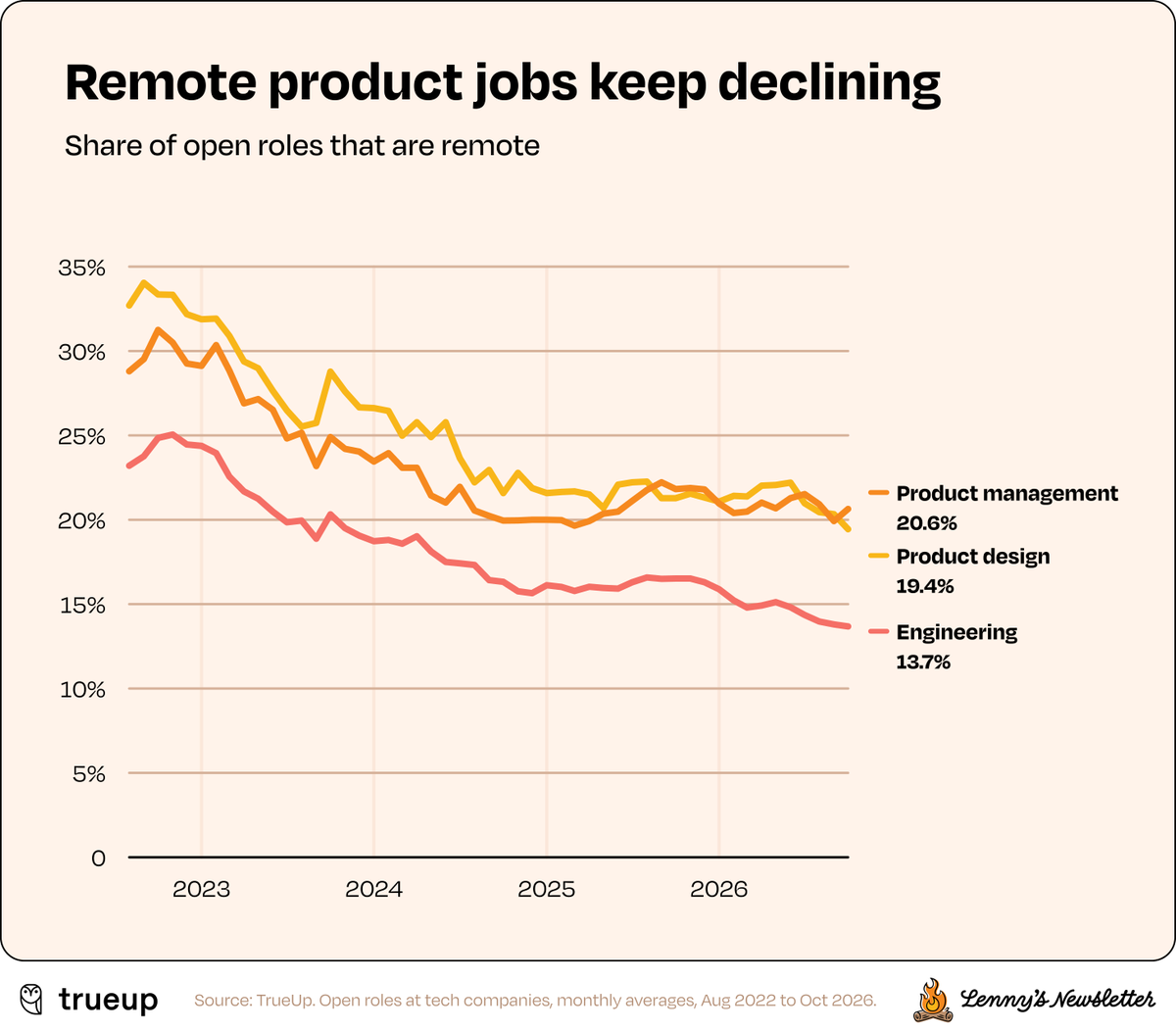
Meanwhile, remote roles keep shrinking. Just 14% of open tech roles offer a remote option, the lowest on record and down from 21% in late 2022.
Remote share by role:
• Engineering: 14%, down from 25%
• Design: 19%, down from 34%
• PM: steady at about 21% for two years, still near its low
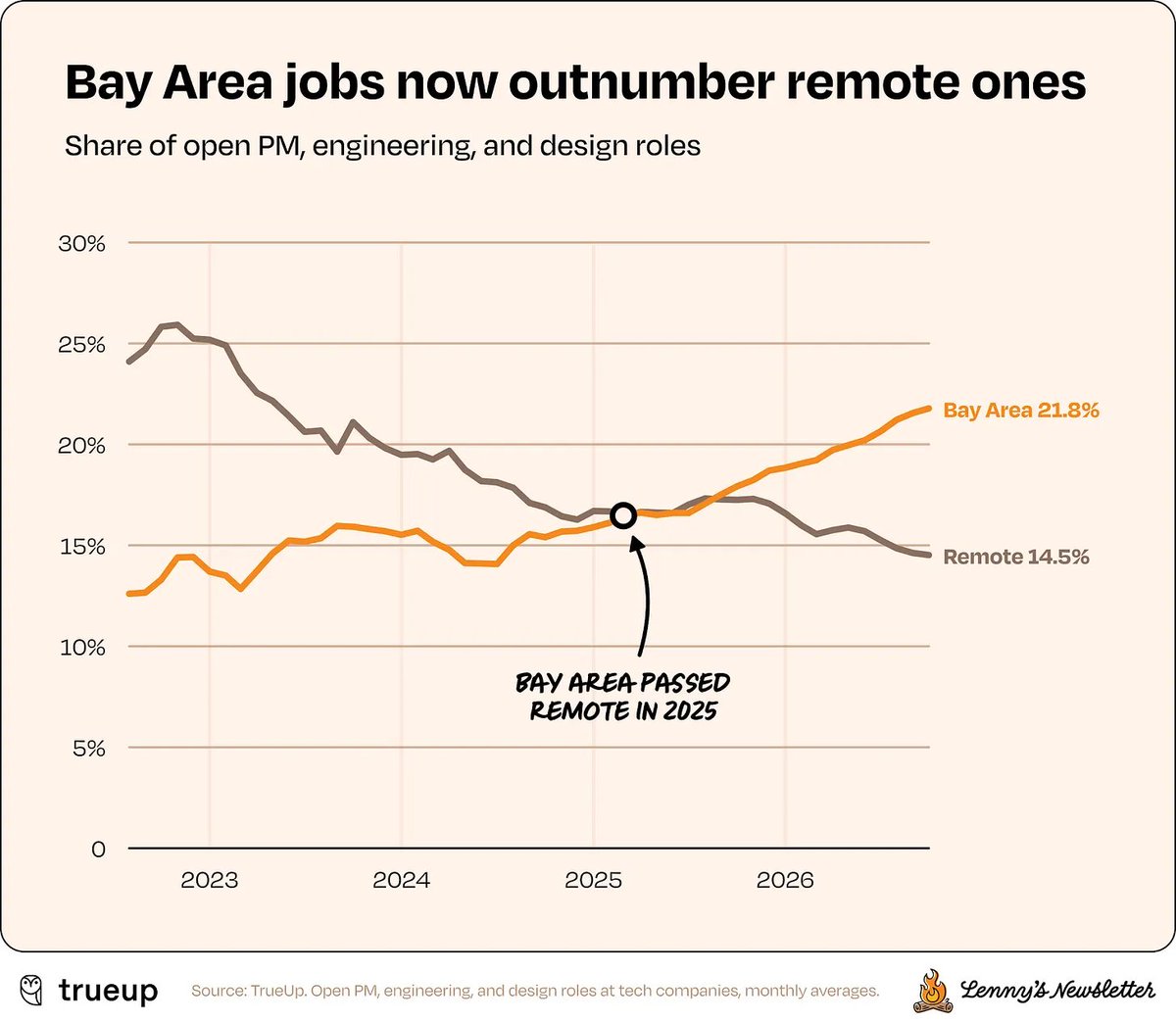
Put it all together: sometime last year, open PM, eng, and design roles in the Bay Area overtook remote roles worldwide. Three years ago, remote led almost 2 to 1.
Elon Musk’s SpaceX AI group has laid off roughly 60 employees working on Grok Imagine, leaving just a handful to maintain the product.
The cuts signal a shift toward AI coding tools and agents as Chinese companies pull ahead in video generation.
Read more details: https://t.co/Cq4rXIi284
Dario Amodei says compute is Anthropic's 'deepest business dilemma'
“Compute is the deepest business dilemma that the company faces. Because this field is growing so fast from a technological perspective, and we don’t know how that is gonna transfer to the creation of economic value on the business side, we have this huge uncertainty.”
“In 2024 and 2025, in both of those years, the company’s revenue grew by roughly 10x. And every year we look at it and we say, we don’t know what’s gonna happen next year. There’s a huge uncertainty in what’s gonna happen next year. And deepening the dilemma, every year the numbers are larger.”
“At the same time, we have to buy compute a year or two years ahead of time. If you buy too much, of course, you can financially overextend yourself. If you buy too little, then you can’t support inference for customers. And even more importantly, as Jamie is hinting at, you can’t do the R&D, which is what produces the model six or twelve months from now, which is what determines your ability to generate revenue in the future. So it’s a very difficult problem.”
Anthropic CEO Dario Amodei says the biggest reason to go public now is cash: a bigger buffer between the low-compute and high-compute worlds, so Anthropic can invest enough in biology, robotics and cyber
“I think there’s a few reasons to go public right now. I think the biggest one goes back to these compute bets.”
“There’s enormous opportunity in the world, where the economic value and the opportunities around work in biology, work in robotics, work in cybersecurity, knowledge work in general. There’s enormous opportunity, and we wanna make sure that we invest enough to achieve those opportunities.”
“And so that buffer between the low-compute world and the high-compute world: the more cash we have on hand, the more buffer we have between those two things.”
@0xce42@rxcastrohacker If you have a good codebase good verification loop opus 5.5 writes better code then me
If the code is bad most of the time this means that your codebase is bad and agents just reproduce what they see
🚨 A man who lives LESS THAN HALF A MILE from Google's data center in Clarksville, Tennessee, says noise and light pollution have NOT been an issue.
"Everybody's saying how bad they're gonna be... I haven't seen anything negative. I've only seen the positive side.”
"software factory" is everywhere rn. my take:
most engineers use AI their own way, with their own prompts and setups. a software factory is when the company sets up its AI agents (AI that does tasks on its own) once, and every team uses those same ones, with the same tools, rules, and security
ex. a bug gets flagged, one agent finds the cause, another writes the fix and opens a PR, and a person reviews it
Claude Managed Agents is one way to build this. as of today you can self-host it (private beta), so the agents and their history can run in your own cloud
Austin Mayor Kirk Watson's push to build a 3-mile light rail extension to the city's airport "comes as rail proponents are emboldened by the November election, which saw key GOP figures who had been opposed to rail plans ushered out of office."
https://t.co/TgIRouBJxQ