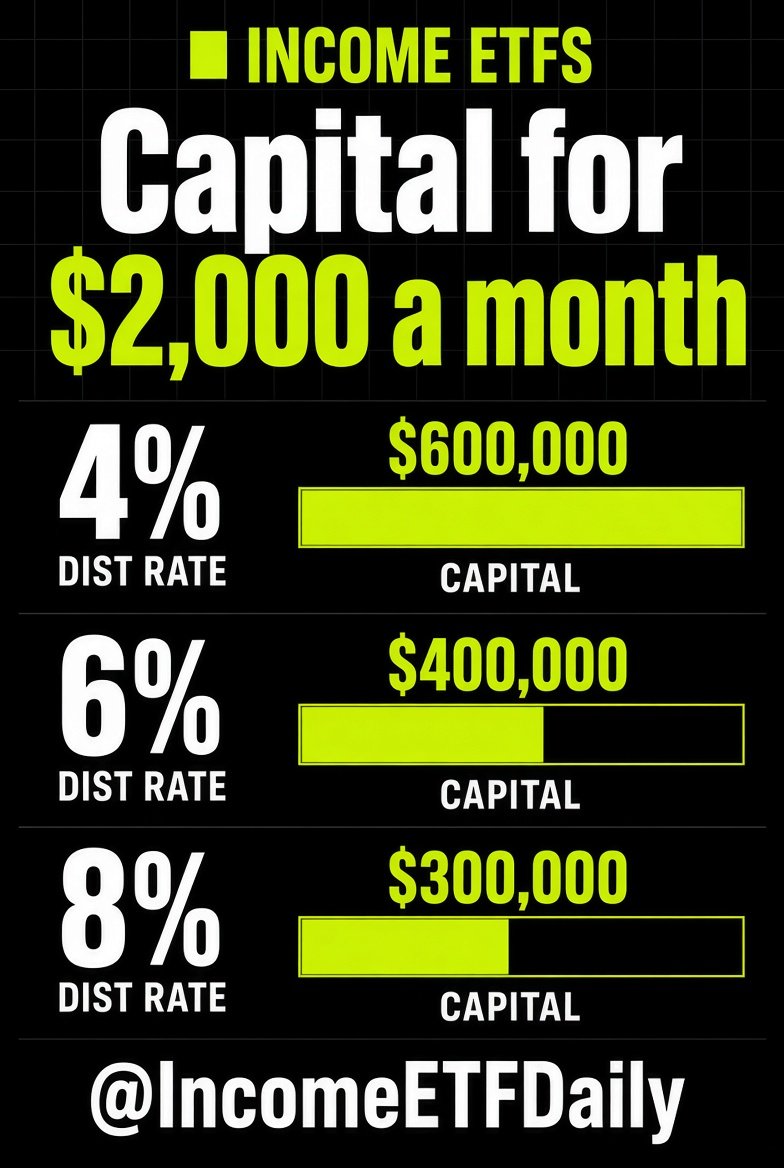
$2,000 a month.
That is $24,000 a year, pre-tax, at recent rates:
$JEPI 7.61% about $315,400
$IYRI 10.84% about $221,400
$JEPQ 10.83% about $221,600
$SPYI 12.04% about $199,300
$QQQI 14.39% about $166,800
$OMAH 15.00% about $160,000
$AIPI 34.78% about $69,000
Rates: JEPI and SPYI Sep 3 desk, IYRI Aug 31 issuer, JEPQ Jul 31 12-month rolling, QQQI Aug 31 issuer, OMAH target, AIPI Sep 1 issuer. Rounded to the nearest $100.
Dist rate is not total return. Higher rate usually means more overlay risk.
NEOS, VistaShares, and REX Shares are paid partners of WOLF Financial. This post is for informational purposes only, not investment advice. Always read the funds prospectus.
⚠️ Options income funds can cut distributions and NAV.
The issue with threatening the Fed and the bond vigilantes with trade is that... they don't care. Jobs data remains strong, which is emboldening their resolve.
However, President Trump does have a card of his own to play if he wants to impact rates: end the war with Iran.
PETER LYNCH SAYS IF YOU CANNOT EXPLAIN WHY YOU OWN A STOCK TO A 10-YEAR-OLD IN TWO MINUTES, YOU SHOULD NOT OWN IT
He said he is amazed how many people hold stocks and cannot say in a minute or less why, and that pressed hard enough, the real answer is usually that they think it is going up.
Warren Buffett's version is the circle of competence, the set of businesses you actually understand.
Buffett's rule for the edge of that circle: if you have any doubt about whether something is inside it, it isn't.
His examples of businesses anyone can understand are Coca-Cola, McDonald's, Walmart, and Costco. Understanding what a company does is separate from deciding what it is worth.
"It's better to be well within the circle than to be trying to tiptoe along the line."
🚨 CEO Buy Alert
The CEO of Vistra $VST just dropped more than a quarter of a million dollars on his own stock as price approaches the 200 week EMA.
This is the first insider purchase of shares since March 2025.
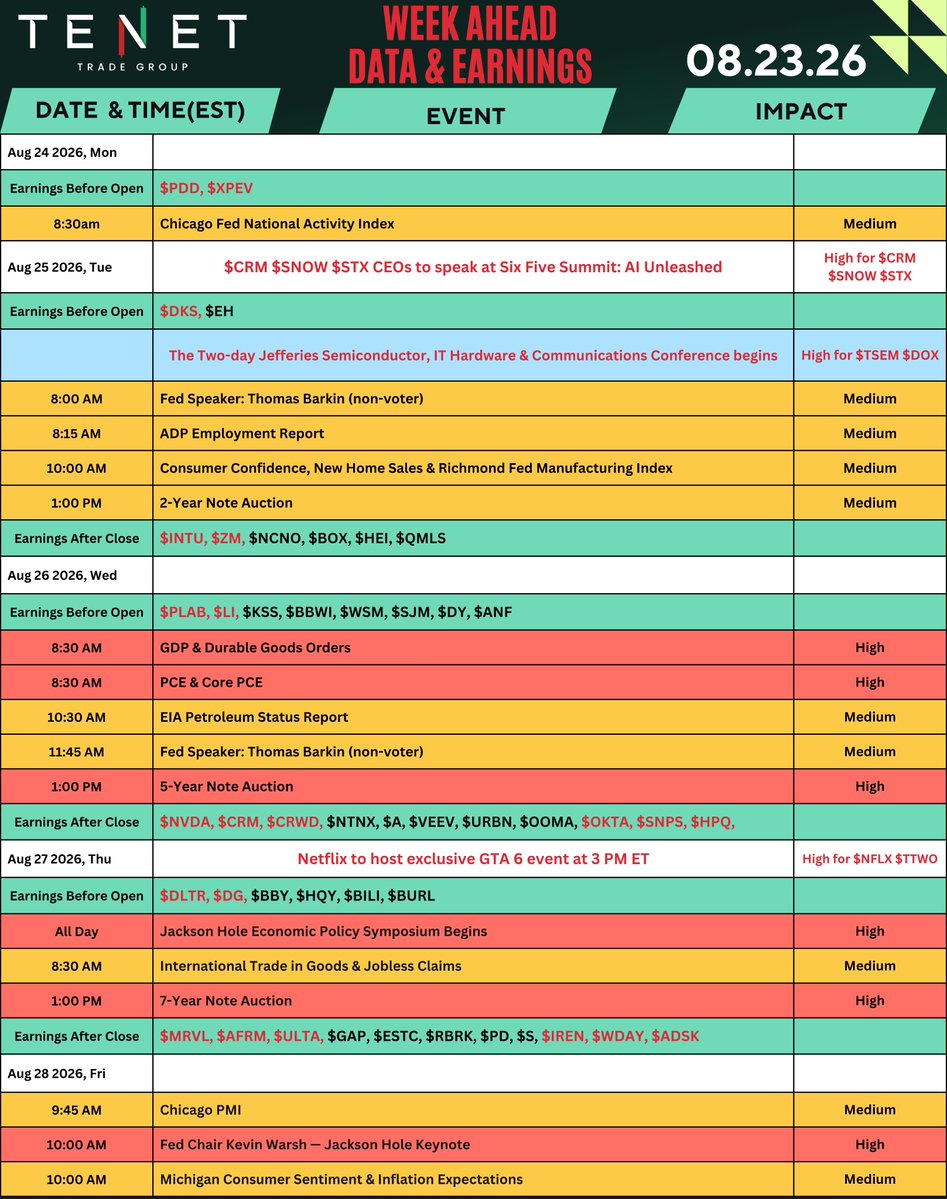
🚨 Get Ready for Another Big Week of Trading with our Weekly Calendar of Market Moving Events
-> $NVDA Earnings — The week’s biggest catalyst for AI, semiconductors and data-center demand
-> Other Major Earnings: $MRVL $CRM $CRWD $INTU $SNPS $HPQ & many more
-> Jackson Hole Symposium begins — Thursday
-> The 5Y Treasury auction in focus amid recent shift in issuance mix.
-> PCE inflation, GDP & Jobless Claims
Ready for Opportunities at @TENETTRADEGROUP
🚨 BREAKING: U.S. DRONE DOMINANCE PUSH ACCELERATES
$AVAV $KTOS $RCAT $ONDS $DPRO $UMAC $NOC $RTX
The White House hosted its first “Drone Dominance” meeting with ~40 drone companies as the Trump administration moves to rapidly expand domestic drone production.
The Pentagon says $1 BILLION is being targeted for small attack drones over two years, with 60,000 platforms expected from the next procurement round.
Defense officials also signaled more major investments in U.S. drone manufacturing and supply chains.
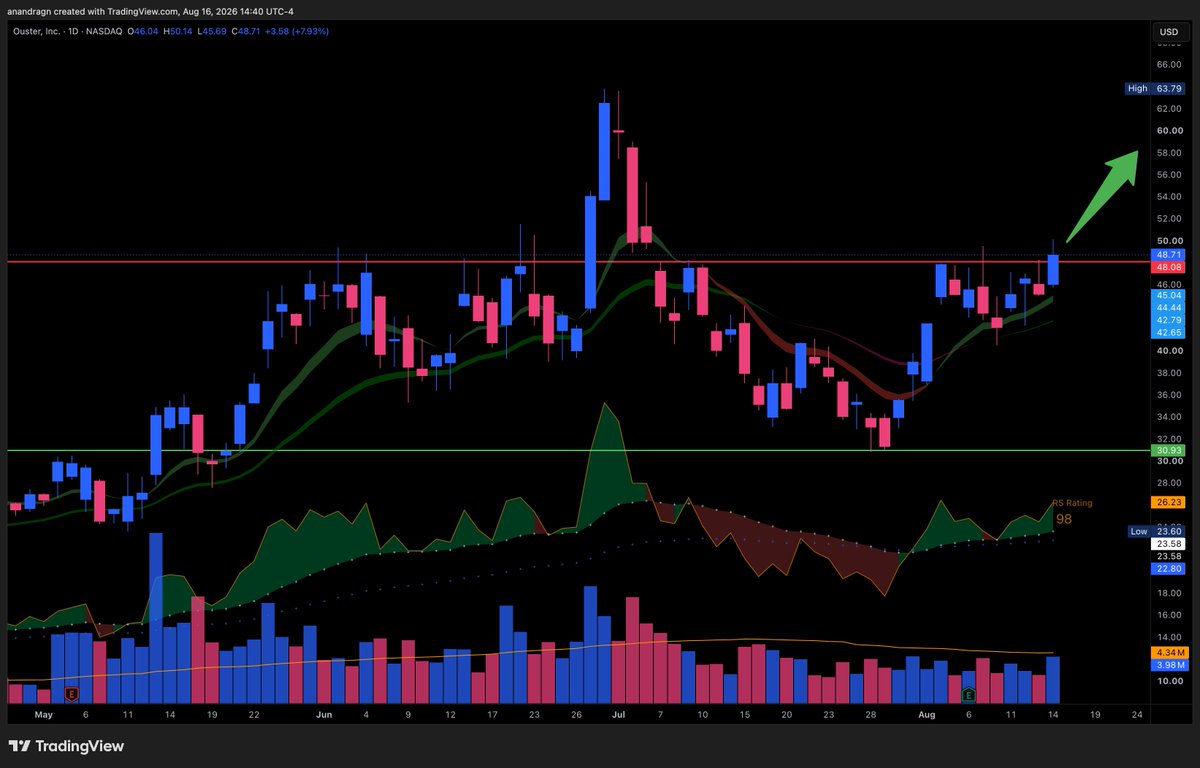
$OUST continues to strengthen the Physical AI thesis.
Robots, autonomous systems, smart infrastructure, and warehouses can’t automate what they can’t perceive.
Before machines can act, they need to “see”.
Lidar remains one of the foundational technologies enabling Physical AI.
Ouster’s Q2:
• Revenue +56% YoY to $55M
• Record 17K+ lidar & camera sensors shipped
• 49% GAAP gross margin
• $263M cash & investments, no debt
• Q3 guide implies +42% YoY growth (midpoint)
Still one of my favorite pick-and-shovel names in the Physical AI ecosystem.
By researching companies and understanding what a secular catalyst is and what a cyclical catalyst is.
Secular catalysts are long-term, multi-year fundamental changes in an industry; they are durable, unlike cyclical catalysts, which are short-term.
Everyone talking optical / photonics again
Remember round hill brought $dram
Well $LYTE just went live another round hill product it’s their photonics and optics etf.
Will watch and see if progresses like dram https://t.co/IBQ4y6Pq5G
Big earnings week ahead for the AI trade.
Jul 27 (Monday)
After Close: $CLS $AMKR $APLD $NVTS $RMBS
Jul 28 (Tuesday)
Before Open: $GLW
After Close: $BE $STX $KLAC $TER
Jul 29 (Wednesday)
Before Open: $VRT $FLEX $APH
After Close: $MSFT $META $ARM $QCOM $LRCX
Jul 30 (Thursday)
After Close: $AMZN $AAPL $RDDT $AXTI
Jul 31 (Friday)
Before Open: $CCJ
What else am I missing?
https://t.co/B92HABkPlG
Big week so check it out if bored. Goes over some of the $MAGS vs $DRAM divergence , $IGV / $SMH pair trade this year , How the indices look (YM / ES / NQ), and much more.
AI Infrastructure Boom: The Supply Chain Expands Beyond GPUs
The AI investment cycle is accelerating into full physical infrastructure — fabs, advanced packaging, automation, robotics, testing, cooling, networking, and massive power systems.
As chip demand surges, these companies are scaling to power the next wave of AI deployment.
1️⃣ Manufacturing Expansion
$TSM — TSMC ramping Arizona fabs and CoWoS advanced packaging.
$GFS — GlobalFoundries expanding capacity for AI & specialty chips.
$INTC — Intel investing heavily in U.S. fabs and packaging.
$MU — Micron scaling high-bandwidth memory production.
2️⃣ Semiconductor Equipment
$ASML — Dominant in EUV lithography for cutting-edge nodes.
$AMAT — Wafer fabrication, materials, and packaging equipment.
$LRCX — Critical etch, deposition, and wafer processing tools.
$KLAC — Inspection & process-control systems.
$ONTO — Metrology solutions for advanced packaging.
3️⃣ Advanced Packaging & Testing
$ASX — ASE Technology, global leader in assembly & packaging.
$AMKR — Amkor Technology, key packaging & test provider.
$TER — Teradyne semiconductor test + robotics.
$COHU — Test, inspection & handling equipment.
$CAMT — Inspection & metrology for advanced packaging.
4️⃣ AI Chips, Servers & Networking
$NVDA — AI GPU powerhouse expanding into robotics & physical AI.
$AMD — MI300 series accelerators and data center growth.
$AVGO — Custom AI accelerators and networking.
$SMCI — High-performance AI servers & liquid cooling.
$MRVL — Custom silicon and connectivity for AI clusters.
$ANET — High-speed Ethernet switching for AI data centers.
$ALAB — High-performance connectivity for AI servers.
5️⃣ Robotics & Factory Automation
$ABB — Industrial robots and smart manufacturing systems.
$ROK — Industrial automation hardware & software.
$FANUY — Leading industrial robotics.
$ISRG — Advanced surgical robotics.
$PATH — AI-powered enterprise automation software.
6️⃣ Power, Cooling & Infrastructure
$VRT — Critical power & liquid cooling for AI data centers.
$ETN — Electrical infrastructure & power management.
$GEV — Power generation, grid & energy solutions.
$HUBB — Electrical components for grid & data centers.
$PWR — Critical electrical transmission & infrastructure.
$NVT — Electrical protection & cooling enclosures.
$MOD — Advanced thermal management for data centers.
The AI buildout is now a true infrastructure supercycle. The biggest opportunities are shifting beyond chip designers into the companies building the factories, machines, power systems, cooling, and connectivity that make large-scale AI possible.
AI AGENTS ARE ENTERING THE STOCK MARKET
Horizon released an agent that turns plain-English ideas into backtested strategies that can run through your broker.
Early access is open to 10,000 users → https://t.co/4HpCulo6sN
📢 𝐉𝐔𝐒𝐓 𝐈𝐍: DeepSeek Reportedly Developing Custom AI Inference Chip - Reuters - $AMD $NVDA
👉 𝐊𝐞𝐲 𝐇𝐢𝐠𝐡𝐥𝐢𝐠𝐡𝐭𝐬:
➤ 𝐃𝐞𝐞𝐩𝐒𝐞𝐞𝐤 is reportedly developing its first 𝐜𝐮𝐬𝐭𝐨𝐦 𝐀𝐈 𝐢𝐧𝐟𝐞𝐫𝐞𝐧𝐜𝐞 chip.
➤ The chip aims to reduce reliance on 𝐍𝐯𝐢𝐝𝐢𝐚 and 𝐇𝐮𝐚𝐰𝐞𝐢 AI processors.
➤ Development remains at an 𝐞𝐚𝐫𝐥𝐲 𝐬𝐭𝐚𝐠𝐞, with partner discussions underway.
➤ DeepSeek has reportedly increased 𝐩𝐫𝐢𝐯𝐚𝐭𝐞 hiring of chip-design engineers.
➤ The company currently uses both 𝐍𝐯𝐢𝐝𝐢𝐚 and 𝐇𝐮𝐚𝐰𝐞𝐢 chips for AI models.
➤ DeepSeek adapted its 𝐕𝟒 model for Huawei Ascend chips in April.
➤ Reuters previously reported DeepSeek plans to raise 𝐚𝐛𝐨𝐮𝐭 $𝟕 𝐛𝐢𝐥𝐥𝐢𝐨𝐧 at a $𝟓𝟐-𝟓𝟗 𝐛𝐢𝐥𝐥𝐢𝐨𝐧 valuation.
➤ DeepSeek did not respond to Reuters' request for comment.
👉 𝐖𝐡𝐲 𝐈𝐭 𝐌𝐚𝐭𝐭𝐞𝐫𝐬:
➤ Custom chips could lower 𝐀𝐈 𝐢𝐧𝐟𝐞𝐫𝐞𝐧𝐜𝐞 costs and improve hardware control.
➤ The move intensifies China's race for 𝐝𝐨𝐦𝐞𝐬𝐭𝐢𝐜 𝐀𝐈 𝐜𝐡𝐢𝐩 leadership.
➤ Success could reduce dependence on foreign suppliers amid 𝐔.𝐒. 𝐞𝐱𝐩𝐨𝐫𝐭 restrictions.
The AI trade finally got a reset. Honestly, a lot of these names needed it.
Positioning was crowded. Sentiment got too one-sided. The boat was loaded to one side.
Some excess may have already been shaken out, and there could be more over the next few days or weeks. Nice healthy reset.
Over the last couple of weeks, leaders at Microsoft, Palantir, and Palo Alto Networks have all raised a similar issue around AI.
I shared a post a few days ago about Alex Karp torching frontier labs like OpenAI and Anthropic. Karp called token pricing a “wealth tax” on businesses.
Enterprises paying for tokens that create little value, while their data, workflow context, and alpha get transferred to a third party.
Nikesh Arora, Palo Alto Networks Chairman & CEO, also shared what he heard after 200+ meetings in Europe.
Customers are asking some tough questions:
Where is the production-level ROI?
What is the business case for embedding AI at current token prices?
Where will token prices go?
Can companies rely on one frontier model?
Are cheaper open-source models viable if secured?
Enterprises have been spending a lot on AI tokens, but the productivity gains are not always showing up clearly yet.
AI’s impact on productivity could still be profound. The issue is whether the current token-pricing model is creating enough real business value to justify the massive capex spend behind it.
Case in point: Coinbase cut its internal AI spend by nearly 50%. Yet, AI usage didn’t drop.
They moved engineering workflows toward cheaper open-weight models through an internal gateway. Usage did not have to die for the massive token bill to come down.
Microsoft, OpenAI’s biggest partner, is shifting Copilot Cowork to usage-based pricing and evaluating a hosted DeepSeek V4 as the cheaper engine underneath it.
The cost per task between frontier and open-weight models is running 60x+ in some comparisons for a much smaller capability gap.
Open-weight models drop your token bill, but they shift the burden to internal platform teams. You now have to handle your own model hosting, optimization, fine-tuning, and security guardrails. It's cheaper, but it also requires serious engineering maturity.
Here’s why that matters for the AI hardware trade specifically:
Memory, compute, networking, cooling, power all of it is a derivative of capex. And capex is a derivative of somebody upstream monetizing AI tokens at frontier prices.
Hyperscalers are expected to spend $700B+ this year on the buildout, with 2027 estimates pushing toward $1 trillion.
If the token layer commoditizes, the market could start asking some tough questions.
Does this mean the hyperscaler piggy bank will start to run dry? This could be just the market forcing the AI trade to prove ROI before the next leg higher.
This does not mean pack your bags, go home, the AI trade is dead. But it could mean the market starts separating AI usage from actual AI value.
1. More tokens doesn’t automatically mean more productivity.
2. More spend doesn’t guarantee better workflows either and all that capex still has to prove its ROI somewhere.
The AI trade could absolutely set up again from better levels with less euphoric, more sustainable positioning. That is healthy for the next leg higher.
But a key trend to watch: Next phase could be less about “Tokenmaxxing” and “Capexmaxxing”, and more about who actually captures value from that demand.
How does a multi-model world with frontier + open-weight models actually look?
Who owns the workflow?
Who controls the data?
Where is the real ROI?
Remains to be seen if the Hyperscalers keep capexmaxxing. Or is the market already starting to price this ahead like it always does? Interesting times ahead…
Goldman Sachs initiates coverage on Twilio $TWLO at 'Buy', with a $300 price-target:
"We initiate coverage of Twilio (TWLO) with a Buy rating and a 12-month price target of $300 (63% upside from current trading price).
We see Twilio as well positioned to benefit from increased developer activity as agentic builders still require communications infrastructure to reach end users (at the 2025 investor day, Twilio disclosed that 50% of the Forbes 50 AI startups were paying customers of Twilio as of 9/30/24).
This is primarily visible in Twilio’s self-service business (grew 28% YoY in 4Q25) and in Twilio’s Voice business (grew 20% YoY in 1Q26).
We believe investors will increasingly focus on 1) sustained gross profit growth acceleration and the durability of AI as a tailwind, 2) the trajectory of gross margins, & 3) how to underwrite positive risk/reward given extended valuation vs. history."