A gyroscope is probably one of the most fascinating physics toys and one of the most useful applications of conservation of angular momentum in several branches of science and technology
[📹 watervalley.2001]
https://t.co/PeLawsN2li
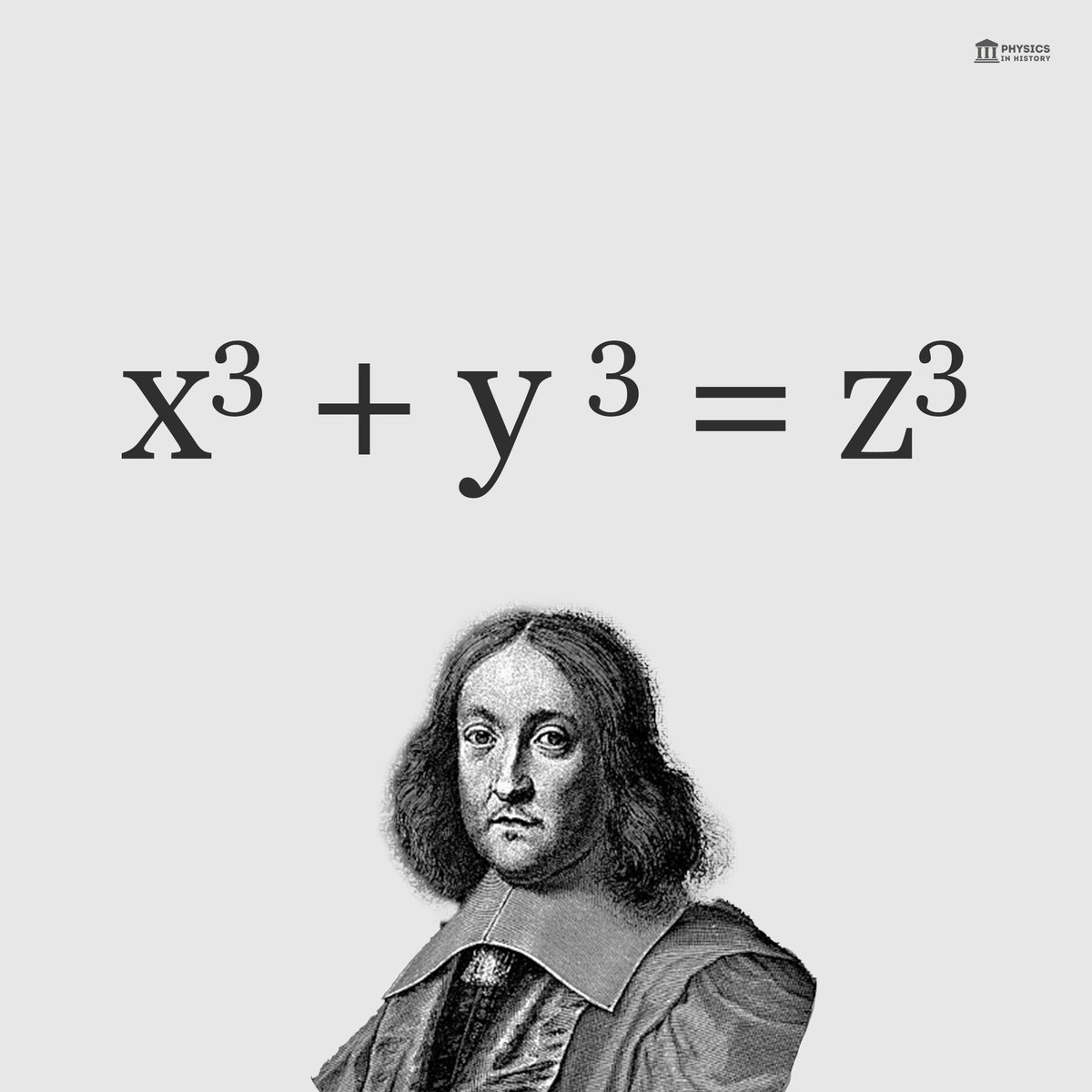
His proof was over 100 pages long and took him seven years to complete. ✍️
Fermat’s last theorem is one of the most famous and challenging problems in mathematics. It was first stated by Pierre de Fermat, a French lawyer and amateur mathematician, in the margin of a copy of Diophantus’s Arithmetica. He claimed to have a proof that was too large to fit in the margin, but he never revealed it to anyone. The theorem remained unproven for more than three centuries, despite the efforts of many mathematicians.
The first complete proof of Fermat’s last theorem was given by Andrew Wiles, a British mathematician, in 1995. He used techniques from algebraic geometry and number theory that were not available in Fermat’s time. His proof was over 100 pages long and took him seven years to complete.
Wiles’s proof was initially flawed, as he discovered a gap in his argument in 1993. He had to work with another mathematician, Richard Taylor, to fix the error and publish a revised version of his proof in 1994.
Why you never touch AM radio towers.
The invention of the AM radio tower revolutionized the way radio signals were transmitted and received, leading to a significant advancement in the field of broadcasting. The story of the AM radio tower begins in the late 19th century when scientists and inventors were exploring ways to transmit wireless signals over long distances.
During this time, Guglielmo Marconi, an Italian inventor and electrical engineer, was conducting experiments with radio waves and had successfully achieved long-distance wireless communication using simple antennas. However, the range and quality of the signals were limited, and Marconi realized the need for more efficient methods of transmission.
In 1906, a significant breakthrough occurred when Reginald Fessenden, a Canadian-born inventor, successfully transmitted the first audio program using continuous wave (CW) radio technology. This accomplishment set the stage for further advancements in radio broadcasting.
As the demand for radio broadcasting grew, engineers began to realize the need for a more powerful and efficient means of transmitting signals over greater distances. The key challenge was to overcome the limitations of the existing antenna systems and achieve higher transmission power.
Enter the invention of the AM radio tower. The concept behind the AM radio tower was to utilize tall structures to support and enhance the transmission of radio signals. The tower would act as an antenna, capable of radiating electromagnetic waves efficiently and effectively.
One of the pioneers in the development of AM radio towers was Major Edwin Armstrong, an American electrical engineer and inventor. Armstrong made significant contributions to radio technology and is often credited with inventing the modern system of amplitude modulation (AM) for radio transmission.
Armstrong recognized that by placing a radio transmitter high above the ground, the signal could be transmitted with increased power and range. He designed and constructed the first practical AM radio tower, known as the "Alexanderson Alternator," which was erected in 1908.
The Alexanderson Alternator tower was an impressive structure, consisting of a tall steel tower with multiple antennas mounted on it. The tower's height allowed for better signal propagation and reduced interference, resulting in clearer and more reliable radio broadcasts. This breakthrough laid the foundation for the future development of radio broadcasting.
Over time, advancements in tower design and engineering further improved the efficiency and range of radio transmission. Tall towers were erected in strategic locations around the world, enabling the establishment of widespread broadcasting networks.
The AM radio tower not only enabled the transmission of music, news, and entertainment to millions of listeners but also played a crucial role in shaping the development of the broadcasting industry. It paved the way for the introduction of FM radio, television broadcasting, and other wireless communication technologies that we rely on today.
In conclusion, the invention of the AM radio tower revolutionized the field of radio broadcasting by providing a more efficient and powerful means of transmitting signals over long distances. It was a key milestone in the evolution of wireless communication and laid the foundation for the modern broadcasting systems we enjoy today.
Rest in peace to the greatest player of all time, thank you Pelé for what you have done for the beautiful game, you will be forever remembered and greatly missed 🤍🕊












![Rainmaker1973's tweet photo. Exemplary representation of the Ohm's law
[read more: https://t.co/d1PqC7zfi5]
#FridayFunday https://t.co/gcly9DMx4C](https://pbs.twimg.com/media/FvXGgrnWAAAP1pW.jpg)