Dream, Discover, Design, Disrupt, Defend (in that order). Sailing, Spearfishing, Healthcare IT, DevOps Culture, Web3 and AI Enthusiast. Opinions are my own.
https://t.co/pmkDoTe9Ug
**NEW: GPT-5.5 Prompting Guide**
"GPT-5.5 works best when prompts define the outcome and leave room for the model to choose an efficient solution path. Compared with earlier models, you can often use shorter, more outcome-oriented prompts: describe what good looks like, what constraints matter, what evidence is available, and what the final answer should contain.
Avoid carrying over every instruction from an older prompt stack. Legacy prompts often over-specify the process because earlier models needed more help staying on track. With GPT-5.5, that can add noise, narrow the model’s search space, or lead to overly mechanical answers.
For more detail on GPT-5.5 behavior changes, start with the Using GPT-5.5 guide. This guide focuses on prompt changes that follow from those behavior changes.
The patterns here are starting points. Adapt them to your product surface, tools, evals, and user experience goals."
Feels like we’re in one of those shifts again.
Not just more AI models and tools, but more ways to actually use them. CLIs, agents, subagents, MCPs, rules, skills, plugins, workflows, context systems… it’s moving fast. Weeks, not years.
Same pattern shows up. A few go deep, get real results, then it stalls. Doesn’t spread. Doesn’t change how the organization actually operates.
For builders, and decisions makers on how to advance your AI initiatives, a lot boils down to writing it down, curating the agentic content and making it easy to adopt and share.
https://t.co/KMScgvrfW6
#aws #kiro #kirodotdev #netsmart #ntst
Today, we’re open-sourcing the draft specification for DESIGN.md, so it can be used across any tool or platform. We’re also adding new capabilities.
DESIGN.md lets you easily export and import your design rules from project to project. Instead of guessing intent, agents know exactly what a color is for and can even validate their choices against WCAG accessibility rules.
Watch David East break down this shared visual language in action👇. New capabilities and links in 🧵
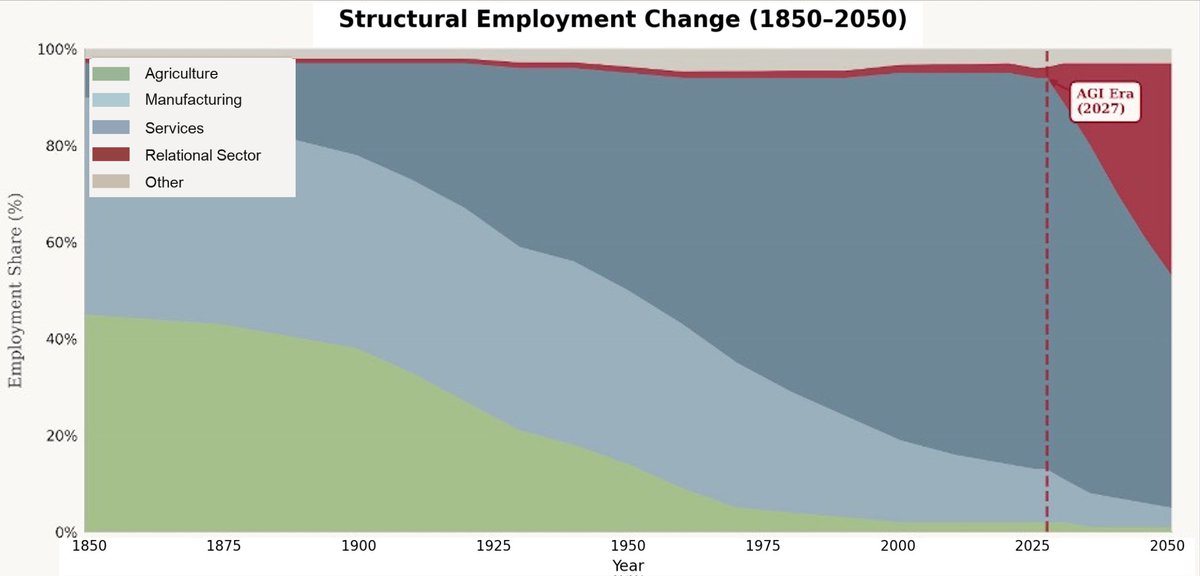
New essay on the economics of structural change and the post-commodity future of work.
1. Almost any question about the impact of advanced AI on the economy needs to start at the same place: what is still scarce? Answer that, and the analysis becomes pretty straightforward. This essay explores what becomes scarce if AI really can replicate most of what humans do in production, and what this mean for the future of jobs.
2. My conjecture, working through the economics: labor reallocates across sectors, and the sector it reallocates to has properties that keep labor a meaningful share of the economy. Ultimately this is about the structure of demand itself. For this, we have to go back to Girard, Augustine and Rousseau: once people's base needs are met, their preferences shift to comparative motives (e.g., status, exclusivity, social desirability). This motive is inherently non-satiated.
4. The key paper is Comin, Lashkari, and Mestieri (Econometrica 2021). As people get richer, they don't buy proportionally more of everything. They shift spending toward sectors with higher income elasticity. They estimate income effects account for 75%+ of observed structural change.
5. The ironic consequence: the sector that gets automated becomes a smaller share of the economy, not a larger one. Agriculture got massively more productive and its share of employment collapsed. Manufacturing too. The "stagnant" sectors absorb the spending and the jobs.
6. So the question is: which sectors have high income elasticity in a post-AGI world? I argue it's what I call the relational sector. Categories where the human isn't just an input into production, it is part of the value.
7. Why does the relational sector have high income elasticity? Because human desire has a mimetic, relational dimension. We don't just want things for their intrinsic properties. We want what others want, and we want it more when others can't have it. Girard, Rousseau, Augustine, and Hobbes all saw this.
8. In work with Kristóf Madarász, we showed this experimentally: WTP roughly doubles when a random subset of others is excluded from the good. And in new work with Graelin Mandel, AI involvement kills the premium. Human-made art gains 44% from exclusivity; AI-made art only 21%.
9. This all comes together for the core argument. The sector that absorbs spending as AI makes commodity production cheap is one where human provenance is part of the value, and demand for it grows faster than income. Exactly the profile that keeps labor meaningful.
10. To be clear about the claim: I'm NOT saying aggregate labor share must rise. It may fall. The claim is about sectoral composition, i.e., where expenditure and employment go once commodities get cheap, and the fact that the sector that will absorb reallocated labor maps to a substantial component of human preferences and desire.
11. If you're interested in the formal model, a linked companion technical note works out all the economics.
Read the essay here: https://t.co/NcjVgn2o8g
My dear front-end developers (and anyone who’s interested in the future of interfaces):
I have crawled through depths of hell to bring you, for the foreseeable years, one of the more important foundational pieces of UI engineering (if not in implementation then certainly at least in concept):
Fast, accurate and comprehensive userland text measurement algorithm in pure TypeScript, usable for laying out entire web pages without CSS, bypassing DOM measurements and reflow
New on the Anthropic Engineering Blog:
How we use a multi-agent harness to push Claude further in frontend design and long-running autonomous software engineering.
Read more: https://t.co/HWvmXk1ykn
Agreed, that will happen if the workflow design is the ticket's state moves statically into the system, drift will occur as you shared. The whole design needs to be aware of these dynamics. It must be more than a delegator and a loop with testing. This also requires teams to ensure updates are captured which can signal to the downstream systems that change has occurred. Feedback to QA of positive matches for tests and gaps in testing surface area. There are likely stages organizations will go through as trust and reliability are built with the system, just because the ticket is dev complete and passing tests may not mean it's PR is merge ready. It's exciting as much of this new evolution requires the organization to inspect and codify these processes, much like the introduction of IaC required organizations to codify infrastructure and create repeatable orchestration.
If you are vibe coding and not placing more time on requirements, testing frameworks which allow for agentic contribution and fast integration loops to support full AI-driven SDLC.
You are missing where the puck is moving.
If you aren’t thinking about how to automate market research and competitor analysis to drive requirements to feed a machine.
You are missing where the puck is moving.
If you haven’t realized the moment you got an agentic development tool in your hands, you became an engineering manager.
You are missing where the puck is moving.
It’s not better power tools for you.
It’s about AI-driven software factories.
Stop chasing tool features and models.
Start chasing how you scale iteration with assertions, learning, harnesses and market signals.
Compliance and regulatory hurdles, that cost of entry, can only buy you time.
Your imagination, life experience, curiosity, and tenacity.
That is your edge.
Godspeed
100% Agree with this statement, changing institutions ironically setup for long term stability is rife with red tape, politics and law. The long-term institutions have yielded results lacking improvement or the domain has outgrown their ability to adapt. For education, it's an interesting challenge as it's a local tax issue in many cases, much riding on resident's property taxes to fund rather than a portion allocated based on criteria from Federal and State taxes. I sometimes think about a world where we shifted away from income taxes and into a VAT system, and would that optimize the tax capture in a way that was fair, and regardless of residency status, would help manage the gaps.
4/4
Bottom line: If you are LLM curious and have something you'd share publicly anyway, the coding plan is a good value, else err on the safe side and give GLM-5 a try on Windsurf. You'll be pleasantly surprised by the quality, agentic chops, and cost. Chinese models are closing the gap on value, but the trust and performance goes to OpenAI and Anthropic, or other trusted parties like Cognition's Windsurf.
Final thought: given the high capabilities of models out of China and the USA, the differentiators are going to be the harness and the context layer. We need to be thinking about what will power the next generation SDLC versus just a better tool for the individual, both are important and will have different decisions for function/performance/value.
@windsurf@Zai_org
1/4
Don't Y.A.A.W.N. yet, this weekend I explored Chinese frontier models via Windsurf + OpenRouter/OpenCode/ClaudeCode: MiniMax 2.5, Xiaomi mimo-v2-flash, and https://t.co/OrCCehdfxJ’s GLM-5 (after months using GLM-4.5 Air for little things). Although I typically prefer OpenAI/Codex/Windsurf, this was the first time spending extended time with them for a focused goal.
GLM-5 is Claude Opus-level impressive: strong reasoning, excellent tool use, ran extended on long horizon tasks. My best experience has been with Windsurf's Cascade and GLM-5, or Claude Code using their Anthropic compatible api endpoint.
@windsurf@OpenRouter@Zai_org@opencode
3/4
That said, Windsurf offers GLM-5 on paid plans, they are security-conscious, so likely solid B2B-grade protections exist. I stuck to safe projects via OpenCode/Z.ai, and results were strong. Slight step down from Opus 4.5 overall (maybe harness?) , but high value. OpenCode hung periodically, Windsurf's Cascade had a smoother integration), but GLM-5 still punches way above weight for the price and speed.
MCP Integration for Agentic CRUD operations against the work queues.
The challenge of making general intelligence vs. specific intelligence is real and apparent in current SOTA models. For as great as GPT-5.4 is with coding tasks, which I am a fan of thank you @openai. The results on a basic question about going to carwash I didn't believe, but I tested my 6 year old, GPT-5.4 vs. Grok 4. Grok and the 6 year old passed on first prompt. Courtesy to @natebjones for this prompt.