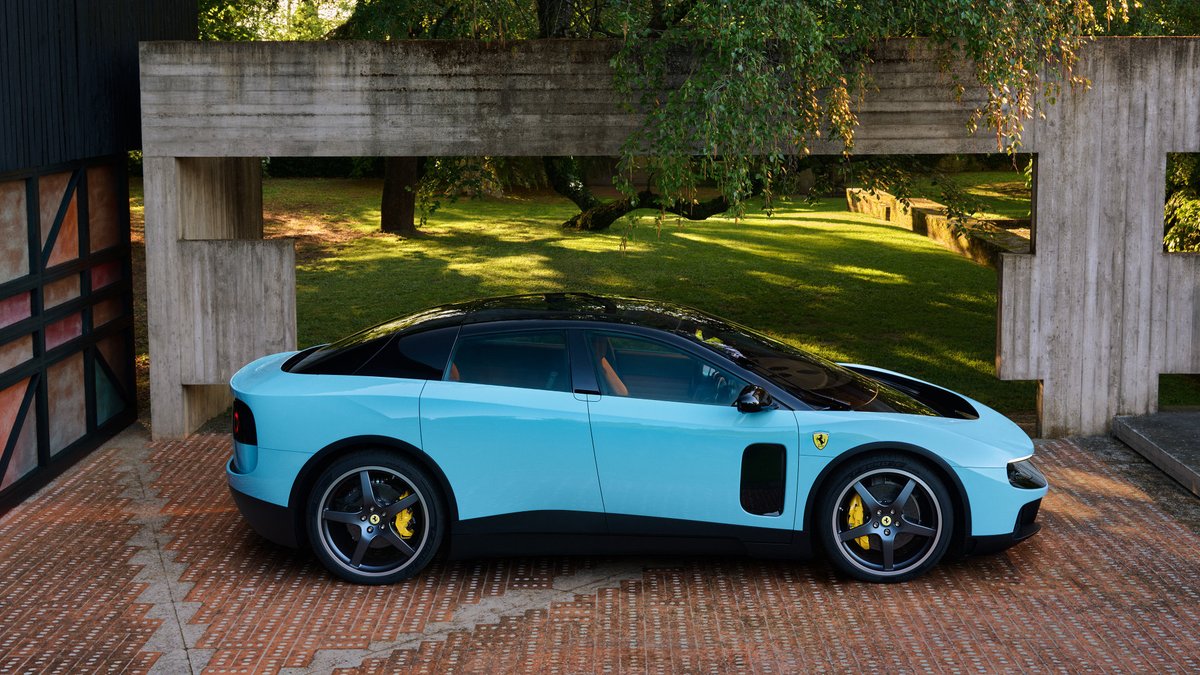
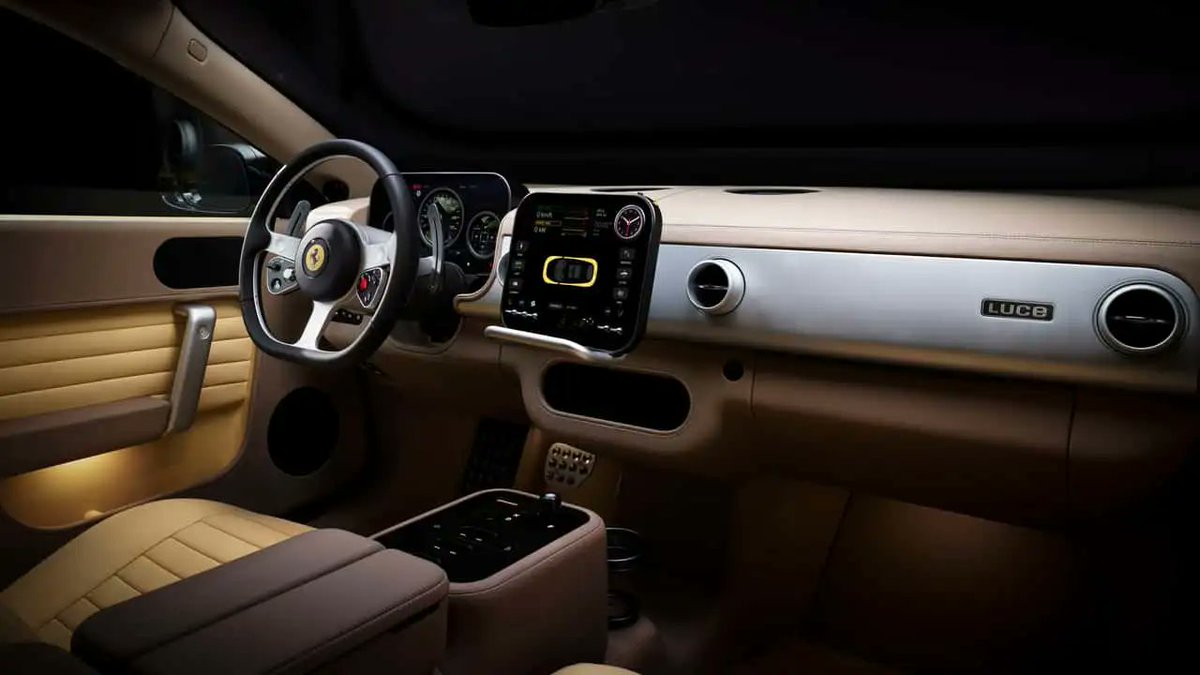
Ferrari has just officially unveiled its first ever all-electric car, called the Ferrari Luce.
• Starting price: $640,000
• Interior co-designed with Apple's former head of design, Jony Ive
• Range: 280 miles (expected EPA)
• Peak charging speed: 350kW
• 122 kWh battery
• 1,050 horsepower
• 0-60mph: 2.4s
• 800v
• Four-door four-seater
• Four electric motors
• OLED screens
• Weight: 4,982 lbs
• Front motors spin to 30,000 rpm, rears hit 25,500 rpm
• Car uses an accelerometer to capture real vibrations from the electric motors & rear chassis. An algorithm filters out unpleasant frequencies and amplifies only the more “musical” sounds. This can be heard inside and outside the car.
• Paddle shifter on steering wheel changes how aggressively torque is delivered, with five different levels
• The trunk has 21.1 cubic feet of space, the largest luggage capacity the company has ever offered
• 197.6 inches long, about as long as a Tesla Model S
U.S. deliveries start in Q2 2027. More photos in the thread below:
The CEO of Take-Two, the company behind GTA, just said something the entire AI industry doesn't want to hear.
And he said it without being anti-AI.
Strauss Zelnick's argument is precise. AI is built on datasets. Datasets are backward-looking. Creativity is forward-looking. A model trained on everything that already exists cannot, by definition, produce something genuinely unexpected. And all hits, by their very nature, are unexpected.
Asset creation and hit creation are not the same thing. AI is getting very good at the first one. The second one is what actually makes money, builds franchises, and changes culture. Nobody has shown AI can do that yet.
The derivative property problem is real. You can clone GTA with existing technology. You could do it before AI. It would take 3 years and look identical. It still wouldn't sell. Because it isn't GTA. It's a clone of GTA.
And consumers, despite what the industry occasionally pretends, can feel the difference between something genuinely new and something assembled from the residue of things that already worked.
Thousands of mobile games ship every year. 0 to 5 hits get made. The same studios make them every time. The technology to make more games has been commoditized for years. It didn't democratize hit creation. It just flooded the market with more forgettable product.
The Silicon Valley thesis that AI unlocks game creation for everyone is true in the same way that cheap cameras unlocked filmmaking for everyone. They did. And the same 5 studios still make the movies everyone watches.
What Zelnick is saying, without quite saying it, is that the thing AI cannot replicate is taste. The instinct for what hasn't been done yet. The cultural antenna that detects the gap in the market before the data can see it.
Data tells you what people wanted. Hits tell people what they want next.
Those are different jobs.
Whether or not Europe stands with us, whether or not your journalists do their jobs, whether or not your politicians demonstrate the courage to act, I will fight for my people and my country.
Jordan Peterson perfectly describes how Tucker Carlson’s weaponization of Christianity for political purposes is the very definition of 'taking the Lord’s name in vain.'
EXACTLY what Tucker Carlson is doing now.
🐣 This Easter, Jesus has a message.
Meet MetaSouls: something I’ve been building over the past few months realtime AI characters with voice, emotion, and presence.
This first reveal is from the upcoming PC version.
A lighter mobile version is coming first.