I'm extremely optimistic about the future of education in the "AI era" (whatever that is), but one worrying trend I don't know how to address is that students are talking to *each other* less frequently. Study groups used to be a forcing function for that, but study groups seem to be an unfortunate casualty of our current processes.
@kn_owled_ge Relatedly, my course's TA office hours attendance is down 80-90%.
Students who "just" want to get the HW done have the LLM do it. Students who want in-depth tutoring also have the LLM do it.
On exams, I've had more perfect scores *and* more failing grades than ever before.
@ShriramKMurthi@ArjunGuha Are your house rules / lab manual public? I'm curious -- I'm working on one for my group but I don't feel like I have anything coherent yet.
@nomad421 Here's an example of the "almost": a LL chained hashmap is one of the most efficient concurrent multi-map implementations! You can insert a new node into a bucket's chain with a single atomic swap. This is useful for hash joins in database systems. https://t.co/uzdNFKcXFQ
@BenSManning@metrics52 Having fun is a (big!) competitive advantage. Those who succeed are likely to have several competitive advantages. So there's an "over-representation" of fun-having at the top.
Of course, not everyone at the top has fun, and not everyone who has fun makes it to the top...
We conclude with a discussion about how database researchers should use industrial traces, and how we might begin to build systems that optimize for "the query the user never sends."
📄Paper: https://t.co/5LbhzV7Pxz
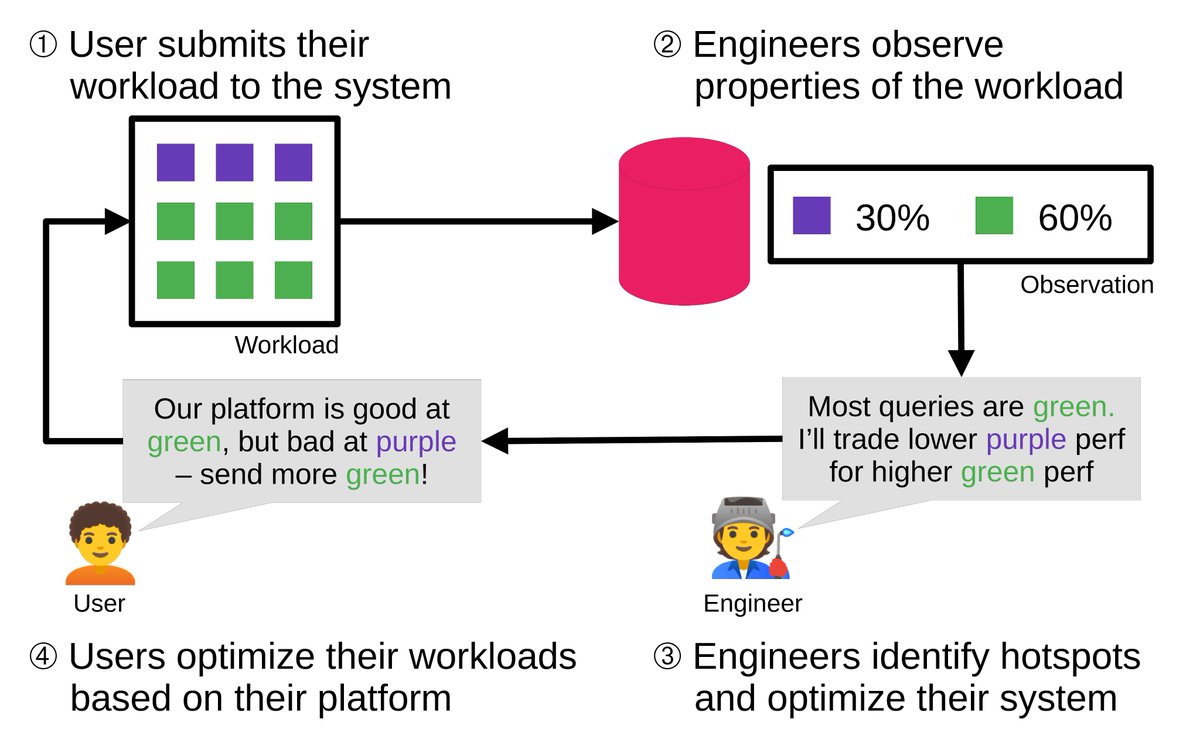
Most database teams optimize what they see in workload logs. But those very optimizations change what users choose to run!
In our CIDR paper, we argue that industrial workloads exhibit 𝐬𝐮𝐫𝐯𝐢𝐯𝐨𝐫𝐬𝐡𝐢𝐩 𝐛𝐢𝐚𝐬: logs reflect a negotiation between users and the platform.
For researchers, databases traces are a MAJOR upgrade compared to synthetic benchmarks (or simply making something up, which is shockingly common). We argue we need more of these workload traces to build a complete picture, and, perhaps more importantly, see what is missing.
For that one query that must go 𝑟𝑒𝑎𝑙𝑙𝑦 𝑓𝑎𝑠𝑡, BayesQO (by Jeff Tao) finds superoptimized plans using Bayesian optimization in a learned plan space. It’s costly, but the results can train an LLM to speed things up next time.
📄https://t.co/ZaHFBd6d7I
OLAP workloads are dominated by repetitive queries -- how can we optimize them?
A promising direction is to do 𝗼𝗳𝗳𝗹𝗶𝗻𝗲 query optimization, allowing for a much more thorough plan search.
Two new SIGMOD papers! 🧵
LimeQO (by @yi_zixuan), a 𝑤𝑜𝑟𝑘𝑙𝑜𝑎𝑑-𝑙𝑒𝑣𝑒𝑙 approach to query optimization, can use neural networks or simple linear methods to find good query hints significantly faster than a random or brute force search.
📄https://t.co/WncZWqOCGe
@DPearsonPHL@coryfromphilly Yeah, college-aged folks in college-adjacent stations wearing college-branded clothing seems like good evidence to make this inference.
I'll report back if/when I get a response from the higher-ups.
@DPearsonPHL@coryfromphilly Is there really a disproportionate trend of Penn students evading the fare? Not saying there isn't, I'm uneducated here.
If so, I'll raise the issue with the university. I imagine I'll at least get a response. Fare evasion is clearly against the student code of conduct.
@alpha_convert Use RDTSCP, with an extra mfence if you want to ensure writes are flushed. This also solves the problem of different NUMA regions having different clocks.
I'm not sure anyone uses RDTSC for timing on modern CPUs, but admittedly I haven't looked into it in a while.
@justinjaffray I think the main reason it's called "JIT" is because it uses the LLVM/GCC APIs that are used for implementing JITs. Obviously if I use a screwdriver to hammer in a nail, that doesn't make the nail a screw, but calling it a "screwed in nail" isn't too far from the truth :D
@fluxtheorist@fizziksBoris@atheorist Oral exams, formal or informal, are a staple of any PhD program and, in my experience, work very well. But I don't know how to scale it up to a class of 300-400.