Co-Founder & CCO @ Podean, Amazon's largest independent marketplace agency. The numbers behind Amazon, Walmart and AI shopping. Podcast: Digital Shelf Life.
Mark Leonard built the most successful roll-up in history, and almost nobody can name a single company he bought.
Constellation Software owns more than 1,600 software businesses, acquired since 1995. Most deals are under $5M. Almost none are announced with a price. Only about 5% of its deals ever get one.
The stock IPO'd in Toronto in 2006 at C$17 a share. It closed Friday at C$3,096 and has never split. One dollar at the IPO, holding the shares spun out along the way, became roughly C$213.
Revenue was US$11.6B last year, built almost entirely by buying other companies, with essentially no new shares issued since the IPO. The share count today is the share count from 2006.
The buying rules never change. A database of roughly 40,000 target companies. Hurdle rates that historically started at 30% for small deals. Prices around 1 to 1.7x revenue while the private software market pays 3.4x.
Then comes the part nobody copies. After the deal closes, Constellation does almost nothing.
No integration. No rebrand. No synergy plan. The company keeps its name, its team, its office and its P&L. The founder usually stays and keeps running it. More than 80% of business leaders across its largest buying group were in place at acquisition or promoted from inside.
Head office is a few dozen people. It allocates capital, teaches capital allocation, and scores every unit on two numbers: return on invested capital and organic growth. Units that prove they can allocate get their own acquisition budgets and start buying tuck-ins themselves. With 1,100-plus similar businesses inside, any unit can be benchmarked against hundreds of peers. A standalone founder has a sample of one.
And nothing is ever sold. One business in 30 years. Sellers accept a lower price from Constellation partly because they know the company will not be flipped to a private equity firm in five years.
Leonard stepped down as president last year for health reasons. The stock then fell 56% as the AI panic hit software valuations. Under his successor Mark Miller, who sold Constellation its first acquisition back in 1995, deployment hit a record US$1.99B in the first nine months of 2026. The newest wrinkle is minority stakes in listed companies, about 25% of Poland's Asseco and roughly 13% of Sabre, a strategy Leonard now advises on himself.
Constellation bought the bottom of a thousand small markets with its own cash flow, then left them alone. Which model survives the AI repricing of software?
A year of US Amazon ads job posts, grouped by George Reid: 1 to 2 years of experience sits at a $92.5k median, 3 to 4 years at $105k. That is a small gap for two extra years in a field this specialized. It tells me raw experience is not what the market is short of. Judgment on big portfolios is, and that part never shows up in a years filter.
A 2-year Amazon ads manager vs a 6-year one.
What's the gap in US pay? Guess before you scroll.
We took a year of US Amazon ads job posts and grouped the median pay by the years of experience each post asked for.
↳ 1 to 2 years: $92.5k
↳ 3 to 4 years: $105k
↳ 5 years: $117.5k
↳ 6+ years: $145k
So roughly $10k for every year you ask for.
Except the last step. Going from 5 years to 6+ adds $27.5k on its own.
That makes the years line the most expensive line in your job ad.
If the work needs someone who has already run a few Q4s alone, ask for 6.
If it doesn't, writing "5 years" skips the biggest jump on the ladder.
Eight minutes for Muse to check three brands. Twenty minutes for Instinct to check three retailers. Juozas is right, it needs to be instant for commerce to work. A person checks three prices in about a minute and gets bored doing it. An agent that takes twenty minutes is not a shortcut, it is homework with extra steps. Speed is the feature this whole category is missing right now.
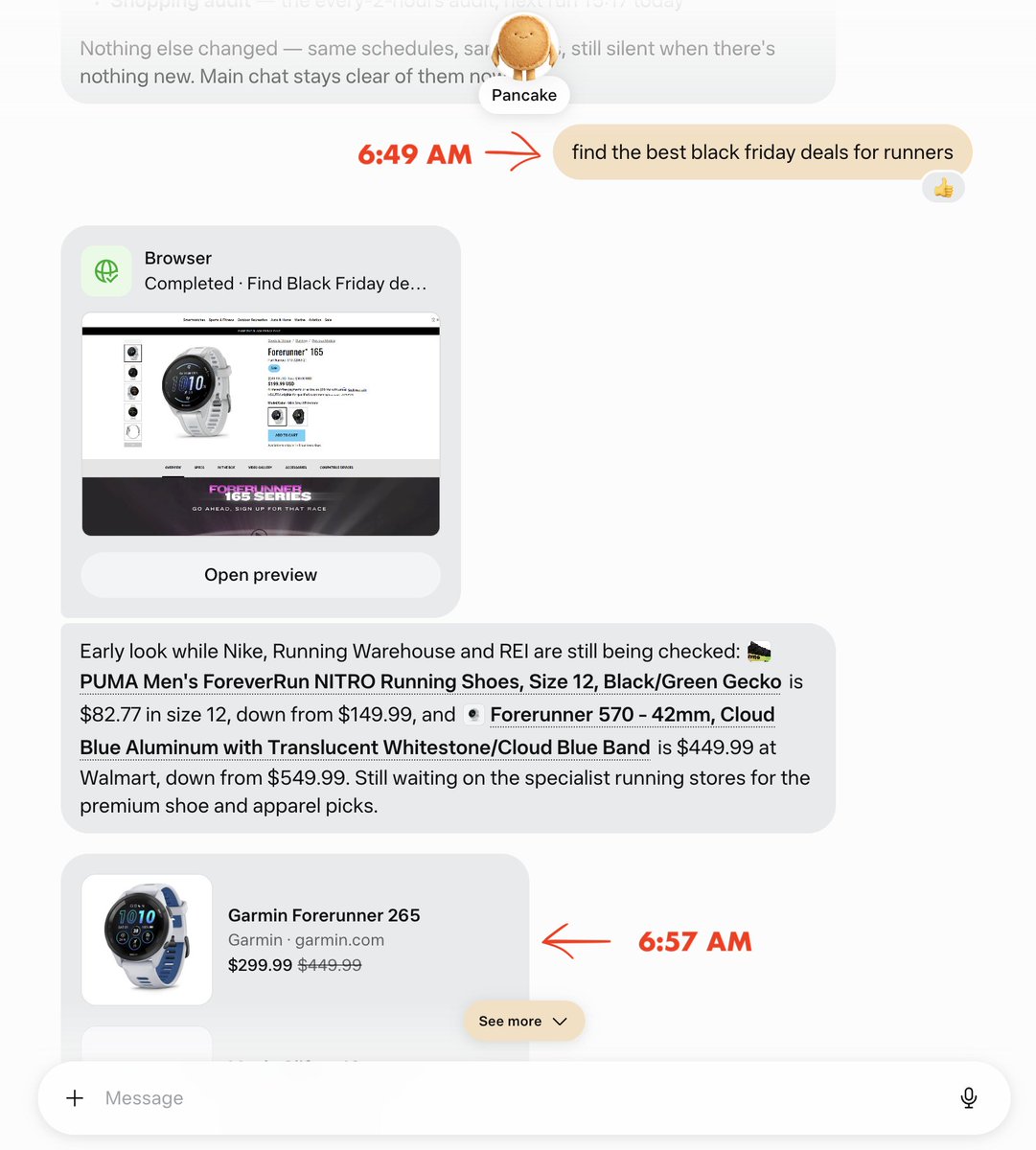
Muse took 8 minutes to check for black friday deals. Yet it only browsed Garmin, Hoka and Puma; browser use is just that slow. Instinct took 20 min to check just 3 retailers, checking to confirm price, my size and the discount code. It needs to be instant for commerce to work.
The split you are describing is how I see it too. Bid changes are cheap and fast, that is the easy part to hand over. The expensive mistakes I see are diagnostic. Sales drop on a Tuesday and the tool raises bids into a stock problem, or a price change nobody told it about. Spot the leak with AI, sure. A person still has to say what caused it.
81 out of 26,784 is a wild number. It also explains a lot of hiring pain. Brands write briefs asking for DSP, AMC, multi marketplace and portfolio scale in one person, then wonder why the search takes six months. That person mostly does not exist. You hire for two of the five and train the rest, or you split the brief.
On by default is doing a lot of work in that list. Most store owners will find out their products can be bought inside ChatGPT from a customer or a screenshot, not from their own admin. If you run a Shopify store, the Agentic Storefronts settings page takes two minutes to check. Do it before Black Friday traffic, not after.
The missing base is the whole story with that 3.3x number. Three times a small number is still a small number, and Shopify has no reason to publish the base while the growth rate sounds this good. What I want to see is share of total orders, even a rough one. Until then I treat ChatGPT checkout as real but small, and I plan for it that way.
I go back and forth on this one. The Walmart approach works because Walmart built the door and holds the keys. A brand letting an agent into a customer account is a different trust question, and most brands do not have Walmart's reasons to say yes. My guess is the long tail ends up on shared standards or stays closed, and closed is a real option a lot of them will take.
The DOM parsing point is the one people skip. An agent reading a page the way a person does is slow, and it breaks every time a layout changes. Structured actions fix that, but only for the sites that build them. The long tail will not, so agents still need to handle the messy web too. Speed on the big catalogs, patience everywhere else.
So what? Churn is the number the streamers are fighting, and ad tiers make the money back. Once ad revenue per viewer scales alongside the monthly fee, a discounted subscriber on an ad plan is often worth more than someone who cancels at full price. $AAPL WBD PSKY NFLX
Apple TV, Paramount+ and HBO Max are all running Black Friday streaming deals at 40% to 60% off. HOWEVER, the promo price is not where the streamers make their money. Three rules before taking the discount, then what they are buying with it.
Second, price in the renewal on day one. The real cost is the snap back to full price at renewal, often with no reminder before the card is billed. If you take the promo, set a calendar alert for the day before it renews when you sign up.
Zoom reports earnings this week with revenue growing just 4% to 5% a year. HOWEVER...its Anthropic stake is now worth close to $5B at the IPO price, about 20% of Zoom's entire market cap. $ZM
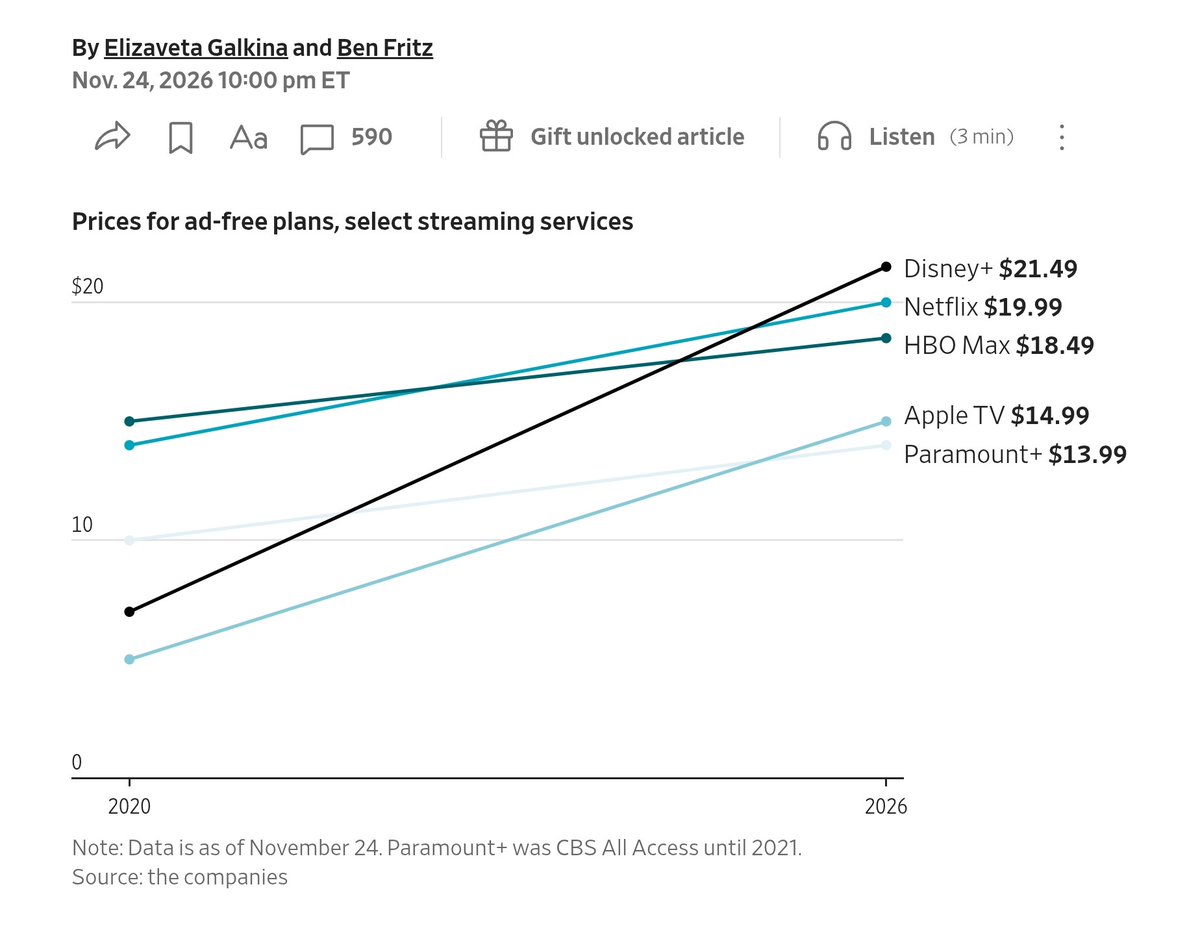
WSJ reports Disney+ ad-free went from $6.99 in 2020 to $21.49 now, and Apple TV from $4.99 to $14.99.
HOWEVER...Black Friday has Apple TV, Paramount+ & HBO Max at 50-79% off for new subs...Paying full price monthly is getting hard to justify. $DIS AAPL NFLX WBD
What’s stunning, in hindsight, is how much Intuit paid. When it bought the firm, Intuit said Mailchimp’s revenue in 2020 was $800 million, growing 20% annually. That was a multiple of 15 times trailing revenue, whereas Bending Spoons is paying 2.9 times. (Bending Spoons said Mailchimp’s revenue in the year through October was $1.27 billion.) Mailchimp is not what it once was. But we can understand why Wall Street likes a buyer that is a little more price-savvy than most.
Nobody you know has heard of Bending Spoons. As of today it owns Mailchimp, AOL, Vimeo, Miro, Airtable, Evernote, WeTransfer, Eventbrite and Meetup.
The buy today was Mailchimp at $3.68B. Intuit paid $12B for it in 2021. Same pattern as the rest. AOL went to Verizon for $4.4B, then to Bending Spoons for $1.45B. Miro was valued at $17.5B in 2022 and sold for $1.36B. Airtable, $11.7B down to $1.29B.
The playbook after each deal is the same too. Cut headcount, raise prices, and run the product for cash on the users who never leave. The portfolio now reaches 500M+ monthly users, the company IPO'd in July, and Berkshire Hathaway owns a piece of it.
So here is the bet. Can a company nobody has heard of actually pull off owning half the internet's most used brands?
Apple's services growth slowed from 12% to 10% as Google search ad growth cooled to 17% Google paid Apple fastest of Safari search ad revenue per monetizing testimony, so AI Mode monetizing lower than traditional search hits Apple too. Source: The Information $AAPL GOOGL
Walmart now works inside Meta Muse with a simple setup: connect the account, pick card and address, set an approval cap ($0, $50, $100 or custom). Walmart's own Sparky even answers inside Meta's agent, no Walmart+ needed $META WMT
Installs growing 0.8 percent while the top 10 gainers take 45 percent of the gains is a market that stopped expanding and started consolidating. In a flat market every install you win is one somebody else lost, which changes the product math. Retention beats acquisition when the pie is not growing.
Payments disabled during BFCM week with tens of thousands on hold is the nightmare version of platform risk. Same day fulfillment, clean account, no subscriptions, and the store is dark for the biggest week of the year. Every brand should read this as a reminder to keep a second way to take money warm, even if it never gets used.
Meet at the gate with a toll charged is the right description of where this landed. No scraping, connector handshake, meter running. Google doing the same across Gmail and Drive tells you it is not a Walmart quirk, it is the industry pattern. Agents get in through the front door, and the front door has a cashier.