We couldn’t make it to IMAX but the family brought Interstellar to me for my 27th birthday. I’m so thankful for all of these people that are worth saving the world for.
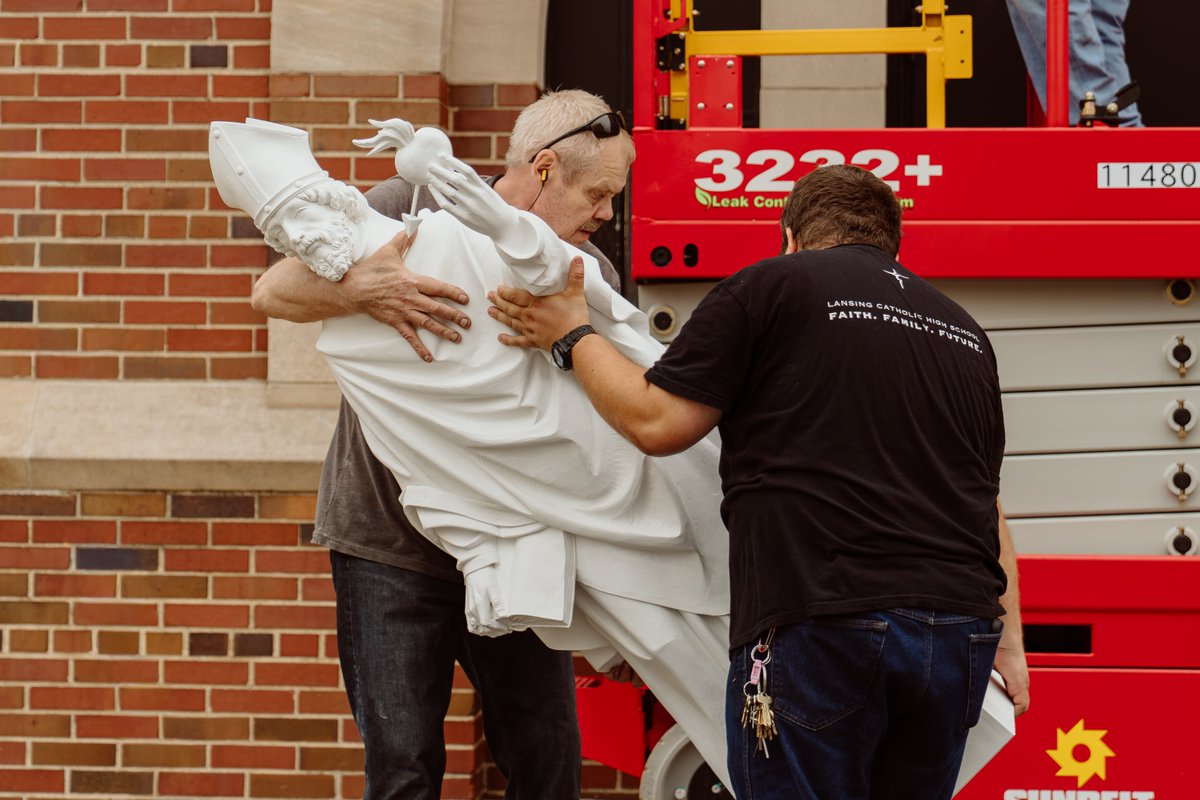
Since its construction in 1939, Lansing's Church of the Resurrection middle school building has had five empty niches on its exterior walls—until now. This month, students will return to find five new statues of saints smiling down upon them: Saints Elizabeth Ann Seton, Patrick, Augustine, Thomas Aquinas, and John Neumann. How wonderful! Well done to everyone at Resurrection School for making this happen! More: https://t.co/g2SKEEaWFA
@dylanpschroeder “According to his sister Mona Simpson, in the very last moments of Jobs’ life, he gazed at his family and said, simply, “Oh wow. Oh wow. Oh wow.””
As a dad, this is the best thing to come out of WWDC26.
I’m looking forward to being able to help people get this set up for their kids and for the default computing experience to be more childhood-friendly.
@Apple is leading the way again with values-based technology.
We believe in helping families create safer digital experiences. With our updated child safety features, parents can easily manage what their kids can see, who they can communicate with, and when they have access to apps. https://t.co/2HcsXobXRn
The three hearts of Jesus | Dedicating our country to the Sacred Heart:
Lansing, Michigan
Monday, June 1, 2026
Month of the Sacred Heart
Dear sisters and brothers in Christ,
It may seem strange to honor a body part, that is, the heart of Jesus. Yet, for the feast of the Sacred Heart of Jesus (June 12), the bishops of the United States will consecrate our country to that heart. Why do we Catholics do this? It was St. John Eudes in the 1600s who encouraged a devotion to the heart of Christ. In fact, he talked about Jesus having three hearts. Let’s look at what he meant.
There is, first of all, the divine heart of Christ. Now, of course, there is no such thing as a physical divine heart. God, as divine, has no body parts. However, it is a great symbol for the love that God has for us, as St. Paul states so clearly in his Letter to the Romans: “God proved his love for us in that while we were still sinners Christ died for us.” (Rm 5:8) We often think about Jesus loving us because he died for us, but imagine offering up your only begotten son to death for someone else. But here the text says that God the Father proved his love in this way. We might be willing to die for someone, but would we be willing to give our child to die for someone? That is the divine love, the love of the Father, the Son and the Holy Spirit for all of us. St. Paul in his Letter to the Romans further tells us that this “love of God has been poured out into our hearts through the Holy Spirit that has been given to us.” (Rm 5:5) Divine love is simply a free, generous, undeserved love. It makes no demands but does invite us to love in the same way.
There is a second heart in Jesus. It is his spiritual heart, that is, the heart of his will, both his divine will and his human will, deeply united to live out true charity. This is his own specific sacrifice for us, the sacrifice of his own will for us, and the sacrifice of his life for us. This love is obvious to us. We see it in the scriptures. We see it whenever we look at a crucifix. But even though we see it a lot, we really do not understand it. Why would someone, anyone, let alone the Son of God, go to such lengths for us — it is a love beyond our measures. We don’t deserve it. Our human love is always so conditioned; we are always looking for what is in it for me. His is a love that makes no sense. Why would you leave 99 sheep in the desert by themselves to go look for one lost sheep, for me? It makes no sense, but that is true love.
The third heart of Christ is his physical, fleshly heart, symbol of his human affection for us. This is an intense, passionate, fixed love, which is expressed in Jesus’ concern, in the compassion he felt in his guts, his tenderness, and tears. Jesus had passion. That passion was always focused on others, on that lost sheep, on that repentant sinner. Sometimes our passions lead us into places we know we should not go, places we perhaps regret having gone, places where we may have ruined our lives or other lives. Not Jesus’ passion. It is always pulsating for others, for their good, to gather them, “from every dark place where they are scattered when it was cloudy and dark.” (Ez 34:12) He really loves helping others. There is no other way to say it. He simply finds great joy, his life’s purpose, in being a man for others. He experiences a rapturous emotive love for us that we creatures will experience only in heaven.
We bishops want our country to be a school of love. On rare occasions we may actually achieve that. Often, as we know, because we are all sinners, we have fallen short. Let us pledge ourselves to the heart, that is, to the hearts of Christ. We can do this because the divine love has been planted in our hearts by the Holy Spirit, because we see the Crucifix of Christ daily and thus, we know to what we are called, and because our own passions are wonderful things and we want to use them in a noble fashion. Jesus, give us a heart like your own.
Sincerely yours in Christ
+ Earl Boyea
Bishop of Lansing
.@Willob on @Pontifex's "Magnifica Humanitas" encyclical, from NEWER THINGS:
"One thing I’m very happy about is the depth that this is bringing to the AI debate.
"In my opinion, the AI debate here in San Francisco has been reasonably flat so far. It’s been AI Doomer versus AI Optimist. Acceleration versus Risk. Go slower versus Go faster.
"Everyone weighing in on it has skin in the game. They run a lab, they invest in a lab, they’re trying to win an election, they’re trying to stop a data center in a district.
"The Pope doesn’t. He is very explicit in advocating that he’s really grounded in the common good here.
"I think it’s a great gift to humanity that we have this institution with a 2,000-year-plus track record of weighing in on topics relating to the human condition, that really doesn’t have any skin in the game, that can guide us at this moment in time.
"Obviously, there have been many callbacks to Rerum Novarum, but in that instance, Pope Leo walked into a similarly flat debate: capital versus labor, Marxism versus unconstrained capitalism. He refused the binary and introduced a nuance that neither side was offering.
"My hope is that Magnifica Humanitas does the same for AI."
Our new 250th Anniversary collection is a nod to the American grit that founded our nation. Limited release available now.
@jockowillink@originpete@prattprattpratt