@SkankHunt_1861@cremieuxrecueil@Roham_hos Because the second claim (and thus the implication behind the first one) is that sperm count is still on the decline. It is not. But also importantly, the measurements used in such analyses 50 years ago were not at all the same or as robust.
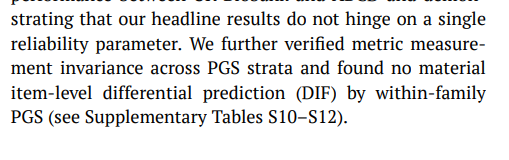
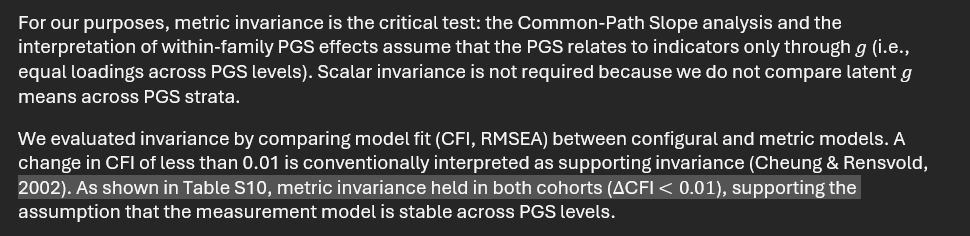
@krichard121212@lu_sichu@_twolfram He doesn’t actually dispute anything, really. He just decided to point out that the WF effects are not exactly the same as the BF ones, and for some unknown reason called it “MI failing” or whatever. The rest of his arguments are simply nonsense and irrelevant.
@krichard121212@_twolfram x should add editing, sigh..
i'm just not at all sure why you would choose to lie about the wf effects not passing MI only to redefine MI to mean "the strongest common-path interpretation" lol. they're not at all the same thing and you know this. your phrasing was deliberate
@DoctorPerin@Hardymatt0@cremieuxrecueil >all measure the same g-factor (a construct!)
>”they measure different constructs”
Two possibilities:
1. You’re just generally incompetent at your job
2. You’re misunderstanding basic, fundamental psychometric terms, which leads back to 1
@Kaasburgers@cremieuxrecueil This assumes “milder cases” don’t get diagnosed, and that autism diagnoses depend on stress, neither of which are really based on anything.
@AnnBauerZ Also notably regarding this point, if the given model includes adjustments for child sex, as Ahlqvist did, mixed-sex pairs are not simply invalid. The residual issue would then be exposure effect diffs by sex, and that's not very likely
@AnnBauerZ "looking at different sex sibling pairs might impact results, when there is a 4 to 1 male bias in autism diagnosis"
Cope, the reason for the difference is not at all likely to be related to diagnostic bias: https://t.co/2Y7FmdNx8e
Autism can be thought of as a spectrum, where passing a certain threshold level of symptoms results in a diagnosis.
Consistent with being a heritable and highly polygenic trait, we also see that the siblings of people with autism have more autism symptoms themselves, even if those symptoms aren't severe or numerous enough to earn them an autism diagnosis.
Symptoms and genetic risk covary, but at the same time, there's also a protective effect for women—which is to say, at the same level of genetic risk, women are less likely to be diagnosed as autistic. This isn't just a classification issue either, as this effect shows up whether you use diagnoses or autism symptom check sheets.
A recent paper showed strong evidence that the liability threshold really is higher for women and girls. In a stylized sense, that looks like so:
Focusing in on cases of autism (ASD) without intellectual disability (ID), we see that having a female sibling with ASD sans ID greatly increases the probability of a sibling having ASD without ID too, far beyond the effect of having a male sibling with ASD sans ID:
This pattern of sex stratification was only seen with autism, not ID, although power for most ID-related outcomes and ASD plus ID was pretty poor. Nevertheless, this result is consistent with a female protective effect because, if someone's female sibling is diagnosed with ASD, that means that they probably have really high genetic risk of ASD.
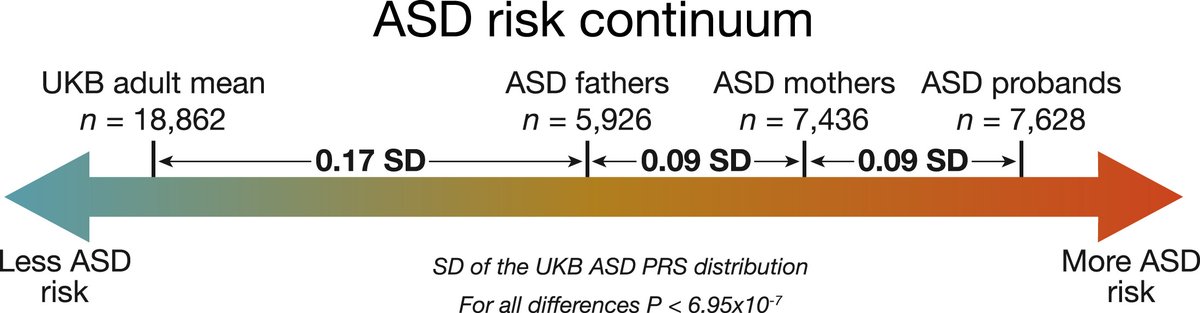
On the parent end, we see a similar pattern that there's plenty of power to detect. Take a look:
The parents of children with ASD have considerably higher polygenic scores for ASD than typical members of the U.K. Biobank (UKB), but when a child has an ASD diagnosis, the mother has more elevated genetic risk than the father. Consistent with intuition, cases themselves (probands) had even higher genetic risk of ASD.
A final way this paper looked at the female protective effect was to look at polygenic transmission disequilibrium in ASD probands where children have ASD and their parents don't. This test—the pTDT—assesses whether cases "overinherit" risk variants from parents. To "overinherit" means to upwardly deviate from inheriting the midparent mean level of a given polygenic score. These results were highly interesting, so take a look:
I think this plot is interesting in so many ways. For one, it shows how the mothers in families with ASD cases tend to have higher mean genetic risk for ASD in a novel dataset, beyond what was shown in the last plot.
In the left-most category, you see that, for non-ASD males in families where there's an ASD individual, they underinherit ASD genetic risk factors. As the authors noted: "This is consistent with an average requirement for their PRS to decline from the mid-parental PRS to around that of their unaffected fathers, in order to remain unaffected themselves."
This finding was also consistent with a female protective effect against autism, as girls were not affected despite higher genetic risk than nonaffected male siblings. But this sex interaction wasn't significant, so replication needs to be looked into.
The middle finding was the least interesting because of power, but it is worth noting it since the category is important: probands with high-impact mutations related to ASD. Analysis of high-impact mutation effects is how the female protective effect was discovered in the past, but in this cohort, there just weren't enough people to obtain a significant interaction. Nevertheless, we see the same pattern here (nonsignificant) of higher genetic risk for affected females, and we see nonsignificantly higher polygenic risk even in this proband where there are known high-risk variants. Interesting in its own right! But low power makes potentially neat results in determinate, so let's move on.
In the right-most column, we see the majority of the affected people in the families with ASD, and we see that affected male siblings again have lower genetic risk for ASD than female siblings. In this bin, this effect is also not significant, but it's against trending in the correct direction to suggest a female protective effect is afoot.
But despite these various interactions within bins being marginal, this chart actually offers stronger evidence for a female protective effect than the authors noted in the paper; just notice how only one category has a balanced sample size. There are just way more males with autism, so there's a sampling issue! Males are more likely to be identified as having autism, so each of these results understates the power of the female protective effect to the extent there's an ascertainment bias due to undersampling of female cases.
In the supplement, we see this laid out in the form of there being far fewer siblings of female cases than of male cases, with universally higher odds of ASD with a female case than with a male one. There are just a lot more boys involved in these studies.*
So there we have it: being female, for some reason, protects against the diagnosis of autism, at the statistical level. Mechanistically, it's not clear why being a woman helps, and we'll certainly need larger samples to be able to delve into this with any level of clarity. It's likely that factors like diagnostic bias (when diagnoses are used as the outcome) by evaluators and by potentially autistic children (due to better masking by girls) contribute to this, and teasing out the effects of those sorts of contributors will take time and effort.
Autism has resulted in a lot of contributions to humanity, but it has also resulted in a lot of grief for families. Understanding this aspect of it might help to better understand it in general, for its goods and its bads.
If you want more information, check out the paper this data came from: https://t.co/JEGh29SyEY
* And since parents often have stopping rules for additional births after having a disabled child, stopping after obtaining an autistic child—who's much more likely to be a son—might aggravate imbalance.