@HarryStebbings As someone who recently moved there, it was easy to train myself from the start not to have my phone out in central areas. East London has its own quirks but for the most part the bike thieves don’t operate here. And from a new resident’s perspective, the pros outweigh these cons
@carlvellotti The older I get, the more I see PRDs and templates as theatrical.
Generally, a checklist of who/what/when/how and several whys applied to a doc, board, ticket, slides, etc. will get the job done.
If it provides context and answer key questions for the team & org - it’s a win.
PMs – I've said it before and I'll say it again:
✅ AI won't replace you
❌ PMs using AI will
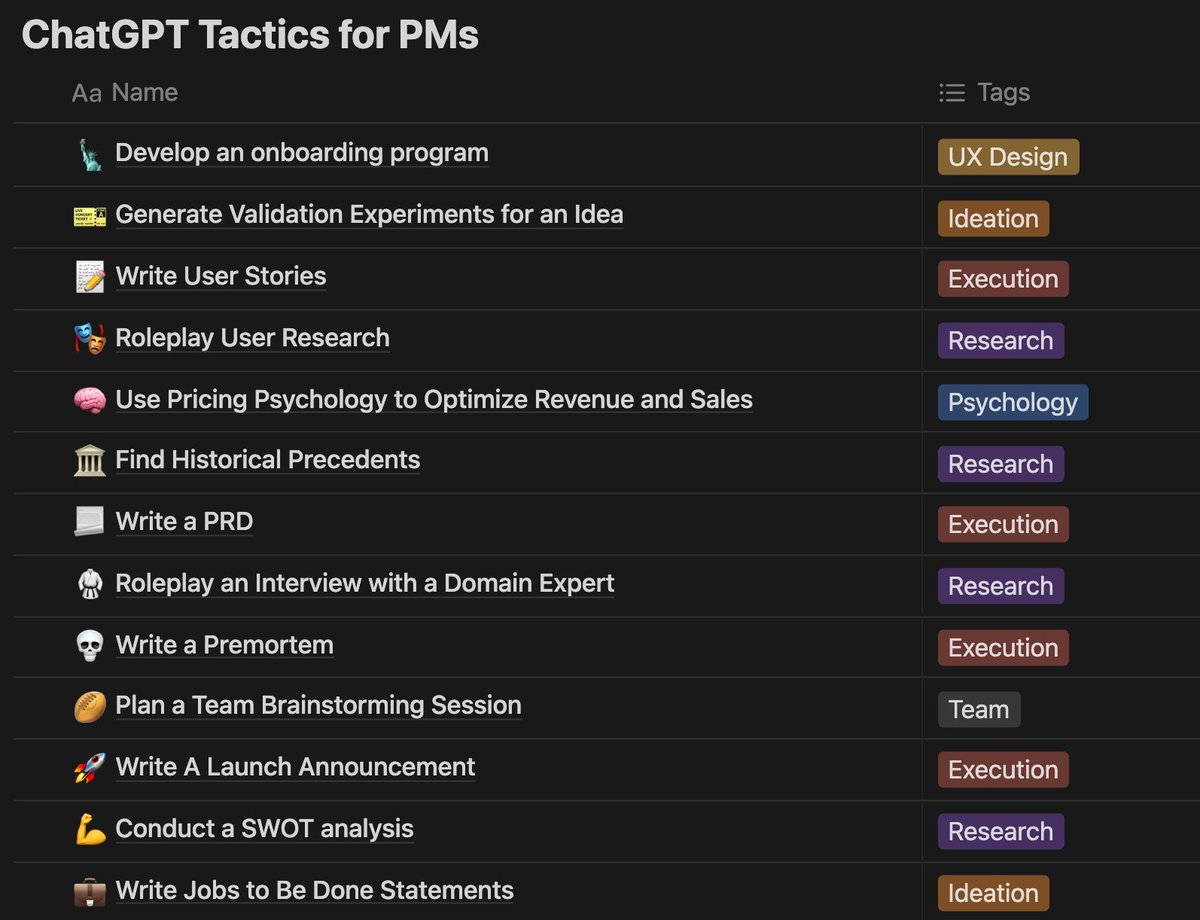
I'm building out PM use cases with instructions + killer prompts.
Eventually I'll sell the full table for $50, but for the next 24h: FREE.
Follow + RT + comment "🤖" for access.
Apple Pie Position:
A statement that instantly elevates the person who is saying it and is simultaneously hard for anyone else to push back on, and so everyone avoids the personal risk and just nods “yes”, even though its actual value in this specific situation might be relatively low, zero, or even negative.
Because everyone in the workplace wants to come across as smart & competent, especially during meetings, Apple Pie Positions end up being frequently employed by your colleagues.
Examples of Apple Pie Positions
(trigger warning: might feel too painful at times)
1) “We need to define the success metrics for <whatever is being discussed>”
Also seen in the wild as:
“How will you measure success here?”
2) “Do you have any data to back that up?”
(narrator: it is either impossible to get useful data in this situation or the effort to get useful data would be greater than just doing it)
3) “We need more scalable team processes”
4) “We have too many meetings”
5) “We need to sync more often”
6) “This is a two-way door, so let’s just decide quickly”
(narrator: it was actually a one-way door. or, it was a two-way door with a hungry lion on the other side of the door, so we kinda died)
7) “We need more metrics before making a decision here”
8) “We need a better go-to-market motion to improve product adoption”
(narrator: the problem is you’ve built the wrong product, no amount of GTM sorcery is going to fix that)
9) “We need to clarify our expectations from people in this role so we can set them up for success”
(narrator: the problem is that you’ve hired too many people whose work overlaps with other functions)
10) “We need better internal documentation!”
(narrator: yes we do. we also need 50 other things so let’s just finally admit that this ain’t happening. besides OpenAI will solve this for us in 2024, right?)
11) “Let us not forget [quote one of the company’s core values].”
(narrator: sometimes used as a weapon to justify one’s position, especially when faced with objective & rational counter-arguments for an issue)
12) “We need to replace our team meeting with written updates”
Fast forward a few weeks/months:
“People are missing live interactions with team members, they don't know what's going on across the team, nobody's reading the written updates. We need a meeting”
13) “Our current org structure doesn’t set us up for optimal execution of our strategic goals. That's why we are announcing a re-org”
14) “We must not slow down our shipping velocity”
(narrator: usually applied to push back against a fairly rational measure that will cause a minor delay in shipping the product but will prevent bigger problems for the customers or the company further down the road)
15) “We need to post-mortem this”
(narrator: you should have pre-mortem'ed this, so you wouldn't have had to deal with an ugly post-mortem. and the systemic changes rarely happen and somehow we are doing another ugly post-mortem 3 months from now. repeat)
16) “After 13 amazing months as CxO, Bob has decided to leave for other personal pursuits. The company wouldn’t be the same without his contributions”
(narrator: this is not how it actually went down)
17) “We need an offsite so we can align the teams better with our strategic priorities”
(narrator: we said the same thing for the previous 6 offsites. it almost seems like we are doing offsites more than we are being onsites)
18) “Remember, we are a mission-driven company”
(narrator: particularly effective when justifying below-market salary / stock for current and prospective employees)
19) “We need to go on a customer listening tour to understand our customers better”
(narrator: no, you need to pay more attention to the customer research that’s already happened over the past 18 months that we haven’t done anything about. you then need to translate that into differentiated features, instead of just building me-too tablestakes)
20) “We need more apple pie”
(narrator: 🥧yum. yes we do)
@AmexCanada can someone please contact me? I am traveling and I’ve been trying to contact customer service re: an issue with a rental car charge (not booked through AMEX, but paid for with AMEX) - every person I speak with sends me to the wrong department
@jamey_johnson (for whatever reason, likely reminiscing) I’ve been been watching every farm aid performance of “can’t cash my cheques” and “in colour” over the past decade—and somehow, some way your voice just gets better each year. You should monetize whatever your routine is 😂
I wonder if the PMs at @Google Home considered whether their YouTube ads would set off every Google Home Assistant in their viewers house haha also if I signed into YT using the same Google account that my home is on, would I not receive the ads?
What everyone thinks PMs want:
• autonomy
• decision making influence
• cool problems to solve
• smart team
• freedom to experiment
What PMs really wanted:
• pageless mode on Google Docs
@johncutlefish It’s easy to get caught up in the day-to-day and deprioritize research in order to meet execution milestones. Having dedicated UX researchers produce reports gives me tremendous peace of mind. And often uncover insights my biases would never allow me to ask about in the 1st place