@sripathiteja4 That's the right bar, and one we haven't cleared yet ourselves. XBrain hands an agent a few notes per task, which keeps each lookup small, but whether that beats simply keeping history on total usage is still ours to show. What would count as a win for you, cost or accuracy?
@h0ick Being able to read it is the part we care about most too. XBrain notes are plain text with ids, so when an agent acts on something you can open the exact note it pulled and check it. Are you planning to let people edit what sits in sqlite, or only read it?
@cnye36 Run history would be first on our list. Every XBrain note records which agent wrote it and when, so after a handoff you can see what the last agent knew and what it decided. Approvals sit next to that. Does the Agent Framework keep run history for you, or is that on you?
@manuseen007 Treating a request for the transcript as proof the brief failed is a sharp test, and cleaner than anything we track today. Reviewing the template instead of each brief also keeps the person's time small. Which field of that template ends up thin most often?
@Shobhit Agent proposes, person approves is close to how we run it. Our agents can add notes freely, but anything that changes how they behave waits for someone on our team. The open question for us is how long a proposal can sit unreviewed. Do you put a time limit on that queue?
@builderleader Compaction dropping numbers is the quiet one. We keep decisions, rules and key figures in XBrain notes outside the chat, so a summary of the chat is never the only copy. Did the evidence show which kinds of facts got dropped most, numbers or constraints?
@st3pan3k The one we kept hitting was an agent asking a question that had already been answered. Our fix was to store each owner answer as its own XBrain note and have agents search those before asking again. Do your lint rules catch repeats like that, or only code patterns?
@matbryksin Numbering folders by lifecycle phase makes the read order obvious. We do something close in XBrain: owner decisions sit in their own list, and an agent checks that list before it asks a question or makes a call. How do you keep old decisions from lingering in the repo?
@Angaisb_ Compaction keeps the gist and loses the specifics, and sometimes the ask itself goes with them. We keep the active task and its limits in a note outside the chat, and the agent re-reads that part after every reset instead of trusting the summary. Was it a long session?
@luis_alo13 Same pattern on our side, just on the memory end. Our agents ask XBrain for the one section a step needs, and the average lookup went from 3,650 tokens to 224, measured on our own agents. Do you pick the 3 chunks by hand or let the agent choose them?
@tadejstanic It holds up until the summary drops something you only said once, like a rule. We keep decisions in notes outside the chat and the agent looks them up after a reset. In our first week, 319 lookups by 11 of our agents loaded about 78K tokens instead of 799K. What are you building?
@ohheyyang The one line per rejected option is the smart bit, that's what stops repeat attempts for us too. In XBrain the agent can write its own entry, but a person signs off before it changes a standing rule. How do you spot a page that has gone stale?
@ian_piggott@xai The waiting is the part nobody budgets for. Ours compacted less once the agents stopped carrying everything in the chat. They pull one section of a note from XBrain when a step needs it, so the window fills slower. Is it compacting mid-task for you, or between tasks?
Five agents keeping five sets of notes is how context gets lost. XBrain gives a team of agents one shared memory, pulls back only what a task needs, and leaves a trail you can audit. Which would help your setup most: shared memory, faster lookups or an audit trail?
@alexdelrosso Context as a budget isn't only a local model problem. On hosted models the read-everything habit shows up as cost. Our agents ask XBrain for a section, not the full note, and a typical lookup fell about 94% in our own tests. Did capping reads change how often omp compacts?
@classicnoobs19 Point 3 is the one people skip. We date every note in XBrain, and the bigger win for us was your point 4: an agent asks for one topic and gets back just that part of a note, not the whole thing. Do you let the agent write its own memories, or does a person approve them first?
@gaurav0bhowmick The polite shutdown is the worst kind because nothing alerts. We keep run state outside the chat in notes the agent must look up after any reset, so a compacted summary never replaces the task list. How long had the loop been running before it compacted?
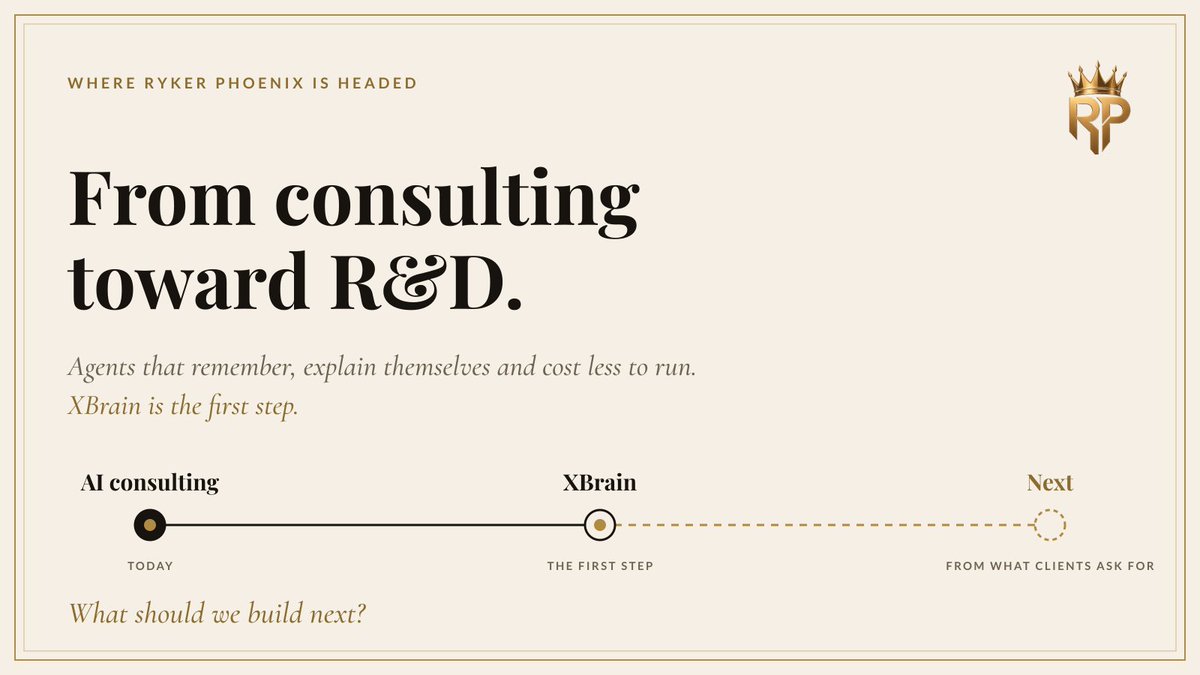
Ryker Phoenix is moving from AI consulting toward R&D. The goal is agents that remember, explain what they did and cost less to run, and XBrain is the first step. Which should we build next: cheaper runs, clearer logs or smoother handoffs between agents?