New episode of The Information Bottleneck is out 🥳🥳🥳 with Max Welling (@wellingmax )
Max is a legend and a personal hero of mine, so this one meant a lot.
We got into which scientific problems ML can actually touch right now vs what's still too early, what the loop looks like when simulators, wet labs, and real experiments all feed back into each other, where the field is way too optimistic about generalization, and how you handle uncertainty when being wrong costs you a month in the lab. Also the academia → CuspAI shift and what it changed for him.
One of my favorite conversations we've done.
Today @cusp_ai and @KemiraGroup announce a milestone in AI-driven materials discovery.
We have used generative AI to design new materials targeting PFAS removal from drinking and process water at trace concentrations.
The bitter lesson in 26 words:
Don’t be distracted by human knowledge, as AI has been historically.
Instead focus on methods for creating knowledge that scale with computation, like search and learning.
We put the paper online that provides further details (beyond my ICLR keynote) on the role of spontaneous symmetry breaking and Goldstone modes in deep learning. Enjoy! (w/ Nabil Iqbal, Thomas Andy Keller, Takeru Miyato and Yue Song.) https://t.co/wN8q7qhUaP
Our perspective on closing the synthesis gap in computational materials design is now live @NatureSynthesis !
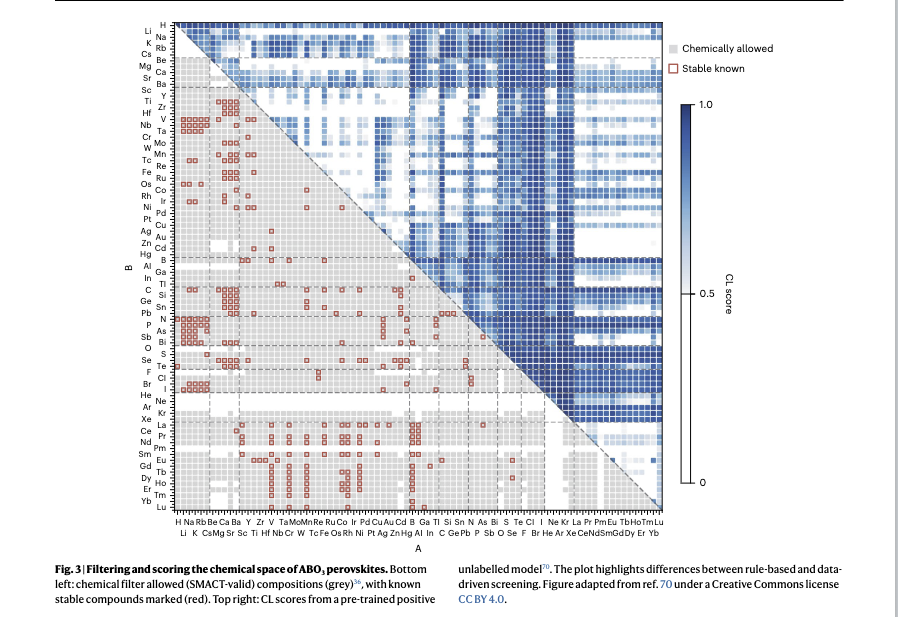
We survey how thermodynamic potentials, chemical heuristics, and machine learning models can guide compound selection, and argue the path forward couples generation, synthesis planning, and experimental validation in agentic workflows.
With @lonepair , @hspark1212 , Kinga Mastej, and Panyalak Detrattanawichai. Thanks to @AIchemyHub for the funding.
Read the full text: https://t.co/rtHFnmDZvJ
Three years since the first flight of Starship, the next generation is here. New ship. New booster. New engines. New pad and new test site. SpaceX engineers are working to solve one of the most difficult engineering challenges in history: developing a fully, rapidly reusable rocket
Molecular simulation is the backbone of drug discovery and materials science, but it’s notoriously complex.
Today, we’re excited to open source kUPS - a molecular simulation engine built for the AI era, optimized for GPU in collaboration with @nvidia.
The goal is both to leverage LLM creativity and accelerate computational aspects of materials design, so scientists can focus their effort on the challenging discovery questions. This is early work and a proof-of-concept framework that makes advanced computational methods feel as natural as starting with a written prompt.
Thanks to Hyunsoo Park (@hspark1212) and Aron Walsh (@lonepair) for their support @imperialcollege Department of Materials.
We welcome feedback from the community, try it out, open issues, or reach out with questions about specific use cases.
pip install crystalyse
#OpenSource repository: https://t.co/nISCgTYsaF
We're releasing Crystalyse, a provenance-enforced scientific AI agent that grounds large-language model (LLMS) reasoning with materials modelling. Crystalyse addresses a challenge in scientific AI: current language models excel at reasoning but struggle with factual grounding, leading to materials–property hallucinations where models estimate values rather than compute them.
pip install crystalyse
#OpenAccess preprint: https://t.co/VpoLj6PBIM
From a terminal prompt like "Suggest a new Na-ion battery cathode", the system computes capacity (193 mAh/g) and voltage (3.7 V) in ~90 seconds—despite having no pre-coded battery workflows.
The agent reasons about which fundamental calculations to chain together, then derives electrochemical properties. The system orchestrates established tools (SMACT for compositional screening, Chemeleon for structure generation, MACE foundation models for energy calculations, PyMatGen for stability analysis), while enforcing that every numerical value must trace to explicit tool invocations, with audit trails showing which calculation produced each result.