One of the best designers I’ve ever worked with is now a principal engineer.
He wants to stay anonymous, but he now designs and builds 95%+ in coding harnesses and the terminal.
His workflow is basically:
→ Get AI to create a design md first
→ Ask AI to generate the components
→ Give AI feedback until it feels right (taste!)
He thinks doing this is now basically a core skill for designers (and frankly any builder).
Not saying you shouldn't design in Figma, but I agree with him that it's important to learn the above too.
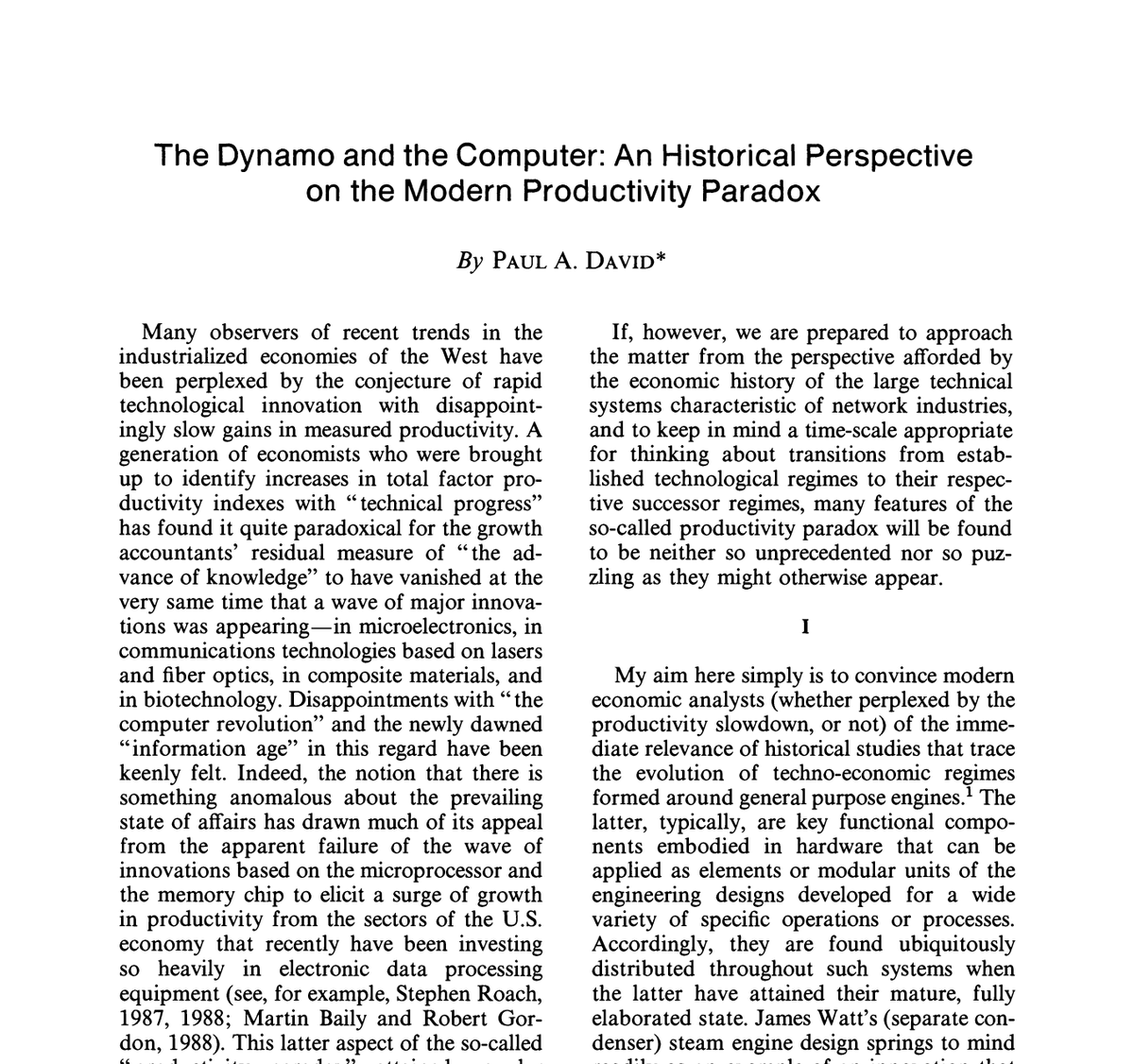
If you've adopted AI at your company but haven't seen any tangible results, read this 1990 article: "The Dynamo and the Computer" by Paul David.
When electricity first arrived, factories that "adopted" it barely got faster. They just swapped the steam engine for an electric one and ran everything else exactly as before: same machine layout, same workflow, same management. Electricity in, no real gains out.
The most common mistake with any new technology is to drop it into the old organization and then declare the transformation done.
The real leap came decades later, when each machine got its own small motor. Suddenly machines no longer had to be lined up around one central drive shaft. They could be rearranged around the actual flow of work.
The productivity gains didn't come from electricity. They came from REDESIGNING THE ENTIRE FACTORY around it.
AI is the same. Bolting it onto your existing process gets you a faster steam engine. The payoff comes when you redesign the work itself.
(link to paper in comments)
This is the tough lesson that a lot of people are learning the hard way
AI might have made building apps a lot easier, but it also set the barrier to entry at zero
Because anyone can do it, there is no moat left
The only edge left in the future will be sales and marketing
Design is full of codewords. Knowing them changes what you can ask for, and what you can get back, whether you're working with devs, or an AI.
“tint this neutral color”, “fix this widow”, “nudge it to the optical center”
I wrote them down: https://t.co/aFyd5avj9o
@signulll Some interfaces go away, but definitely not all.
For example, audio recording & production. I can't see the specific apps going away. Same for design tools like Figma. Humans want a level of familiarity with timeline or canvas manipulation instead of a novel interface.
I definitely feel this one!
Orgs within niche industries that have proprietary operating models will thrive once there are better ways to hold DEEP knowledge.
Time for someone to build an API for applying regulatory compliance guidance, federal medical billing procedures, etc!
Imagine replacing 90% of your employees with a team of geniuses who have no idea how your company operates.
Total chaos. Nothing works.
That’s what AI feels like today.
The missing piece is extracting all the domain knowledge from people’s heads and providing that as structured context to the models.
@TrungTPhan I love that when you put your cursor in front of the bear walking towards the letters, the bear stops and smells your cursor. Great detail that only is revealed when interacting.
Very excited about @figma Make working directly with your codebase! This has unlocked a lot for us internally already, and there's more to come :)
Props to so many designers for their great work here: Iris, Pete, Sean B, Tom, Gui, Liam, Henry, and more.
https://t.co/E1cFNWGEa7
good news: /goal in codex has solved all my problems
bad news: i'm sitting here twiddling my thumbs while the agents do all my bidding
it's no secret i'm a little bit obsessed with codex, and /goal is a big part of that.
i put together a 30m ep on /goal including:
- what it is
- how to write a good goal
- how to drive bug zero with @vercel@sentry and codex
- two non-technical use cases for goal, including cleaning up 4,000 emails over 4 hours
A HUGE thank you to our wonderful sponsor, @mercury - radically different banking loved by over 300K entrepreneurs: https://t.co/eQRKWOCxKh
my favorite engineering skills for AI:
- Compound Engineering: https://t.co/BM7tA2RAHf
- Ryan Singer's shaping skills: https://t.co/yaWg0nI7Vm
- Matt Pocock's skills: https://t.co/0WtRqce6x5
I switched from Superpowers to Compound Engineering as they perfected the plugin over time, and I'm pretty sure I still only use like 10% of it
Jobs can be broken up into 3 kinds of tasks:
1. Rote - answering a customer support ticket
2. Linear - updating docs
3. Exponential - improving the product itself
Value for the most valuable tasks in the long run are often negative in the beginning, making them hard to prioritize.
My biggest takeaways from @danshipper:
1. The future of work will happen inside Codex or Claude Code. Instead of putting AI into your SaaS tool, you’ll use your SaaS tools inside your favorite AI agents' in-app browser. Dan spends all his time in Codex now—writing documents, managing email, doing research, everything. He's using Google Docs, PostHog, and everything he needs within the agent's in-app browser. The agent can see what he’s doing, and has all of his context, so he and his agent collaborate quickly and super effectively.
2. Automation is a lie—every automation needs a human. Dan's company doubled in size this year despite being incredibly AI-forward. Why? Because in order to make automation work well, you need humans making sure everything keeps working. This is why benchmarks are misleading—they measure AI on problems we’ve already framed and can score, but there’s always a higher frame.
3. PMs will win the AI era. Marcus, a former PM who previously ran Axios’s writing product, joined Every after getting super AI-pilled. Now he runs their product Spiral, and ships faster than anyone on the team. He pairs technical knowledge with spiky product sense, deep user empathy, and an eye for what matters. Dan thinks any PM who gets really AI-native will be incredibly dangerous because the building is done for you—what matters is figuring out what to build and if it’s great.
4. Full-stack designers are becoming superheroes. Designers used to make beautiful interactions that engineers didn’t want to build or couldn’t execute properly. Now designers don’t need to hand things off; they can build it themselves. Designers are naturally creative people, and AI is the perfect tool for them because it lets them bring their vision to life without the traditional bottlenecks.
5. SaaS is not dead. In fact, Dan is bullish on SaaS stocks. When users bring their own AI (via Codex or Claude Code) to use SaaS products, the user—not the SaaS company—pays for tokens. This saves SaaS company’s margins. Since the agents need their own seats, Dan predicts that agents will create massive new demand for SaaS because there will be tons of agents using these products at high volume.
6. Every company will have one “super-agent” inside their Slack that every employee will use. Dan initially thought every employee would have their personal work agent, like a shadow AI org chart, but he’s completely flipped his view. He realized agents need humans who care about them. When someone gets tired of maintaining their personal agent, it becomes useless. The winning model is one forward-deployed engineer or AI-savvy person who maintains a company-wide agent (like Shopify’s River or Viktor), and then it trickles down to more specialized team agents as models improve and become less fiddly.
7. The AI job apocalypse is not happening, but you do need to evolve to stay relevant. Models make yesterday’s human competence cheap. But because everyone uses the same models, it all looks the same if you use it the default way; it becomes commoditized slop. Humans then take that frozen competence and use it to make something new and interesting for their specific situation. The key: “ride the models”—use them for everything you do, try new models when they drop, keep turning over rocks.
8. We will read way more AI-generated writing, and we will like it. Human writing is incredibly important for things that matter, but for internal docs, planning, and email, AI-generated is often better because most people are bad at writing strategy documents.
9. Build software for humans and agents to use together. The current model is building a CLI that an agent uses independently. Instead, you and your agent should be using the app together. This creates new design challenges—agents can make a billion requests in three seconds, so you need approval flows, inboxes that summarize what happened, logs, and easy rollback.
10. Forward-deployed engineers are the new most essential role. The big model companies have teams of people managing their internal agents, and those teams aren’t going away. It’s different from traditional software building, and certain engineers love it. As models get better, this role will evolve—you’ll be managing more agents doing more things.
Everyone keeps asking if AI is going to kill the PM role.
My guest this week runs an AI-native company, and the answer was the opposite of the hype. They're hiring more PMs than ever. More engineers than ever.
But the bar moved.
Code is cheap to produce now. So the PMs who stand out aren't the ones who write the cleanest spec. They're the ones with a real opinion about what to build. Product taste is the alpha.
So I asked the obvious follow-up. Where does product taste actually come from?
The answer was more concrete than I expected.
Taste is an output. It comes from consuming an enormous volume of feedback from every direction at once.
The best PMs already do this manually. YC has been telling every cohort the same two words for years: talk to users. But "talk to users" in 2026 means something bigger than customer calls.
It means building a context graph. One connected feedback layer that pulls from:
- Wherever your team logs issues
- GitHub discussions
- Slack and Discord conversations with your community
- Gong transcripts from every customer call
- Product analytics from PostHog, Amplitude, Pendo, and FullStory
- Twitter, if your users post about you there
Every one of those is a feedback stream. Most teams let them sit in separate tools, read by separate people, never connected.
Here's the part that reframes the whole thing.
Once that feedback lives in one graph, a human doesn't have to be the one reading it. Your agent can consume it.
That changes what a PM's day looks like. Instead of manually synthesizing scattered signal, an agent reads the full context graph and surfaces the patterns. You spend your time on judgment, not collection.
This is why I don't buy the "death of the PM" narrative.
The PMs who lose are the ones who thought the job was writing requirements. The PMs who win are the ones building the feedback machine that taste is actually made of.
Taste used to feel innate. It's becoming a system you can engineer.
My favorite way of interacting with Claude Code is to have it generate static HTML files as outputs (reports, explorations, code structure, mockups etc.)
I wanted to iterate on the file by commenting in browser and having Claude update the output live.
So, I built this Claude Skill👇
How it works:
- Install Claude Code skill (ask it to clone repo)
- Build an HTML page for anything (e.g. research coding agents and generate HTML report)
- Ask it to make the page interactive
That's it. CC will launch a localhost server and allow you to then leave comments on the page itself and once it updates, will give you a tour of changes.
It's like Google Docs kind of comments/iteration but for HTML pages.
Google just made it official.
They added llms.txt as a Lighthouse audit. That means Google is now checking whether your website has a file that helps AI agents understand what your business does.
Think of it like robots.txt was for search crawlers. llms.txt is the same thing for ChatGPT, Perplexity, Gemini, and every AI tool scraping the web for answers.
Here's what it is:
→ A plain text file at https://t.co/PmsrDIQGI1
→ It summarizes your business, products, and key pages in a format AI can read
→ It helps LLMs cite you accurately instead of guessing
I just created one for @HireAutoM8. Here's what it looks like so you can model yours from it: https://t.co/EosGM5jaZO
If your business isn't showing up in AI answers, this is step one.
Founders: go create yours today. This is the new robots.txt.
never seen this type of treatment before - https://t.co/WAFGBPP2VG has a cursor dwell UI for enabling scroll on one of their interactive homepage sections. so by default you don't hijack regular scrolling. neat detail