@ChainLinkGod
$Link Native @chainlink staking is rapidly turning into @stakedotlink staking and there's no end in sight. They have a sniper bot doing the rounds. Is this being looked at or whats your thoughts?
https://t.co/OtA0HANu5r
@thegraphers@stakedotlink Is it just me or is it SUPER annoying that @stakedotlink have been monopolising the native staking pool?
They've stolen the chance from retail to stake and forced them into using theirs (or nothing). Its non native so I refuse to stake there. @CatfishFishy@ChainLinkGod
@Dimitri_DLT@puremurkage@CatfishFishy@hypebeasteth It has multiple purposes, some of which - fees through CCIP, pays for node operations (node ops also required to put up link as collateral), provides security though staking and most recently the chainlink reserve from off-chain revenue.
@Memesandmkts@inneroperator Good 10 minute explanation on the oracle side of things but as you mentioned briefly, they do a lot more. Even just CCIP - is a behemoth in waiting. Connected to unified golden record + ACE, tokenised stocks can move from chain to chain seamlessly and most importantly, legally.
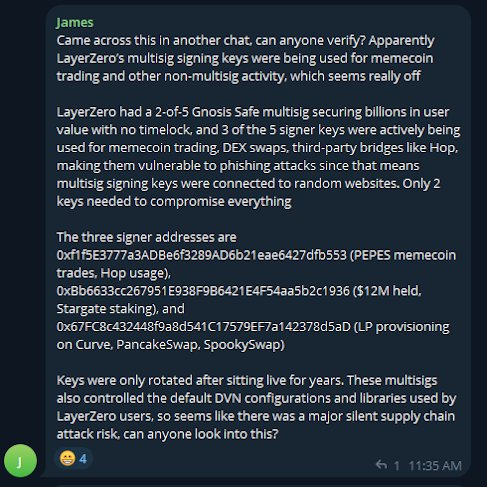
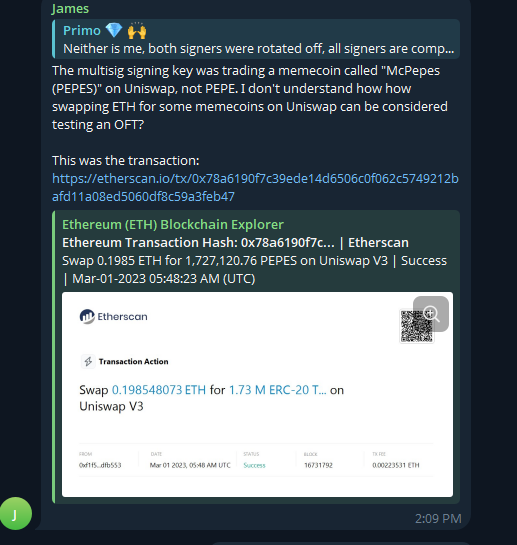
🚨JUST IN: @LayerZero_Core is facing opsec allegations after production multisig keys used to secure user funds were reportedly also used to trade the McPepes memecoin.
LayerZero’s Bryan said the transactions were made by people who were part of the LZ multisig but have since been removed, while denying “memecoin trading” and saying it was OFT testing.
disappointed in LZ.
As a leader in cross-chain infrastructure, this should have been a moment to reflect, improve, and help raise security standards for the entire industry.
Instead, LayerZero seems more interested in blaming its partner while dodging responsibility.
Yes, a 1/1 DVN setup is obviously naive.
Yes, Kelp’s technical judgment is very amateur despite their large TVL.
But the core fact does not change:
a LayerZero DVN was compromised, and that is what caused the loss.
If you ship a service, put it into production, and allow users to run 1/1 configs, then any security failure in that service is still your responsibility, even if the setup was not best practice.
Infrastructure providers do not get to take the upside of trust and outsource the downside to users.
We will not use LayerZero in any of our products, and we refuse to trust assets built on LZ OFT.
If LayerZero refuses to take responsibility for this incident, then the whole defi industry should boycott LayerZero products
@PrimordialAA@LayerZero_Labs It’s okay bud if you want to throw out a multisig bridge and claim it’s trustless to capture market share when it is actually completely trusted and figure out the details of how it’s going to work later that’s your prerogative I don’t judge
KelpDAO using LayerZero's 1 of 1 DVN and the peer was LZ's in-house node 🤦🏻♂️ for nearly $300m. This shouldn't even secure $1k. A multisig that's 1/1 what irony.
We’re fully aware of the rsETH exploit and have been in active remediation with the @KelpDAO team since the incident and continue to monitor. All other applications remain safe.
We are still identifying the root cause alongside @_SEAL_Org and others. We will publish a complete post-mortem with @KelpDAO as soon as we have all information.
@tjbate2000@ChainLinkGod@chaoslabs The way I see it is staking is a tool for security, as it only covers an ETH feed at the moment there's no chance the cap is lifted. Further integration into TradFi will need higher levels of security which should bring more staked $Link. We live in hope anyways
Was not expecting something like this for a few more years.
Book it as a Top 5 2026 stablecoin “breakthrough”. Bypasses the card networks w/ direct transfers. Epic!!
@ChainLinkGod@aris_jewels Surely the redeem early options also play a part in the value per cube as the remainder goes back into the pool? Which no1 knows how many wallets and on which tokens they'll redeem early.