Lend & Borrow Anywhere! 🥚
@0xSoulProtocol is connecting multiple lending protocols across many chains.
I just tested its seamless cross-chain experience.
Start earning seeds now!👇
Join now using my referral link: https://t.co/I6RSxgfKn2
We’re excited to introduce Soul Protocol, a new DeFi primitive, now live on Testnet!
The first unified, omnichain liquidity layer connecting cross-chain money markets.
Supply anywhere. Borrow anywhere.
Seamlessly, across any chain and protocol.
🧵
Enter the @Ta_da_io Gleam challenge and win your share of the $8,000 in $EGLD prize pool 🔥
Discover the platform enhancing cutting-edge AI models via #MultiversX microtransactions & participate in the growing AI data economy.
Win up to $2,000! 🍀
https://t.co/ZCoeYEn3Tm
The risks in DeFi are serious, and everyone should understand this. The recent @CurveFinance hack was significant and led to millions being lost. @AaveAave is facing bad debt if @CurveFinance's CEO won't be able to repay his debt, and the entire DeFi community might be affected by this.
Many of you asked if @HatomProtocol could end up in the same situation. Let's clarify what happened in the first place and how @AaveAave arrived at this position, and let's explain what @HatomProtocol is doing differently.
Just to help you be up to date, @CurveFinance faced a hack in the last couple of days. The root cause of the hack was a 0-day compiler bug in certain older versions of Vyper. A misalignment of storage slots between two functions (add_liquidity and remove_liquidity) caused a malfunction in the non-reentrant guard. This allowed the attacker to re-enter the transaction between these two functions to manipulate LP token prices and drain the pool.
Several protocols were affected by the hack. @JPEGd_69 lost $11.5M from the pETH/ETH pool, @AlchemixFi lost $20.5M from the alETH/ETH pool but was able to save $11.5M, @MetronomeDAO lost $1.6M from the msETH-ETH pool, and Curve itself lost $24.2M from the CRV/ETH pool. Smaller amounts were lost from dBridge and BSC Curve-fork Ellipsis.
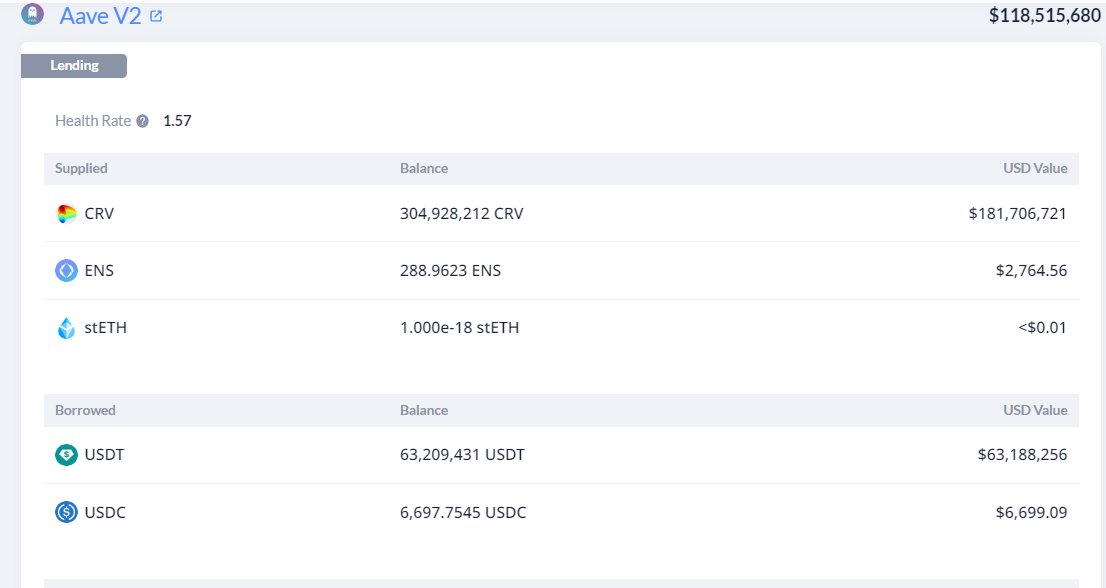
The biggest problem now is that @CurveFinance's founder has millions of dollars worth of $CRV supplied into different lending protocols that were used as collateral to take a loan against.
He has a loan on @AaveAave worth over $60m in USDT while providing over $180m $CRV as collateral; another $25m in loans are opened on protocols such as @fraxfinance and @MIM_Spell.
Now, what is the biggest problem for @AaveAave?
You might be thinking that there is no problem, as the value of the collateral is higher than the value of the loan, which is not wrong.
Selling over $60m worth of $CRV to pay the loan will create a lot of damage for $CRV holders, and it seems that this is not the solution that the founder is seeking.
On the other side, if the price of $CRV drops and @CurveFinance's founder reaches the liquidation threshold, his position of $300m $CRV will need to be liquidated in order to pay the debt.
Sounds easy, right?
The problem is that there is not enough liquidity anywhere to liquidate that position. This means that if @CurveFinance founder won't be able to repay his loan one way or another, @AaveAave will end up with bad debt.
Bad debt is when you owe more money than the collateral you have; in this scenario, the price of $CRV will dump, the liquidation threshold will be achieved, the position can't be paid due to lack of liquidity, and the value of the collateral will be worth less than the value of the loan.
In this scenario, @AaveAave will need to use the safety module to repay the debt and ensure that users' funds are covered. @AaveAave's safety module has enough funds to cover the bad debt (almost $300m worth of $AAVE tokens), but the problem here is that it will put a lot of selling pressure on the $AAVE token.
Why is it unlikely to see this scenario on @HatomProtocol?
@HatomProtocol implemented strong methods to combat this kind of situation, such as:
1️⃣. Borrowing Cap Limit
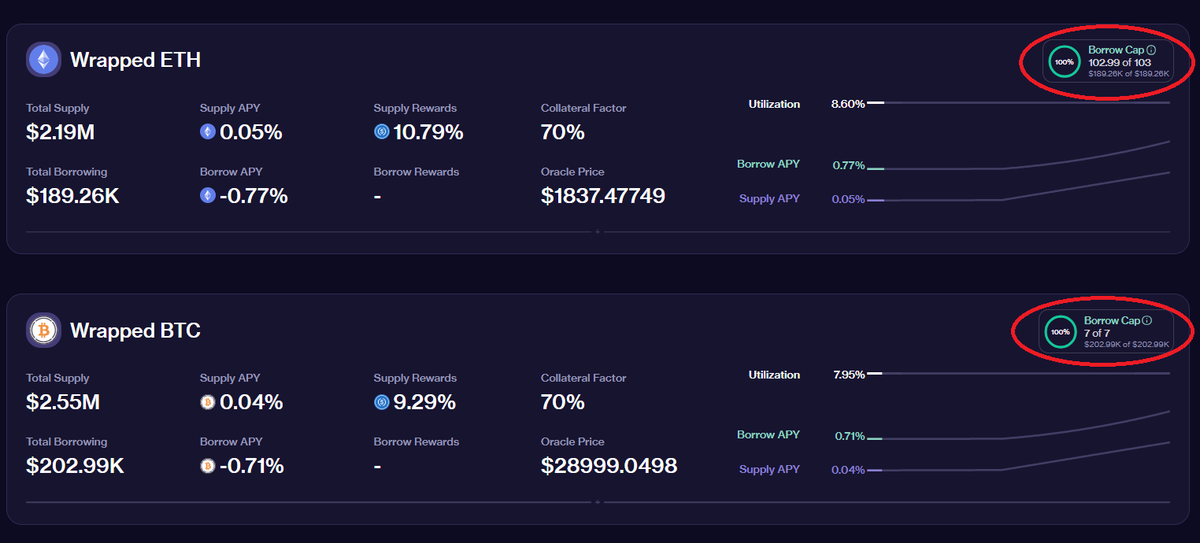
Over the past weeks, we had users complaining about the fact that they can't borrow $ETH and $BTC on the lending protocol. This is because @HatomProtocol imposed a borrowing cap on these two assets due to low liquidity on #MultiversX.
If this borrowing cap limit weren't imposed, users could borrow most of the liquidity on the chain, and in order to pay the debt in case something happens, liquidators would need to bridge assets and pay extra fees.
The borrowing cap limit was introduced on @AaveAave with their v3, and this current situation could have been avoided if it had been implemented sooner, as the possibility to take such a big loan despite low collateral liquidity wouldn't exist.
2️⃣. Isolated Lending Pools
@HatomProtocol lending protocol won't include money markets for all tokens, but only for tokens that will pass certain risk assessments.
The risk parameters that are assessed include:
➼ Smart Contract Risk = focuses on the technical security of a currency based on its underlying code
➼ Counterparty Risk = assesses qualitatively how and by whom the currency is governed
➼ Market Risk = linked to the size and offer and demand fluctuations. These risks are particularly relevant for the assets of the protocol: the collateral.
If the collateral value decreases, it might reach the liquidation threshold and start getting liquidated. The markets then need to hold sufficient volume for these liquidations - sells, which tend to lower the underlying asset price through slippage, affecting the value recovered.
If a token won't be able to meet all these parameters, it can be added to an isolated lending pool; verified projects will be able to provide their community with enhanced token utility by incorporating their token as a money market within their customized lending protocol.
These pools are separated from @HatomProtocol main pools and are managed individually by the creator of that particular pool.
In case of a bad event that would happen with one of those tokens, there won't be any additional risk that @HatomProtocol will face, as the pools are separated and won't affect the main liquidity of the protocol.
3️⃣. Safety Module
As explained above, if @AaveAave needs to use the safety module, there will be selling pressure on the $AAVE token, which will result in the price of the token going down.
This is happening because the @AaveAave model only allows users to supply $AAVE tokens or the LP token $AAVE + $ETH in the Safety Module.
@HatomProtocol users are permitted to deposit a range of assets, including $EGLD, $sEGLD, $BUSD, $USDT, $USDC, $WETH, $WBTC, $UTK, and $HTM. In return, they can earn safety incentives denominated in the $HTM Token, which is procured using a part of the ecosystem's revenue.
In the event of a shortfall, a portion of the funds housed in the Safety Module may be tapped to compensate for the losses incurred. Due to the fact that multiple tokens are used in the Safety Module, in case of this event, we won't see massive selling pressure on the $HTM token alone, and there would be a somehow balanced pressure on all tokens.
What is happening now in DeFi is a challenge for many founders and users, but even if it looks bad, these things must happen in order to learn and adapt. This current event can escalate and can also lead to more serious damage done to DeFi space.
It's important to simulate all possible bad scenarios and from my point of view, @HatomProtocol prepared accordingly to face any of them.
All of the facets that make @HatomProtocol one of the fastest-growing DeFi protocols.
From financial historic roots to the gaps it is filling and impact on the ecosystem.
Excellently put together by a few experienced DeFi users. 🔥
https://t.co/WK5ZDEfTYv
Level Up your game on @MultiversX!
Get ready to ascend from 0 to POWER USER with all the tips and tricks you need in one image!
RT is much appreciated!
A 🧵 ↓ #EGLD#HypergrowthX
Liquid staking can change #MultiversX
We have ~575mln$ locked in normal staking.
If these were moved to liquid staking, we'd move into the top 10 for TVL.
Do you want to push #EGLD? Liquid stake!
Yeah, but what about risks?👇🧵
.@HatomProtocol is coming.
And it will start with a bang with $3mln in incentives for the first year.
How to get them? Here is a short and easy tutorial.
The best risk/reward strategy on Hatom🧵 ↓
🚨7 HATOM strategies you can do at launch.🚨
Lot of earning opportunities and strategies.
Let's see the 7 best ones and their risk & rewards.
#MultiversX DeFI is at a tipping point⚡
A thread🧵
The upcoming lending protocol from @HatomProtocol will open doors to great opportunities for the #MultiversX community, but at the same time, it will introduce a level of risk.
The most significant risk a user can face when using such protocols is LIQUIDATION.
What is Liquidation?
Simply put, liquidation occurs when the value of a borrower's collateral falls below a certain level, known as the liquidation ratio. This safeguard ensures that there's always enough collateral backing the loans.
You see, @HatomProtocol uses over-collateralized loans, which means that for a user to take a loan, they need to provide more collateral than the loan itself.
The main risk of liquidation stems from the unpredictable nature of the market. If the market takes a downturn and the value of the collateral drops significantly, the loan could end up not being fully covered by the collateral. If this happens, the lending protocol might step in to initiate a liquidation to recover the loan amount.
With mechanisms similar to those of @AaveAave and @compoundfinance, @HatomProtocol will likely see a lot of liquidation bots go live, which will monitor the markets, ready to repay users' loans and make a profit.
But let's explain step by step how a user can become subject to liquidation:
1️⃣. Taking Out a Loan: A borrower deposits some collateral and borrows money against it. The amount they borrow is less than the value of the collateral, creating a safety net for the loan.
2️⃣. Market Changes: If the market takes a turn and the value of the collateral drops significantly, the loan might not be fully covered by the collateral anymore.
3️⃣. Reaching the Liquidation Threshold: If the ratio of the loan amount to the value of the collateral (the loan-to-value or LTV ratio) hits the liquidation ratio set by the protocol, the loan is in danger of being liquidated.
4️⃣. Starting the Liquidation: Once the liquidation threshold is hit, the protocol allows liquidators to step in. They pay off part or all of the borrower's debt, and in return, they get some of the borrower's collateral, usually with a little extra as a bonus for their trouble.
5️⃣. After the Liquidation: After the dust settles, the borrower still owns any remaining collateral, but the loan is either smaller or completely paid off. They can continue to use the protocol, but they might need to deposit more collateral if they want to borrow again.
In a nutshell, a user needs to monitor the market and their positions to ensure that a good health factor is maintained and they won't become subject to liquidation.
@HatomProtocol won't allow the position to be fully liquidated; it's a maximum of 50% at a time. This means that even if you are liquidated, you won't lose your entire collateral, but in the worst-case scenario, you'd lose half of it, plus a fee that's paid to the liquidator.
Here's an example of how this works:
You have 100 EGLD at $50 per token and you take a loan of 50% loan-to-value, so $2500.
Let's say that the liquidation threshold is set at 75%.
To calculate the price at which you'll be liquidated, we need to find the price at which the LTV equals the liquidation threshold. This happens when the value of your collateral falls enough that the loan is 75% of the collateral's value.
So this happens when the price of EGLD drops to $33, so the total value of your collateral is $3300 and the loan value is $2500 (your loan is now worth a bit over 75% of your collateral value).
When this happens, a liquidator will come into play and will pay 50% of your loan (just an example).
So it will go as follows:
You have a loan of $2500, and your collateral is worth $3300.
A liquidator comes in and repays 50% of your loan, which is $1250.
In return, the liquidator receives a portion of your collateral. The exact amount they receive is the amount they repaid plus a 10% fee. So, they would receive $1250 (the repaid loan) + $125 (10% fee) = $1375 worth of your collateral.
After the partial liquidation, you would have $1925 worth of collateral left ($3300 original collateral - $1375 taken by the liquidator), and you would still owe the remaining 50% of the loan, which is $1250, and your loan-to-value now stands at 64%.
It's extremely important to always monitor your positions and keep a close eye on market trends. Remember, the crypto market is highly volatile and prices can change rapidly.
If you want to play it safe, take out small loans, a maximum of 50% loan-to-value. This will give you more peace of mind, and you won't have to worry as much about market fluctuations.
Don't go crazy, it's a wild west, educate yourself first!
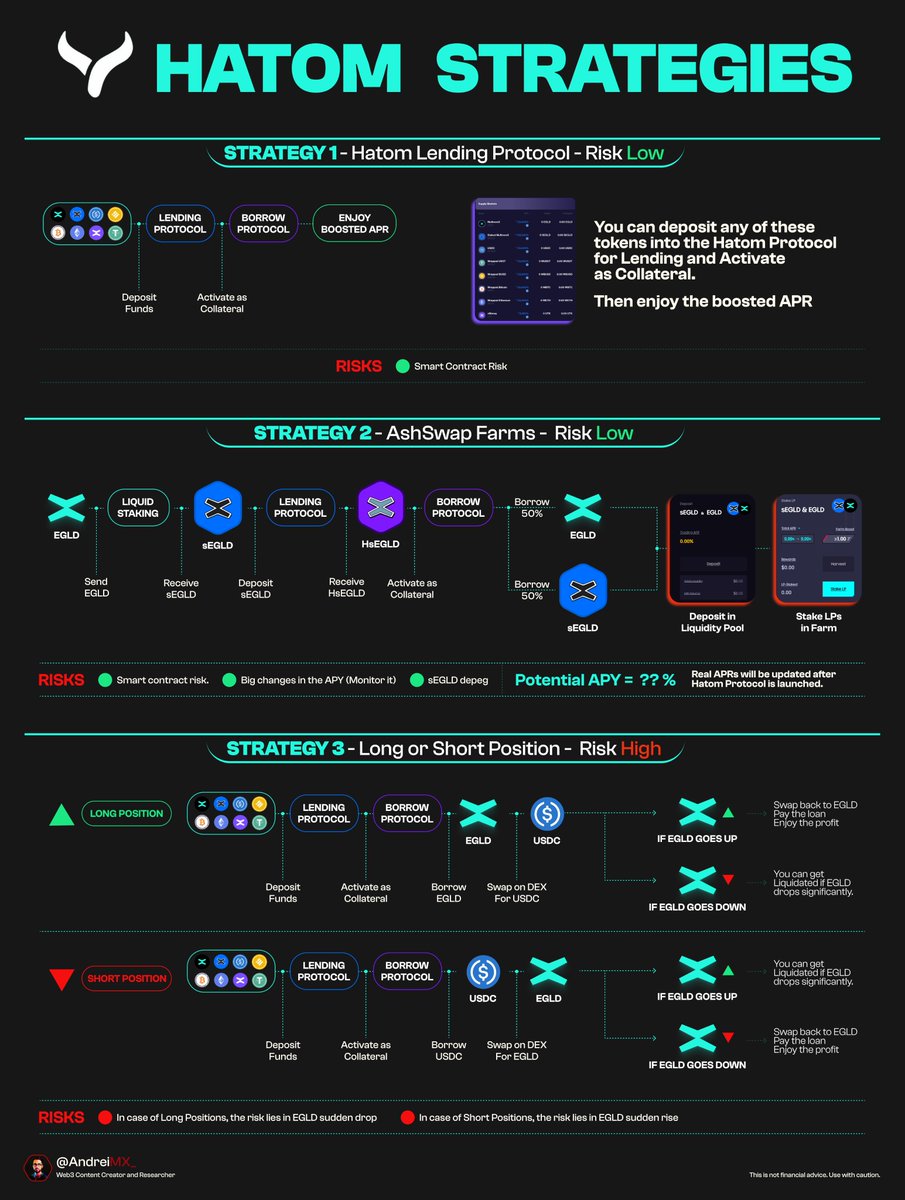
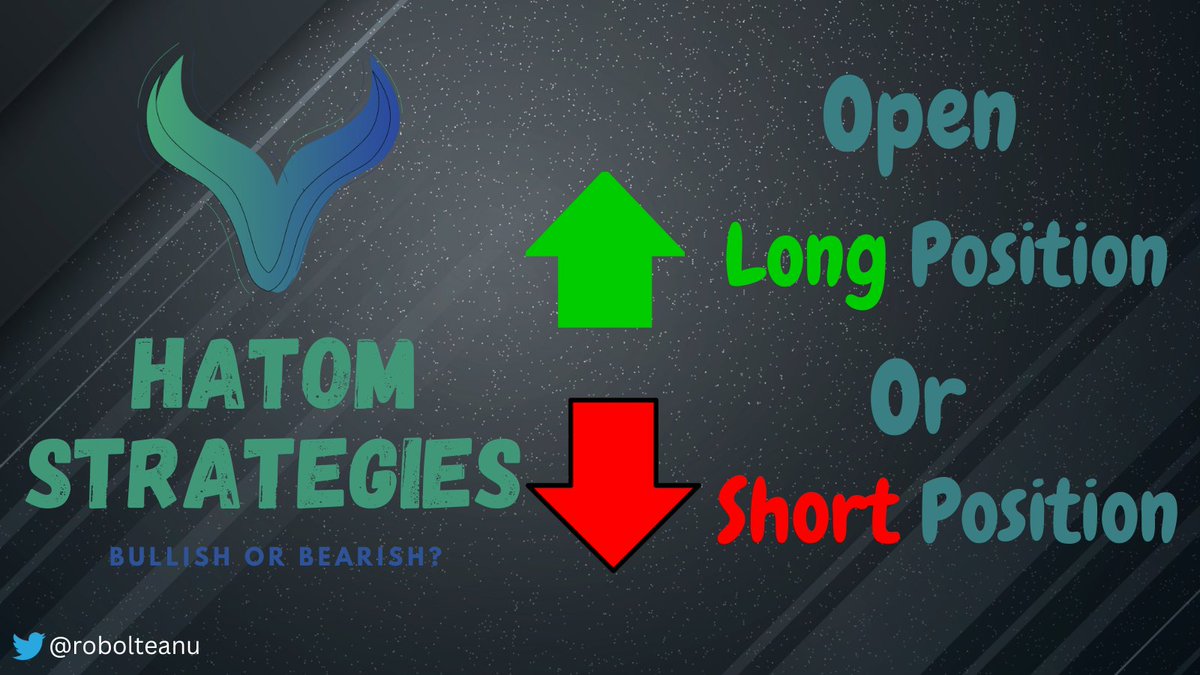
Nothing complicated on the first day of strategies for @HatomProtocol, just a simple explanation of how to open a long or short position.
Learning the basics before we delve into more complicated ones is important.
Let's go 👇
🧵
Liquid staking derivatives are powerful tokens!
Today's strategy will focus on reaping the rewards offered by liquid staking derivatives like $HsEGLD and will leverage a looping strategy to maximize returns.
Curious to find more?
👇 🧵
That's a good question and it's worth clarifying.
To understand the differences, we must first discuss what happened with UST.
The failure of Anchor occurred due to several factors such as unsustainable interest rates and its dependence on an algorithmic stablecoin (UST).
Terra used a two-token model to maintain the stability of its stablecoin, UST. The two tokens are UST, which is pegged to the US dollar, and LUNA, which was used to stabilize the price of UST.
Here's how it works:
When UST is above $1: If the price of UST goes above $1, the system mints and sells more UST to bring the price down. This increases the supply of UST, which should lower the price back to $1.
When UST is below $1: If the price of UST falls below $1, the system allows LUNA holders to buy UST for $1 worth of LUNA. This effectively burns UST and reduces its supply, which should increase the price back to $1.
When the depegging of UST occurred, users had a few options to exit their position. They could use Terra's burn-and-mint mechanism, where LUNA could be exchanged for UST, and the stablecoin would be burned. However, this eventually led to the dilution of the LUNA token.
What then happened was that UST's market cap became larger than LUNA's market cap, and there was no possibility for LUNA to absorb all the pressure from UST, thereby creating a death spiral.
Of course, many other factors were in play, but this is the simplest way to understand what happened there.
The yield that Hatom offers will come strictly from the staking rewards of the EGLD (essentially, the inflation of the token) and the rates that the borrowers will pay on the lending protocol to the lenders.
Even when USH, the Hatom stablecoin, goes live, it will be over-collateralized and not algorithmic. Therefore, it won't rely on another token to help with the repegging, but will rely on arbitrage.
I would suggest looking into protocols like @AaveAave or @compoundfinance as the mechanism of @HatomProtocol it's quite similar.
I hope this helped!
Let’s do things a little differently today.
Progress & updates on @xMoney_com #BuiltOnMultiversX
EXCLUSIVELY shared on Twitter with @martinhoaragao, @luciantodea & myself, covering strategic and important next steps for xMoney and UTK 3.0.
Join us.
There are a lot of L1 chains.
I looked for many, was tempted by some, invested in a few.
But in the end I focused on one.
This is #MultiversX .
But what makes it different, why MvX and not others?
#hypergrowthX
A thread🧵
1/
Hold on tight as we uncover the mind-blowing story behind this astonishing price surge of a single EGLD and why I think this is very possible based on facts.
Where does this amount come from? Let's dive in and find out #together. ⬇️
Many have been talking about the #ledger drama that has unfolded.
There are already heaps of informative and extensive threads.
Let's keep mine short, sweet and simple.
If you keep $EGLD on the Ledger, you should pay attention.