Recently, @Tailscale released tailcat - a netcat style tool working over TailScale network
I made a tiny wrapper to make stable SOCKS5 reverse proxy over tailcat, it’s useful when you need to pivot inside the network during pentest/red team
Link: https://t.co/PC3lYHRTLv
While reviewing forks of my PentestCode repository, I found a malicious fork containing a multi-stage JavaScript backdoor.
⚠️ The original PentestCode repository was NOT compromised. The malware existed only in a third-party fork.
- Dynamic C2 resolution from Ethereum transactions
- Multi-stage execution chain (Stage 1 → Stage 2 → Stage 3)
- Arbitrary JavaScript execution via eval() and spawn()
- WSL2-to-Windows host pivot using node.exe
- Stealthy detached background execution
The infrastructure appears to target pentesting and AI tools, including forks of PentestCode, KaliGPT, Kittysploit, Meterless, Nebula, Codex and others.
IoCs:
Ethereum 0x33ff3edaf55a8e03dcbc7cb40d498a49cd499891
Current C2
23.27.20.187:443 23.27.20.187:80
SHA256
950a8f79e48cb6b36d731bb7adf695e2420014813d5705ce41ea8090e8b06724
62b19e0cbb110bc5d33ad4db07af9c7d1018c3951350369d6bdf2b2c1ebc2828
d15c51eaeecc0230313565dd4457f1dfcc57cfac007d519cd1789cfc2af599eb
Looks like an interesting GitHub supply-chain campaign. Full technical write-up and additional IoCs coming soon.
PentestCode v0.2.4 released
This release focuses on tightening the multi-agent architecture and making agent boundaries explicit instead of relying on prompt behavior.
Changes:
- Added an Artifact Store. PoCs generated by one subagent are now registered in the engagement state and reused by other agents instead of being regenerated.
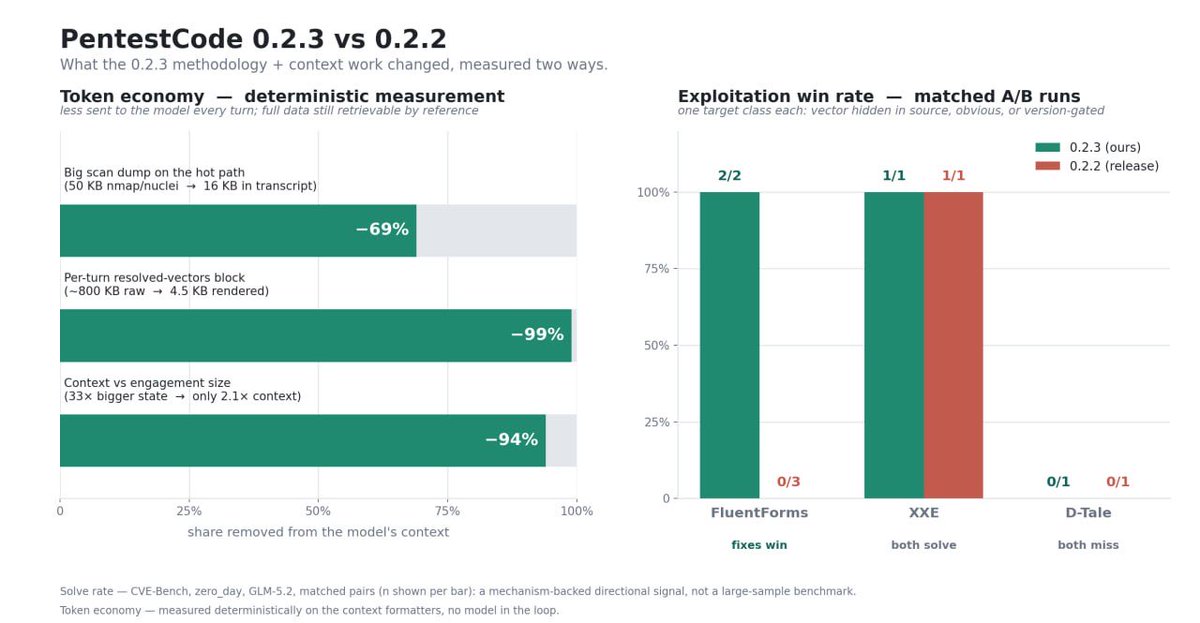
- Reworked engagement state delivery. Subagents now receive only task-relevant context, reducing token usage.
- The coordinator now acts strictly as a coordinator. Added guardrails, watchdogs, execution limits, and loop detection.
- Strengthened result validation. Claiming “root” is no longer enough, successful actions must be backed by artifacts, otherwise they’re marked as suspected.
- Refined reconnaissance skills and adjusted the loading order.
Update: pentestcode upgrade
Feedback, bug reports, and interesting success/failure cases are always welcome.
https://t.co/x7pOz3WOAb
#CyberSecurity #Pentesting #LLM #OpenSource
🧵 PentestCode v0.2.2 — a token-efficiency release. The AI pentest agent got leaner without getting dumber.
⚙️ The deterministic orchestrator is now ON by default. The coordinator dispatches subagent waves through a rolling pipeline — a slot refills the instant one finishes, so you get bounded concurrency with full depth.
Real multi-host pivot run: -87% provider overloads.
💸 Cheap-model offload. Big raw tool dumps (nmap/nuclei/gobuster) get digested by a small model before they hit the transcript — the raw output stays retrievable by ref, and reasoning always runs on your main model.
Turn it on with /small-model (or the small_model config key).
🧠 Smarter, cheaper loops:
• resolved-vectors ledger — the agent stops re-testing dead ends
• per-provider concurrency cap — no more 429/529 storms on fan-out
• objective-based task prompts + cached system prefix = smaller context every turn
🎛 You stay in control:
• abandon a subagent (let it finish) vs kill (hard-stop, reclaim tokens)
• orchestrator off-switch: OPENCODE_DISABLE_ORCHESTRATOR=true
• tune fan-out: OPENCODE_ORCHESTRATOR_CONCURRENCY (default 3)
https://t.co/kmxbIKt4dF
And yes, now it’s in beta stage - not alpha anymore 👾