I’ve given my #voicefortheplanet to call for a #newdealfornature. Nature is vital for our health, our livelihoods and our wellbeing. Let’s set the planet on a path to recovery by 2030. https://t.co/ReROyvy0xb #ourplanet https://t.co/tueuqDufQh #naturematters
Hey @ICICIBank,
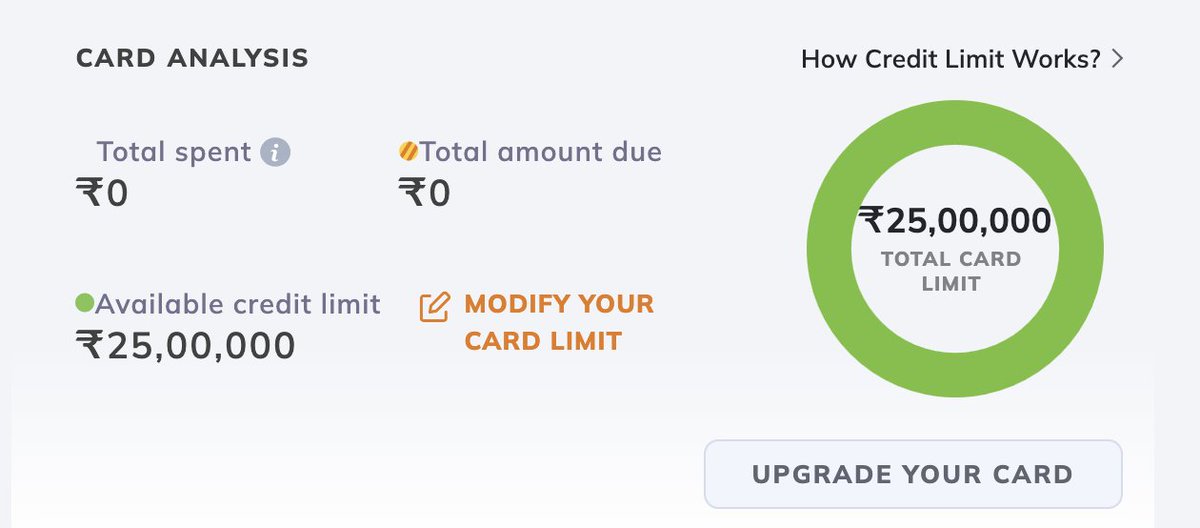
Just found a bug in your website which lets me change my credit card limit/spend limit to any value. I just tried and it changed the Credit Limit on my card from 5L to 25L.
Let me know where can I send the details. Thanks
#Bug
Internet Freedom Foundation
Statement on the Information and Broadcasting Ministry’s piracy notice to Telegram
New Delhi, 4 July 2026
As per a press handout on 4 July the Ministry of Information and Broadcasting issued a notice to Telegram over pirated films and OTT content, directing the platform to build systems to detect, report, disable and remove infringing material, to act against repeat infringers including channels, administrators and “associated entities”, and to file an Action Taken Report within fifteen days. Piracy causes real harm. However, a Union Ministry ordering a platform, by undisclosed letter, to build a private content policing machine is not the answer.
The notice has no clear basis in law, and may not even lie with this ministry. Intermediary obligations under the IT Rules, 2021 are in Part II, administered by the Ministry of Electronics and Information Technology. The Information and Broadcasting Ministry’s remit is Part III, covering digital news publishers and OTT services. Even the constitutionality of Part III is pending determination and several stay orders have been passed. Telegram is neither a digitial news publisher nor a OTT service provider. Beyond the this, no provision of the IT Act lets the executive order an intermediary to build filtering systems. As we have stated the Union Government meddling into platform design when without any clear legislative authority is an arbitrary action of a digital license raj.
As a reminder on first principles, copyright is a private right, enforced by rights holders before the civil courts, which already grant the film industry site blocking and John Doe injunctions. Dressing it up in the language of a, “creator economy” is disingenuous and likely to lead to censorship of those very online creators (for instance, reaction videos or parodies).
Beyond the law, the demand in feasible. The model that may be used as an example is YouTube’s Content ID, which cost Google over a hundred million dollars and nearly two decades, and still only detects a match. It cannot read a licence or recognise fair dealing under Section 52, so it flags lawful criticism and public-domain works.
Telegram’s architecture, where files are forwarded, re-encoded, renamed and rebuilt, is a poor fit for fingerprinting, and encrypted secret chats (enabled by the platform) cannot be scanned without breaking encryption. What can be built in fifteen days is a blunt filter that removes lawful speech to avoid risk.
Secrecy is an unfortunate hallmark of digital censorship and continues as the notice has not been published. What exists in public is a handout briefed via unnamed sources and helps contour reporting and narrative control by public authorities. This is the third such step in a fortnight, after the block of Telegram and the username notices to WhatsApp, Telegram and Signal.
IFF is sounding the alarm on the rapid acceleration of digital authoritarianism in India under the guise of moral panics and social issues. We demand regulatory governance than the control of platforms by the Union Government.
We call on the Union Government to publish the notice, state the provision of law under which it was issued, and explain by what authority it directs a messaging intermediary.
After WhatsApp, MeitY has reportedly sent notices to Telegram and Signal over their username features, raising serious questions about privacy, executive overreach, and constitutional safeguards.
Watch to understand what's happening and why it matters.
Statement on MeitY's notices widen an unconstitutional dragnet over privacy features
New Delhi, 2 July 2026
A day after its notice to WhatsApp on the usernames feature, as per press reports MeitY has today evening sent the same kind of notice to Telegram and Signal, asking each to explain a username feature and its safeguards against impersonation and misuse. In two days the Ministry has gone from one platform to three, and from acting on content to policing the design of products. This is a dragnet, it is widening, and it has no basis in law. As we warned in our first statement it is a digital license raj that is expanding arbitrary executive power.
We know of these notices only through press reports, and the notices themselves have not been published. Where that reporting is sourced from within the Government, MeitY is left free to shape the coverage by choosing what to hand out and to whom. Releasing a document selectively, is not the same as disclosing it to the public, and it is the opposite of transparency. The public is told that platforms are being made to answer for "misuse", while the notice that would show the demand has no basis in law stays out of sight.
We again highlight that the core defect is constitutional. The executive is restraining lawful features, and with them the private communication those features protect, without the authority of law. We agree there can be regulatory authority for such features however it requires a clear articulation of policy intent that is rooted in legislation. This simply does not exist at present. No provision of the IT Act permits it as we have explained in our statement yesterday. A restraint on how a platform may operate cuts into its freedom to carry on its work under Article 19(1)(g), and a restraint on private messaging cuts into the users' freedom of speech under Article 19(1)(a). A restriction on either must fall within Article 19(2) or 19(6) and must rest on a law, and here there is no law at all.
The sweep is also indiscriminate, which is a vice of its own. The three features are not the same. Here, the inclusion of Signal is the sharpest sign of what this is really about. Signal is a non-profit. It is encrypted by default, it collects almost no data, and its username feature exists for the single purpose of letting people communicate without handing over a phone number. Signal's is a private contact tokens with no public directory, which reduces what a user reveals rather than expose it. Signal in particular keeps almost nothing, has refused to build the searchable directory an identification order would need, and is the tool journalists, activists and many at risk people and their contacts rely on, so a notice aimed at it strikes straight at protected speech.
Beneath all three notices sits the demand for traceability under Rule 4(2) of the IT Rules, 2021, which cannot be met on an encrypted service without breaking the encryption that protects every user, and which is already under challenge before the Delhi High Court as exceeding the Act.
Each notice is a step here makes the next look ordinary and needs to clearly and unequivocally condemned for the widespread digital authoritarianism. First pieces of content are blocked in thousands, even entire accounts sometimes just for parody posts, then a whole platform is blocked for a week, and now companies are told to account for the features that keep their users safe. This is how executive power grows past the limits of our constitution.
We call on MeitY to withdraw the notices to WhatsApp, Telegram and Signal, to publish them, and to state the provision of law under which it claims to act. Privacy protective design is not a wrong to be explained away, and the Constitution does not permit a widening dragnet over the means by which people speak.
Statement on MeitY's notice to WhatsApp over the "usernames" feature
The Ministry of Electronics and Information Technology (MeitY) has sent WhatsApp a notice about the usernames feature it announced on 29 June 2026. The notice asks the company to explain, within three days, why regulatory action should not be taken against it "for launching a feature that may increase cybercrimes", and it directs the company "not to roll out this feature until the consultation on this point is achieved to the satisfaction of the Government". The Internet Freedom Foundation is concerned that the notice has no clear basis in law. It is an attempt by the executive to decide what a company may build and ship, which no statute permits.
The notice treats the launch of a lawful feature as a wrong the company must justify. That reverses the ordinary position especially given the absence of any clear legal power that exists. MeitY does not name any provision that lets it approve a product feature before release or order one withdrawn, because there is none, and the provisions it does cite do not supply that power.
Section 79 of the IT Act, 2000 is a safe harbour that protects an intermediary from liability for what its users post, so long as it observes due diligence. It decides when a platform can be held liable. It is not a power for MeitY to decide what features the platform may offer. Sections 66C and 66D punish identity theft and cheating by personation. They are criminal offences, tried by courts, aimed at the person who steals an identity, not at the maker of a tool that a third party misuses. Also, on MeitY's logic, a telecom operator could be told not to sell SIM cards because SIM cards are used in almost every online fraud.
Rule 3(1)(b), Rule 3(2) and Rule 4 of the IT Rules, 2021 are due diligence and grievance obligations and cannot be converted into a licensing scheme. Section 69A, the one provision that lets MeitY control what appears online, permits the blocking of specific information through a set procedure. It says nothing about which features a company may build. Further the IT Rules, 2021 are subordinate legislation made under Sections 79 and 87 of the IT Act, and subordinate rules cannot travel beyond the parent statute (Ajoy Kumar Banerjee v. Union of India). If a rule cannot exceed the Act, a letter certainly cannot. The power to require prior permission for a feature is not in the Act, not in the Rules, and cannot be created by a notice.
MeitY has tried this before. In March 2024 it told the same large intermediaries, among them AI Companies, to obtain its explicit permission before deploying under-tested AI models. That was criticised as an overreach that sought to build a licensing mechanism with no empowering provision in the IT Act, and within a fortnight MeitY withdrew it and dropped the permission requirement. This notice repeats the move for a single feature and goes further, because it names one company, sets a three-day clock, and bars the launch until MeitY is satisfied.
This matters beyond WhatsApp. A power asserted against one company by letter can be turned on any company and any feature. On this reasoning MeitY could tell a browser not to switch on a privacy setting by default, or a payments app not to add a login method, each time until it was content. The notice also invokes traceability, through Rule 4(2) of the IT Rules, 2021 and the identification of the "first originator" of a message. Rule 4(2) has been challenged as exceeding its parent provision and resting on no law made by Parliament, and that challenge is pending before the Delhi High Court. Raising it against a feature meant to share fewer identifiers fits a pattern.
We ask MeitY to state the exact provision of law under which this notice, and the direction to halt the roll-out, has been issued, and to withdraw that direction. It should stop using Section 79 and the contested traceability rule as leverage to control product design and to reverse features that improve privacy. Impersonation and fraud are real risks, but they are met by enforcing the criminal law against those who commit them, and by open processes that rest on identified legal powers. They are not met by MeitY deciding, in private and by letter, what features Indians may use. That is a licence raj for software features.
New Delhi, 1 July 2026
@VoltasBeko Where the hell is the manual for Voltas Beko 6 kg 5 Star Fully Automatic Front Load with In-built Heater White (WFL6012B7COUBAA/WWV)? It's definitely not on your support site.
Statement : Shutting down Telegram is a band aid solution and is a disproportionate answer to exam fraud
The Internet Freedom Foundation objects to the directions announced today in the National Testing Agency's press release on action against the Telegram platform. On the NTA's recommendation, the Ministry of Electronics and Information Technology has, under Section 69A of the Information Technology Act, 2000, restricted access to the whole of Telegram in India until 22 June 2026, and has separately ordered the platform to switch off message-editing for every Indian user until 30 June 2026. This is a blunt, nationwide measure aimed at the conduct of rampant fraud rackets, and on the Government's own admission is constitutionally incompatible.
At the outset it is important to note that Section 69A and the Blocking Rules of 2009 framed under it allow the Government to block access to specific “information” on a computer resource. They do not extend to switching off an entire intermediary, still less to ordering a company to redesign its product by removing a feature for a whole country. In Shreya Singhal v Union of India, the Supreme Court upheld Section 69A because it is narrow and hedged with procedural safeguards. Reading it to authorise shutting down a platform that lakhs use is an overbroad restriction by the NTAs own admission. For the message-editing direction the release identifies no source of power at all. If one exists, the order must say so.
The release argues against itself
A restriction on access has to be the least intrusive measure that achieves its aim as per the constitutional test of proportionality laid down in Justice K.S. Puttaswamy v. Union of India (2017) and applied in Anuradha Bhasin v. Union of India (2020). The NTA's own narration shows the block fails its nodal agency, the release says, “has secured the prompt take-down of a substantial number of Telegram channels, groups and bots”, and this targeted work “is the reason the harm caused by these rackets has been contained to the extent it has”. If channel level takedown contained the harm, the case for a blanket block collapses and hence the Government has reached for a heavier tool while conceding that a lighter one was working. The collateral cost sits on the record too as noted in the press release. The block, the NTA accepts, “affects lakhs of citizens who use the Telegram platform for legitimate personal, educational, professional and informational purposes”. The release also says there is "no such paper available outside the secured examination chain" and that “the security of the examination is unaffected by the action taken”. If the exam is secure and no leak exists, what is being suppressed is rumour, and rumour cannot justify closing a platform when specific blocking and criminal prosecution remain available.
Students use of Telegram
The block of telegram is reactive and ineffective and will punish ordinary users instead of addressing the systemic source of exam leaks. This blocking comes in the final days of NEET preparation, when thousands of students depend on Telegram for study groups, doubt-clearing, and shared resources. Also, it is important to consider that the source of exam papers leak will occur from inside the system, among insiders and across the printing and logistics chain, with the platform being the most downstream channel for distribution. Hence, switching off Telegram, is merely a deflection from the repeated failures that will continue while media attention is directed towards this Telegram ban.
Lack of transparency
At present only a press release from the NTA has been provided, which recommended the block but the reasoned order of MeitY, the authority that issued it, has not been released. The Anuradha Bhasin decision requires that orders restricting access be published so they can be tested in court. Here the order, and the reasoning of the committee behind it, stay out of view, and we do not know whether Telegram was heard at all. An announcement of a block is no substitute for an order the affected party can challenge.
Blunt to enforce and very easy to evade
Usually, app-level blocks run through IS-level DNS and IP filtering. They are over inclusive, sweeping in lawful use, yet simple to evade as a determined exam leak racket moves to a VPN or a mirror within minutes while ordinary users lose the service for a week.
We ask the Government to:
1) Publish the MeitY Section 69A order and the NTA recommendation behind it, with reasons;
2) State the legal basis for the message editing direction, or withdraw it;
3) Confirm whether Telegram was given a hearing under the Blocking Rules, and place the committee's record before any court that hears a challenge; and
4) Lift the platform-wide restriction and rely on the targeted takedowns the NTA itself credits with containing the harm.
We emphasise that the NEET (UG) 2026 re-examination is worth protecting and it concerns the future of lakhs of aspirants. It requires securing the entire process of examination rather than reaching for purported band aid solutions that instead cause more harm. The State cannot switch off a service used by lakhs to answer the wrongdoing of a few, and cannot do it through an order no one affected is allowed to read. On its own facts, the Government has done both.
New Delhi, 16 June 2026.
I ask the reason for lock & they say requesting multiple OTPs. WTF. How am I supposed to login without OTP? Because you fuckers have decided to remove username & password OTP.
@JioHotstar I bought an annual subscription and logged in to my 3 devices but unable to play any content because you f**kers have locked my account due to suspicious activity. I get in touch with customer care and these assholes ask me to clear cache & data.
@TeamYouTube I don't want to do this every time. If someone needs to change they can change it manually, why the non original audio is the default option?