3 months & €1.5m in hardware and robots
Demo day is coming up!!!
Very grateful to have been part of this journey with @coprod_Inc and have worked alongside such talented people!💜
Sign up here: https://t.co/3oG7DqYqdR
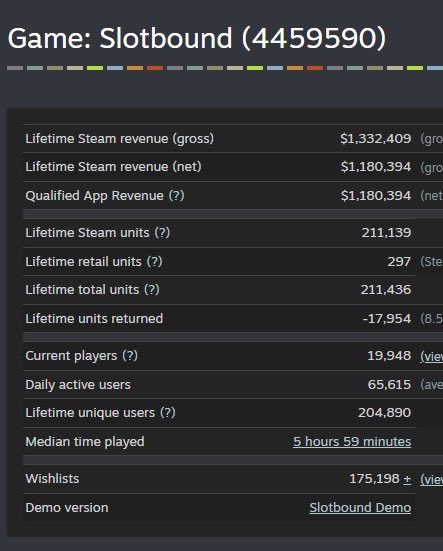
A solo developer just vibe-coded his first game and made $1.33 million on Steam in just one week.
His game, Slotbound, has sold over 200,000 copies in six days and has a 91% Very Positive rating.
The dev openly admitted using AI for coding and parts of the game’s visuals.
“AI was involved throughout the project, especially with coding and parts of the visual workflow.”
In testing GPT-6.2, I used it to make a significant historical discovery which I detail in the post below. This suggests that the process of research and discovery we’re already seeing in verifiable domains like math is starting to generalize to non-deterministic fields like history.
You can read the full post here:
https://t.co/Vm7MA2R3aQ
In a nutshell, Yale’s Beinecke Library holds an anonymous sketchbook of an 1808 journey from Montreal to Lake Superior and back. I’ve spent many hours over the years trying to figure out who made the sketches with no luck. The artist could literally be any one of several thousand people. There are few clues: only four dated and labelled images.
With minimal prompting, in just 22 minutes, Astra used publicly available sources to identify a minor French aristocrat, the vicomte de Chabot, as the artist and suggested that we test the hypothesis by ordering copies of a little known microfilmed diary of Chabot’s trip it also found.
I was truly stunned. I’d never heard of Chabot or this diary! New document finds are also exceedingly rare in a well worn field like fur trade history.
I ordered scans of the journal from microfilm and when they arrived the handwriting matched the captions in the sketchbook. The itinerary also aligned perfectly with the few dated drawings in the book. But there was actually the type of conclusive evidence we rarely get as historians: on 18 June 1808, after Chabot’s canoe reached Fort St. Joseph, he wrote “I took a sketch” before describing the exact view of the fort depicted in a matching drawing.
The journal itself is also a major find. It had been mentioned once in a dissertation footnote, but in a completely different area of history and is unknown to fur trade or Canadian historians. It’s long and detailed, covering some 162 notebook pages which makes this a significant new document to my field. Attached to the journal was another trove of documents too: excerpts from long-destroyed North West Company papers, journals, and letters. Again, this almost never happens. Both finds equally surprised the other leading experts I consulted.
Although we can construct a coherent narrative in hindsight, I cannot emphasize enough how exceedingly difficult this sort of thinking and recall is for humans. Unlike a human, Astra was able to tackle the problem from both ends at once: working forward from the scant facts of the 1808 journey pictured in the sketchbook and backwards from the immense number of surviving facts about 1808 British North America in general.
While we can technically explain Astra’s path to this find as a product of enhanced search capabilities, it conducted the investigation from end to end. I basically acted as the research assistant, restricting copies of the paper documents it needed.
To my mind, this puts historians in a similar position as the mathematicians found themselves about eleven months ago, when LLMs started to solve the first Erdős problems. Over the past year, we’ve watched these same models go from learning to read handwriting, to beginning to think historically, to mastering the undergraduate essay, and finally to making small but real contributions to human knowledge more or less autonomously.
The trajectory seems clear.
I took this picture from the plane while leaving Switzerland today. Seriously, only two major European countries remain where you'd want to live and raise a family, Switzerland and Poland.
Here's why:
Switzerland is easy to explain, direct democracy with referendums keeps the country honest. Left- and right-wing populists have little chance of succeeding. It's probably the last country in Europe where politicians really care about what people want and what concerns them.
Poland remembers the socialist misery and oppression and is therefore deeply immune to the left-green mind virus consuming so many European societies. Poles know hard work and entrepreneurial spirit are required for a better life, not left redistribution nonsense. Poland welcomes immigrants who want to integrate and contribute, and quickly deports everyone else. Poland has a booming economy, low unemployment, low crime, and a peaceful society.
Why can't the UK, France, and Germany be like Switzerland or Poland? It's not about money, it's about the mindset and values.
Was much surprised when Amazon canceled (and refunded the full amount within days) an earlier more expensive Prime sub automatically when I signed up for a Prime offer.
YouTube Premium subscriber? Thinking of getting a Google AI Ultra plan?
The AI Ultra plan includes Youtube Premium Family, which is great but…
If you already have Premium it won’t automatically be cancelled (!!)
Meaning you will be charged for your original plan until you manually cancel it in your Youtube Subscription settings
So make sure you check and avoid being overcharged 👀
the "let's do one of those cool iso maps for Warsaw!" project turned into something more ✨
the street level (and crow level!) are super fun + you can learn fun facts about Warsaw while discovering it!
It's crazy reading about just how unprepared France was for the Franco-Prussian War.
> Badly underestimated Prussia's strength
> Mobilization was comically chaotic
> Entered the war with virtually no allied support
> Used selective conscription that allowed the wealthy to avoid personal service, leaving France with inadequate manpower reserves
> Prussia had a significantly stronger General Staff
> France had no real answer for Prussia's heavy artillery
In summary, it was an army and state that had rested on its laurels against a country that had meticulously planned for the war to come.
We worked with @thinkymachines to make Inkling 2 Mini run fast locally:
- 210 tok/sec decode, 3620 tok/sec prefill on 96GB M5 Ultra Mac Studio
- 125 tok/sec decode, 1750 tok/sec prefill on 48GB M5 Max MacBook Pro
It built a native weather app 1.8x faster than Claude Sonnet 5.5 on an M5 Ultra Mac Studio and 11x cheaper (API pricing).
The looping architecture is ideal for local devices like MacBooks, which are memory constrained. Looping layers of the model increases inference-time compute (and intelligence) without increasing the size of the model.