New #NeurIPS2026 paper from @NVIDIA
Video world models can now generate realistic interactive worlds, but they often forget places they have visited. Turn the camera away and back again and the scene has changed.
We introduce WorldTrace 🧵
https://t.co/KOa83ehJNa
@Parskatt yeah npy is too large and is bottlenecked by disk/network bandwidth. I wonder how sz3 compares against bitshuffle + lz4 though. That’s been my go to in a packed storage format like hdf5. Gonna do some testing. Thanks for sharing!
Check out our latest work, BirdDreams! It's a world model that jointly simulates scene appearance and agent behaviors. If you run a red light inside it, the other agents will abruptly brake for you (cussing 🤬 not yet modeled).
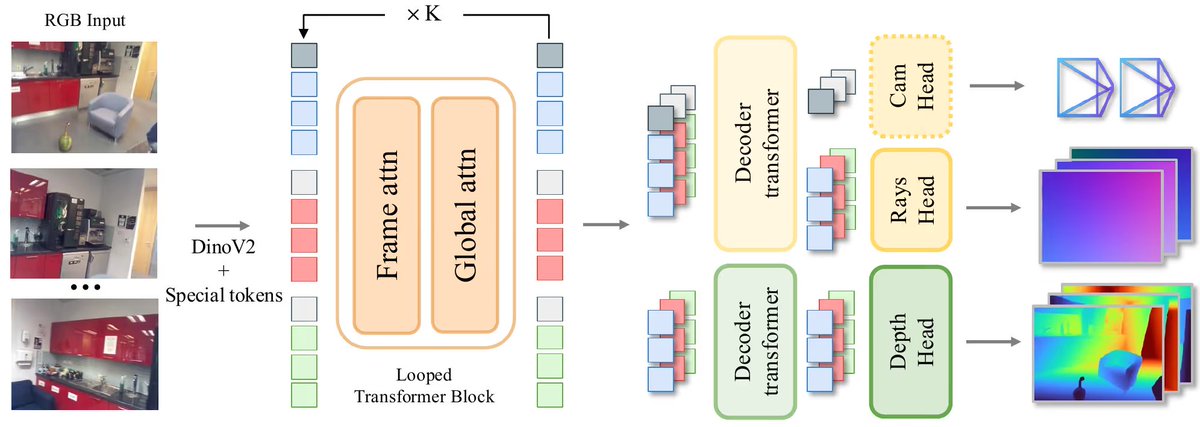
Meet Déjà View, a model that turns photos taken from different angles into 3D geometry and camera positions.
By looping a single transformer block, this 117M-parameter model matches or outperforms models up to 10x larger across five benchmarks, using comparable or less compute. Researchers can dial the number of loops to fit their compute budget.
#NeurIPS2026 oral paper + code: https://t.co/4jiCRA71Oo
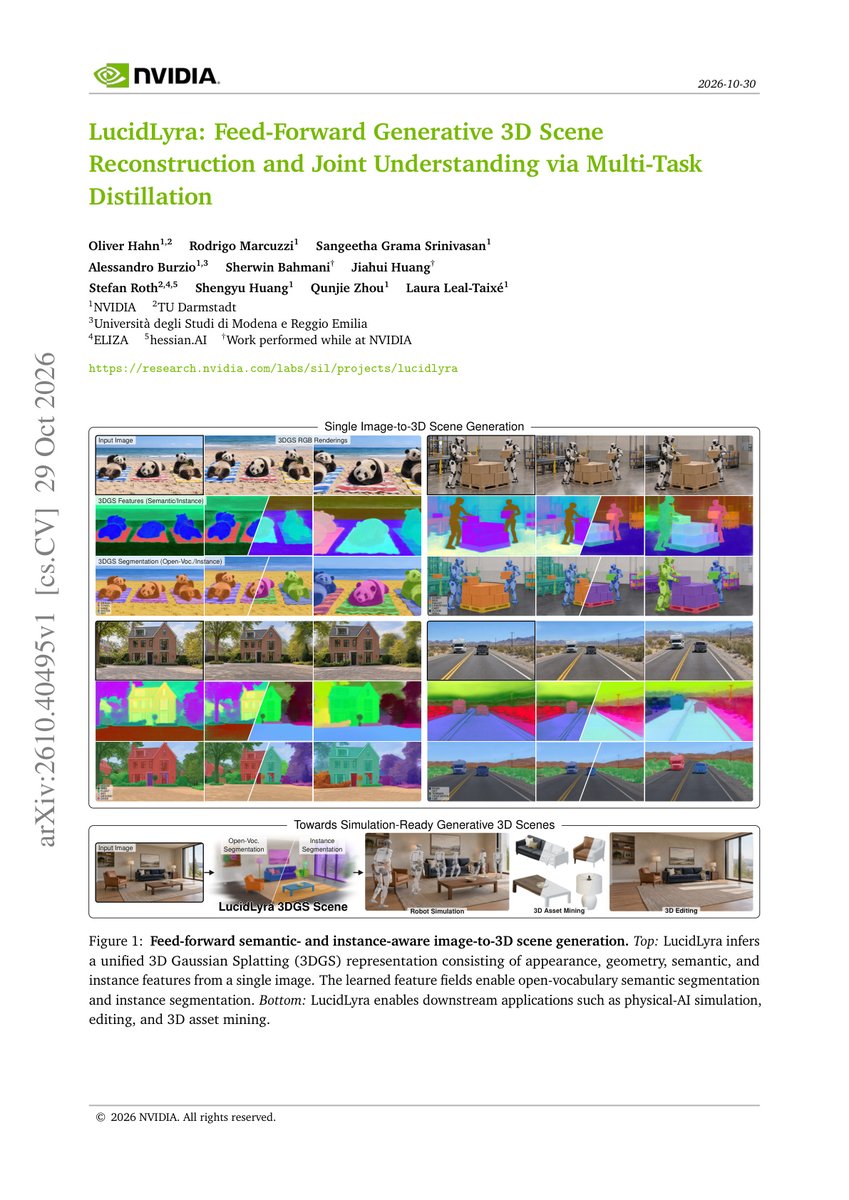
Single-view 3D gives you a nice scene or semantics — not both. LucidLyra distills video diffusion into 3D Gaussians that answer open-vocabulary queries instantly, no fine-tuning needed 🎯
📄 https://t.co/AfgrvVLtma
🌐 https://t.co/PYuySuIUv1
Super proud to share what the team has been working on! Foundation4D, one model, shared video features, multiple ways to understand and reconstruct a driving scene: depth, camera poses, 3D objects, occupancy and Gaussian splats. 5 things I'm excited about:
NVIDIA Foundation4D is a unified 4D perception foundation model generating camera-based annotations for training and NVIDIA Omniverse NuRec reconstruction, simplifying dataset preparation without lidar input.
Explore more: https://t.co/Hv733SJfbt
Excited to share our new Cosmos3-Nano–based ArtiFixer is now out 🚀 Almost matching the quality of the Wan 2.1 14B based one with just 8B parameters in the generation tower. And most importantly 3–4× faster inference while using about half the GPU memory! https://t.co/oGKcr5cCmU
Check out Cosmos Simulation: Interactive World Simulation with Cosmos for Physical AI:
🌐Website: https://t.co/zknXhmyyIS
📜Report: https://t.co/npgPFQM764
🤖 Models: https://t.co/awKq1781ia
At @VeedaAI we are growing our team across all fields and locations (Zurich, Bay Area, Toronto)! Come join us and help build the future of Physical AI! My DMs are open!
Come build the future of simulation for AV and robotics at @nvidia! We are looking for interns to work on generative AI, world models, reconstruction, policy learning, VLMs, geometry and scene understanding. Apply here!
https://t.co/nFoeqQzzxt
We’re hiring PhD interns for NVIDIA Research's Learning and Perception Research (LPR) team!
We are passionate about embodied AI research that pushes boundaries while making real-world impact. We are particularly interested in agentic reasoning, multimodal and continual learning, AI scientists, and beyond.
To be considered, you must be a currently enrolled PhD student with a promising research track record (publications and/or core contributor to open-source projects). Please apply directly at the link below!
Listing: https://t.co/sgxSsvXJs9
Team homepage: https://t.co/kfkLSzMmHi
This reminded me of NVIDIA’s Deja Vu.
Deja Vu repeats a single ~10M-parameter Transformer block K times and can approach VGGT-omega 1B performance.
For 3D reconstruction, this idea feels especially natural. The model may not need huge parameter count to store knowledge. A lot of the work is repeatedly updating correspondence, geometry, and consistency from the same observations.
Maybe scaling reconstruction/reasoning is less about parameter count, and more about recurrent compute depth.