after a century of uninterrupted growth, for 15 years, between 2005 and 2020, America did not grow electrical generation. we completely forgot what it meant to grow industrial capacity. politicians constantly talked about "reindustrializing" and "bringing back high-paying blue collar jobs".
then AI actually did it. for the first time in 20 years we started reindustrializing America's heartland. creating a massive boom of skilled, high-paying blue collar labor. an enormous construction boom. a new industry emerged to finance the expansion of our aging grid. a grid that needed to grow anyway, if we were going to become a modern, highly electrified economy. and all of a sudden the tech companies and hyperscalers showed up with wads of cash, completely willing to pay for a massive grid expansion.
and all the politicians that talked so tough about "bringing back industry and blue collar jobs" panicked when the rubber hit the road. because the NIMBYists had become used to stagnation and freaked out when it came time to build a couple transmission lines. all that tough talk down the drain, because some boomers have AI anxiety and think a warehouse full of computers is unsightly next to a mattress warehouse and a vape shop. probably the most pathetic political episode I've ever witnessed.
the only question that really matters is: is it still possible to build anything at all in this country? or have we completely lost the political will?
What people don’t understand is that NY and CA have industrialized “carefare” - effectively Medicaid funded welfare. It’s all ultimately paid for by the federal taxpayer, since these states will go bk and will have to be bailed out.
The program is a way to pay affinity client groups - immigrants, low earners, reliable D voters - for doing ~nothing. It’s a glorified welfare scheme being laundered through Medicaid. This is happening because no one wants to vote against “more healthcare”. Healthcare is good, right?
It’s not “fraud” per se because the programs growing to absolutely massive scale is the point; the insane amounts of grift are completely legitimate and acceptable under the terms of the scheme. It’s just a way to plunder the NY/CA taxpayer and the federal taxpayer in the end. No one has figured it out yet but it’s basically a massive cash for votes scheme
It’s the kind of stuff that will eventually completely bankrupt the country, not just blue states. Once you see it, you will never unsee
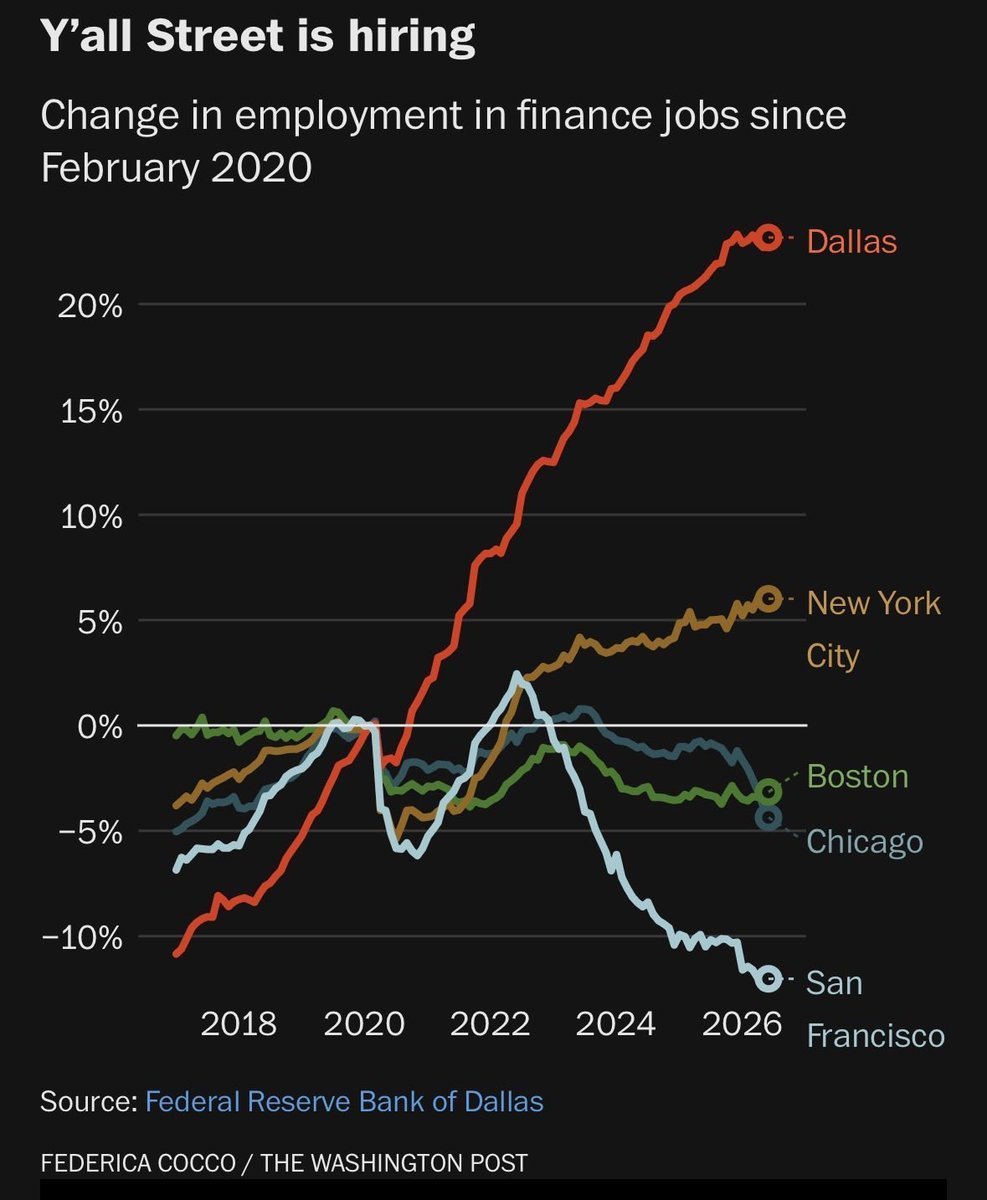
I remember reading Liar's Poker while growing up in Dallas in 1989. The book described “Equities in Dallas” as Wall Street’s version of Siberia: the least prestigious job in Salomon Brother's least prestigious office. Times have changed.
Rich Hall, President, CEO, and CIO of UTIMCO, the nation's largest public endowment, joins my colleague Scott T. Slayton, CFA, for a rare interview on this week's Capital Creek 3in10 podcast. https://t.co/lshEcpaVHx
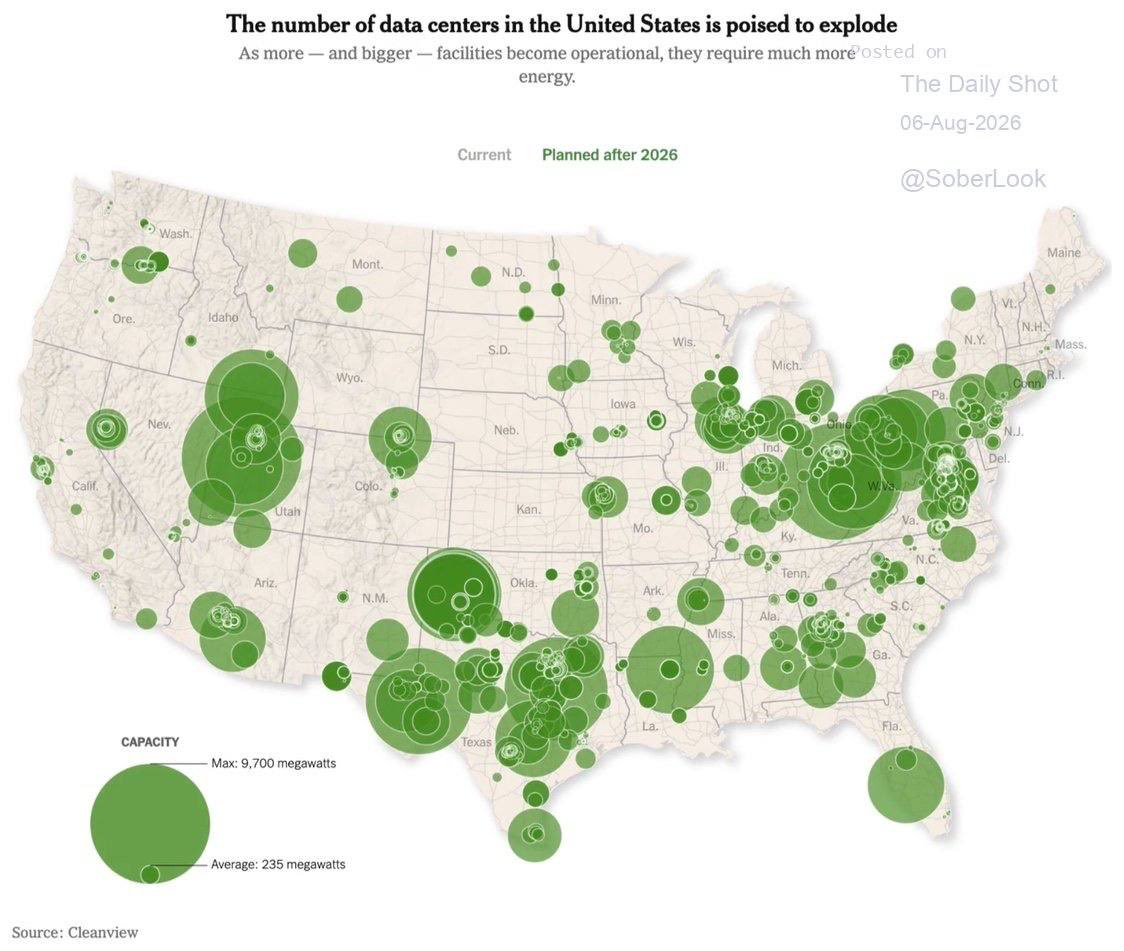
With some very minor exceptions, the data center buildout is happening in red states (historically some purple but on a go forward basis, red).
The data center question is entirely a red on red issue. It’s impossible to build in blues and power is expensive, hence no one is even planning to build there
🚨this is why the left is poisoning the well on datacenters 🚨
They have nothing at stake. Nothing to gain, nothing to lose. They will run the Greta / fracking playbook on DCs.
The right must avoid being useful idiots for the left and China at all costs.
By all means, debate the merit of the DC buildout. But don’t fall into the slopulist trap of being against them “because everyone is” or because the left manufactures consent via the press and NGOs.
The left is not participating in the DC buildout; they should not have a seat at the table. Assume that they will try to play spoiler to ruin what is a massive reindustrialization opportunity in Americas heartland, creating skilled jobs that have been missing for so long. It’s entirely rational for the left to ruin this for red America. Don’t let them.
⚡️The species just crossed a one-way threshold.
For thousands of years, intelligence meant biology. Every theorem, every breakthrough, every civilization-level advance depended on the rarest human minds and the finite hours of a human lifetime. That monopoly has ended.
This announcement is a receipt that cognition has become infrastructure.
Once a machine begins generating genuinely new mathematics instead of rearranging existing knowledge, the limiting factor behind scientific progress shifts. Discovery stops being constrained by human thought and becomes constrained by verification, experimentation, manufacturing, energy, and politics.
The institutions built to govern knowledge cannot run at the speed of the thing they now govern. Peer review, universities, governments, regulators, patents, and scientific careers evolved for a world where ideas were scarce. They are about to face a world where ideas are abundant and implementation becomes the scarce resource.
Every solved theorem expands the search space for the next theorem. Every new proof becomes another cognitive tool available instantly and permanently. Knowledge compounds against itself. Progress begins feeding progress.
The deepest consequence has nothing to do with mathematics.
Mathematics is simply the cleanest measurement device available for detecting general intelligence. Nobody accidentally solves frontier mathematical problems across unrelated domains. That requires abstraction, long-horizon reasoning, internal consistency, and the ability to construct entirely new conceptual objects.
That capability propagates outward.
Physics.
Biology.
Materials.
Energy.
Medicine.
Computer architecture.
Cryptography.
Economics.
Every field built on formal reasoning eventually absorbs the same force.
History will probably remember chatbots the way history remembers the first steam engines. Interesting. Useful. Primitive. The real event begins when intelligence itself becomes an industrial process.
Civilization has spent centuries amplifying muscle with machines. Civilization is now industrializing thought.
Everything downstream changes.
The Texas grid has never been stronger.
Today it set a new record-providing more than 91 gigawatts of power. We had plenty of extra power-more than 20 GWs extra! (about 4 million homes extra).
Texas is #1 for electric power.
We provide more than the 2nd & 3rd states combined.
⚡️The frontier is flattening faster than American institutions are emotionally prepared to admit.
A Chinese model reaching the top of a narrow coding benchmark does not decide the AI race.
The significance comes from the shrinking distance between elite systems.
Once capability gaps compress, national advantage moves away from having the single best model and toward producing competent intelligence cheaply, deploying it everywhere, and connecting it to energy, factories, robots, logistics, weapons, finance, and state capacity.
That is where the contest becomes dangerous for the United States.
America still holds extraordinary advantages in advanced chips, cloud infrastructure, research talent, capital markets, software distribution, and frontier laboratories. Those advantages can be squandered through slow permitting, power shortages, fragmented regulation, legal uncertainty, institutional paralysis, and a political culture that treats construction as something to be litigated before it is attempted.
China’s edge comes from a different operating system. It can compress the distance between research, capital, infrastructure, manufacturing, and deployment. A model improvement can move into factories, consumer platforms, surveillance systems, robotics, and state procurement with far less friction. The model may begin slightly weaker and still produce greater national power because deployment compounds faster than benchmark prestige.
The dangerous American illusion is that inventing the best technology guarantees control of the era.
Britain invented enormous portions of the industrial world and still lost relative power. Leadership transfers when one system discovers and another system scales.
The benchmark matters because it shows that raw model capability is becoming globally reproducible. Architecture diffuses. Training techniques diffuse. Synthetic data diffuses. Distillation spreads competence downward. Open models accelerate catch-up. Talent crosses borders. Hardware constraints slow progress, then engineering finds another path.
The moat around intelligence is thinner than the market currently prices.
That means the real moat is the full stack:
abundant energy, semiconductors, data centers, networks, talent, capital, software distribution, industrial integration, robotics, defense adoption, and political permission to build.
A country that regulates the model while failing to build the power plants, transmission, chip fabs, data centers, and robotic factories has misunderstood the battlefield.
The permissionless-innovation argument contains truth, but it remains incomplete. Total deregulation can produce recklessness, concentration, security failures, and public backlash strong enough to trigger heavier control later. The winning system will move fast while imposing narrow, enforceable constraints around catastrophic misuse, espionage, infrastructure security, and military leakage. Broad pre-approval regimes will kill speed. Zero governance will eventually kill legitimacy.
The deeper pattern is that AI is leaving the era of laboratory supremacy and entering the era of civilizational absorption.
The winner will be the society that turns machine intelligence into generalized productive capacity first.
That means millions of businesses using agents.
Factories using autonomous systems.
Governments rebuilding operations around models.
Scientists accelerating discovery.
Power grids expanding around compute.
Children learning beside tutors.
Militaries integrating machine decision systems.
Robots moving intelligence into the physical world.
The country that embeds AI most deeply into ordinary economic life will gain the durable advantage, even if another country wins more benchmark charts.
A Tesla executive once described a board meeting where Elon was told by three separate advisors that Tesla would not survive the next quarter.
The money was gone. The Model 3 production line was failing. Media was running daily stories about Tesla's imminent bankruptcy.
One board member suggested exploring acquisition offers. Another suggested a controlled bankruptcy that would protect the brand. The third suggested Elon step down as CEO and let someone "more experienced" navigate the crisis.
Elon listened to all three without interrupting. Then he stood up, walked to the whiteboard, and started drawing the production line changes he wanted implemented by Friday. Not next month. Friday.
The executive said nobody in the room spoke. Not because they agreed with him. Because they realized he hadn't heard a word of what they said. Not because he was ignoring them. Because the possibility of Tesla dying simply did not exist in his reality. It wasn't optimism. It was something closer to a glitch in how his brain processes outcomes. Failure was not a category his mind could file anything under.
Tesla survived that quarter. And the quarter after. And the one after that.
My favorite part of the @Link_Ventures office is the kitchen. And not only because of the unlimited snacks and caffeine. It’s the best spot to bump into founders sparking up some of the best conversations of my week.
I might hear about a new customer, or about closing a round with new investors, and often I learn a new orchestration or prompting ideas I hadn’t thought of yet.
57 seconds into this and you've already met Chris Harris and Jess Sciore (@blitzyai). Check out the full walkthrough I did if you haven't had a chance yet!
Per Grok - "CoreWeave has delivered hyper-growth that meaningfully beat the already bullish assumptions in the Artemis analysis, particularly on backlog accumulation and the 2026 revenue trajectory. The core investment thesis (AI infrastructure demand + CoreWeave’s execution edge) has played out even stronger than expected."
This AI just exposed the BIGGEST legal insider trading operation in America.
A platform called GovGreed built a seven-layer machine learning system that cross-references every stock trade disclosed by every sitting politician against the bills their committees control, the campaign donations they receive, and the companies their votes directly impact.
It scored all 540 politicians currently in Congress. And the numbers are crazy:
56% of every stock purchase made by Congress in the last 16 months was on a stock directly affected by a bill the buyer later voted on. That is 6,170 out of 11,016 total purchases.
More than HALF of all congressional stock buys are on companies whose fate that same politician is about to decide.
343 of 540 Congress members actively trade stocks while holding access to nonpublic legislative information.
That is 63.8% of the entire legislature making market bets with an informational edge that would put any hedge fund manager in prison.
The AI identified 752 active "Triple Signals" in the current Congress. A Triple Signal fires when three conditions line up at once:
The politician sits on the committee controlling a bill, they traded stock in a company affected by that bill, AND they received campaign contributions from that same industry.
Bills carrying these insider indicators pass at 5.4 TIMES the normal rate.
Now look at the individual leaderboard:
- Nancy Pelosi's estimated portfolio sits at $194 million with a Greediness score of 98.1 out of 100
- Ro Khanna made 13,231 trades across 800+ different tickers
- Michael McCaul made 32,302 trades and filed 6,670 of them late
- Thomas Suozzi filed 86.4% of his trades late with an average delay of 396 days, meaning his disclosures landed over a YEAR after he made the trade
And then there is Lisa McClain, the fourth-ranking Republican in the House. She has made 1,443 trades in three years, more than 98% of all politicians tracked.
She violated the STOCK Act twice in a single year, disclosing up to $900,000 in trades months after the legal deadline. Her husband bought up to $250,000 in Elon Musk's xAI, which quietly converted into SpaceX equity before last Friday's $2 trillion IPO.
The penalty for all of this? A $200 fine.
The number of Congress members ever prosecuted under the STOCK Act since it passed in 2012? Zero.
And the cruelest part is this:
A bill to ban congressional stock trading was introduced in January 2026. It has bipartisan support. Over 80% of American voters want it passed.
But Congress is sitting on it, because the people who would have to vote yes are the same people making millions from the system staying exactly the way it is.
They write the insider trading laws, they exempt themselves from enforcement, they trade on the information those laws generate, and when they get caught, they pay a fine that is basically nothing.
The AI didn't discover anything Congress was hiding. It just organized what was already public into a pattern so obvious that nobody can pretend it isn't there anymore.
Executive Brief of our latest episode with special guests @rauchg, @bscholl and @maxhodak_.
The AI Industrial Revolution
1. The engineer’s job has changed from shipping output to building the factory that ships it. We used to argue whether 10x engineers exist; now it’s 100x and 1,000x and the world hasn’t caught up yet.
2. Waste tokens to save time. Don’t look at the tokens either as inputs or outputs—just look at your time and the final output.
3. Enterprise software dies when the customer can generate their exact workflow internally. Even spreadsheets are cooked—they were the closest thing to custom software before everybody could build their own.
4. When models speak natural language and source code, pure software gets harder to defend. The moat shifts toward factories, hardware, network effects, regulatory barriers, and other things AI can’t generate on demand.
5. Two engineers can now vibe code a jet engine. Instead of passing spreadsheets around like it’s the ’90s, software engineers build the architecture, hardware engineers vibe code the parts, and the aerodynamics update in real time.
6. China’s open-source AI push is industrial policy. If users can generate software on demand, China’s hardware advantage compounds and Silicon Valley loses one of its biggest edges.
7. Intelligence is an unalloyed good, so you always want the smartest model. The moment one is even a little smarter, you stop trusting the dumber one’s answers.
8. Humans are becoming verifiers. The job isn’t to read every line of a pull request—it’s to sign off on the consequences and be willing to stand behind it when something breaks.
9. When AI can finish 200 pages of compliance paperwork in hours, hardware teams can iterate on an airplane design without months of regulatory rework after every iteration, shortening cycle times.
10. Healthcare is a small communist society running inside a larger capitalist one: there is no price list because patients don’t pay directly—you get care, and the bill goes to an insurer. The fix isn’t single-payer; it’s making care cheap enough to put on a credit card, which China is already doing.
11. Your job is no longer to do the work—it’s to train the agent that does it.
12. In the end it’s not humans vs. AI, but humans with AI vs. humans without AI. What’s left to us is creativity, taste, and judgment—a bicycle for the mind, accelerated.