@kingofknowwhere want to track each molecule. But it doesn't. It reads like I assume X because I perceive Y. I perceive Y because I don't want to do Z. (But why?)
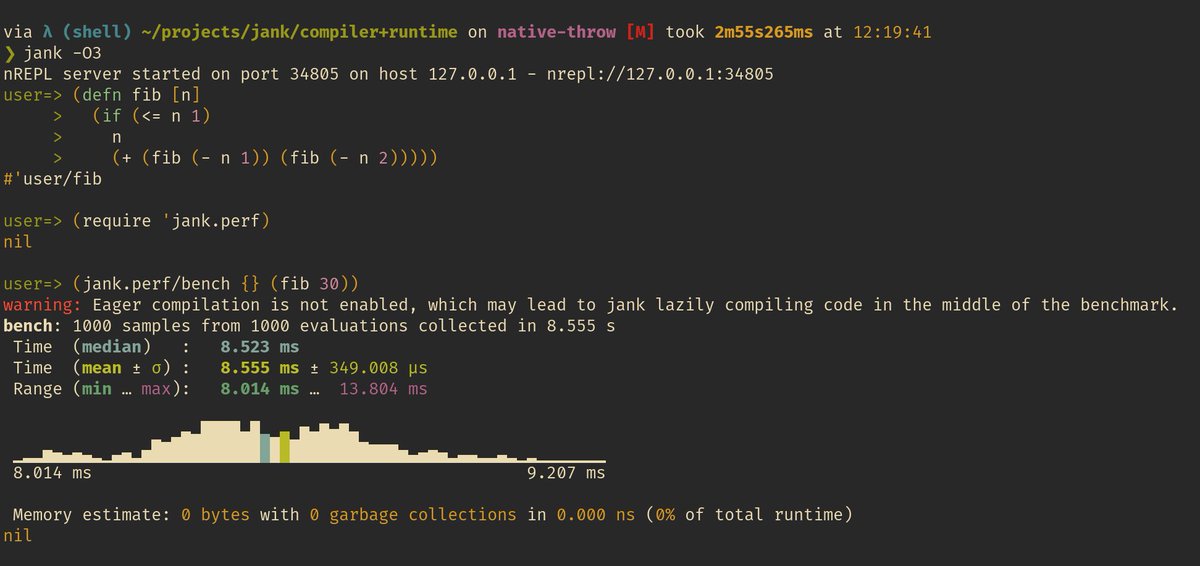
Did you know jank has a built-in benchmarking library for easy benchmarks with beautiful output? It even checks for common benchmarking mistakes, like debug builds, missing optimization flags, and lazy compilation.
#clojure
jank's terminal REPL client has been revamped to support completions, syntax highlighting, and multi-line inputs. The jank command will now start up the REPL client by default.
Post. Share. Tag. Participate.
Demand freedom from excessive income tax, corruption and waste.
Use #AbolishIncomeTax.
Let’s see how many of us stand together.
Final version is out! #bioelectricity Patrick McMillen (https://t.co/BAl7oalrG4)
"Lifetime imaging reveals long-distance non-neural bioelectric patterns on timescales from seconds to hours"
https://t.co/StCqmltMP1
Translating the bioelectric code remains one of the core challenges to widespread biomedical translation of bioelectric interventions, as well as a better evolutionary understanding of how developmental ionic signaling evolved to become the basis of neural intelligence. To advance our understanding, it is crucial to develop model systems that allow simultaneous, quantitative study of diverse bioelectric parameters in living states, which must also be linked to cell- and tissue-level outcomes. Here, we apply quantitative Fluorescent Lifetime Imaging (FLIM) optical estimation of membrane potential (Vmemoe) to map the bioelectric dynamics of spreading Xenopus laevis neural crest explants (NCEs) over > 17 h. We identify a slow hours-scale bioelectric component and distinct faster minutes-scale and seconds-scale components. These dynamics often span multiple cells, consistent with roles in the collective behavior of NCEs. We then use information theory to show that minutes-scale NCE Vmemoe dynamics are largely distinct from calcium dynamics. Finally, we provide a survey of diverse bioelectric events revealing a deep complexity in collective bioelectric dynamics, likely involving tunneling nanotubes in their transmission, which suggests numerous avenues for further investigation. These combined data demonstrate FLIM as a powerful tool for observing subtle bioelectric signals at the large temporal and spatial scale needed for developmental biology studies.
@sabeer@nishu_bundi13 Are you inferring that a "way of thinking" should not scare people? Or is that a question?
Way of thinking - does really affect reality objectively. Hitler had a way of thinking, Israel, US and India are concepts that invoke a way of thinking.
@sumanthchandar@krishnabgowda One-off initiatives are a good first step but we need to set up processes and incentive systems for these initiatives to sustain for longer than a week. Hope he's working on them.
@nsitharaman@Jairam_Ramesh Do you take the public as a fool? If the merchants have to pay the fee they offload it to the retail users. So ultimately it's us who will pay. I'm okay with having a fee for UPI infra as I understand that it's not cheap to host it. But at least be respectful to the public.
I’m looking for my next role.
I’m a software engineer and product designer with deep experience in databases, sync engines, frontend systems, performance, and UI/UX.
Open to full-time or contract work, remotely or in Berlin.
Details in reply ↓
RT for reach 🙏