@kevinace@GergelyOrosz Not hard to believe at all. Top engineers for physical work have had far fewer good alternatives
Musk's success with Tesla and SpaceX has been enabled by attacking stagnant industries. General Motors isn't as appealing to hardware engineers as FAANG companies are to SWEs
@andreasklinger@euromaximal C'mon, legislation doesn't appear from an abstract wish to protect citizen rights. Your work with EU Inc makes you well aware of how much of an investment and work it takes to lobby
EU-centralization makes rewards for corrupting leaders higher than if one goes country by country
@andreasklinger@euromaximal For Europeans the only choice is really corrupt local leaders who take order from the US ("shut down your adtech/AI industry!" - "yes, sir! Here comes GDPR/AI Act") or to work with the US overlords directly. Neither is healthy
@ID_AA_Carmack What Vivek calls excellence benefits from desperation to grind leetcode
Like national parks have trouble designing garbage cans accessible to humans but resistant to persistent bears, employment tests that filter for excellence with minimal effort can pass persistent mediocrity
I think this should really be read as widening the recruitment criteria
Unless the startup is Anthropic or OpenAI, they're not able to get the top talent from big tech and have to be more open about how they recruit
From a startup founder: “it’s now a red flag for me if I don’t see side projects on someone’s resume / application, because it signals lack of autonomy. Because it’s now so trivial to build anything on the side, vs before.”
One exciting prospect of AI is that of more innovative organizations as the need for professional managers shrinks when the boosted productivity lets smaller-scale organizations accomplish greater things
Marc Andreessen revealed how Harvard Business School was built on a broken 1941 theory, and how it's now collapsing...
Andreessen co-founded Netscape in 1994 and a16z in 2009.
He has sat on Meta's board since 2008.
He has spent 30 years backing founders and watching managerial CEOs lose to them.
The pattern traces back to one book: James Burnham's The Machiavellians (1941).
Burnham argued every great company had been founder-run.
Henry Ford ran Ford. Bob Noyce ran Intel.
Today, Elon Musk runs Tesla, SpaceX, and Starlink.
Then, he said, something broke.
Between the 1880s and the 1920s, a new philosophy replaced the founder. It was called managerialism.
The professional manager would now hold a portable skill, usable across any business.
The consequences were:
- Harvard Business School
- Stanford Business School
- Management as a universal skill
- The 1970s conglomerate
"That assumes the managers are going to do a good job," Andreessen says.
For 30 years, they haven't.
Managers can run something static, he says. Soup is soup. A bank is a bank. A car is a car.
But when the industry changes, the manager freezes.
Look at SpaceX.
"Imagine being a professionally trained manager, trained at a top management school, working for a rocket launch company, competing with SpaceX."
Then Elon's rockets started landing on their butt.
"Your management skills ... what good are they at that point?"
Andreessen's conclusion:
"You're much more likely to build something important in the 21st century if you start with the founder and train them on management."
@andreasklinger Yes, Sweden's nationalist party shrunk for the first time this election after the right-wing goverment cooperated with them to address crime and low-quality immigration
Centrists everywhere have themselves to blame when they let populists own major issues to try to isolate them
@andreasklinger Same with people on Twitter, they want less crime and immigration and support populists
You seem to find that discourse more problematic than Hamas-communists being voted into official power in your capital...
@j_crona Bolag som har en IT-avdelning lär nog också behöva se upp då det innebär att de inte är fullt tekniskt integrerade
Taxibolag har IT-avdelning, Uber har det inte. Advokatfirmor har IT-avdelning, Legora inte
AI kan ta sig an det kunskapsarbete som gjordes utanför IT-avdelningen
@andreasklinger The containers also need camera drones to do environmental surveys and AI lawyers to run the permitting process :)
(Aren't the main obstacles to building regulations and bureaucracy?)
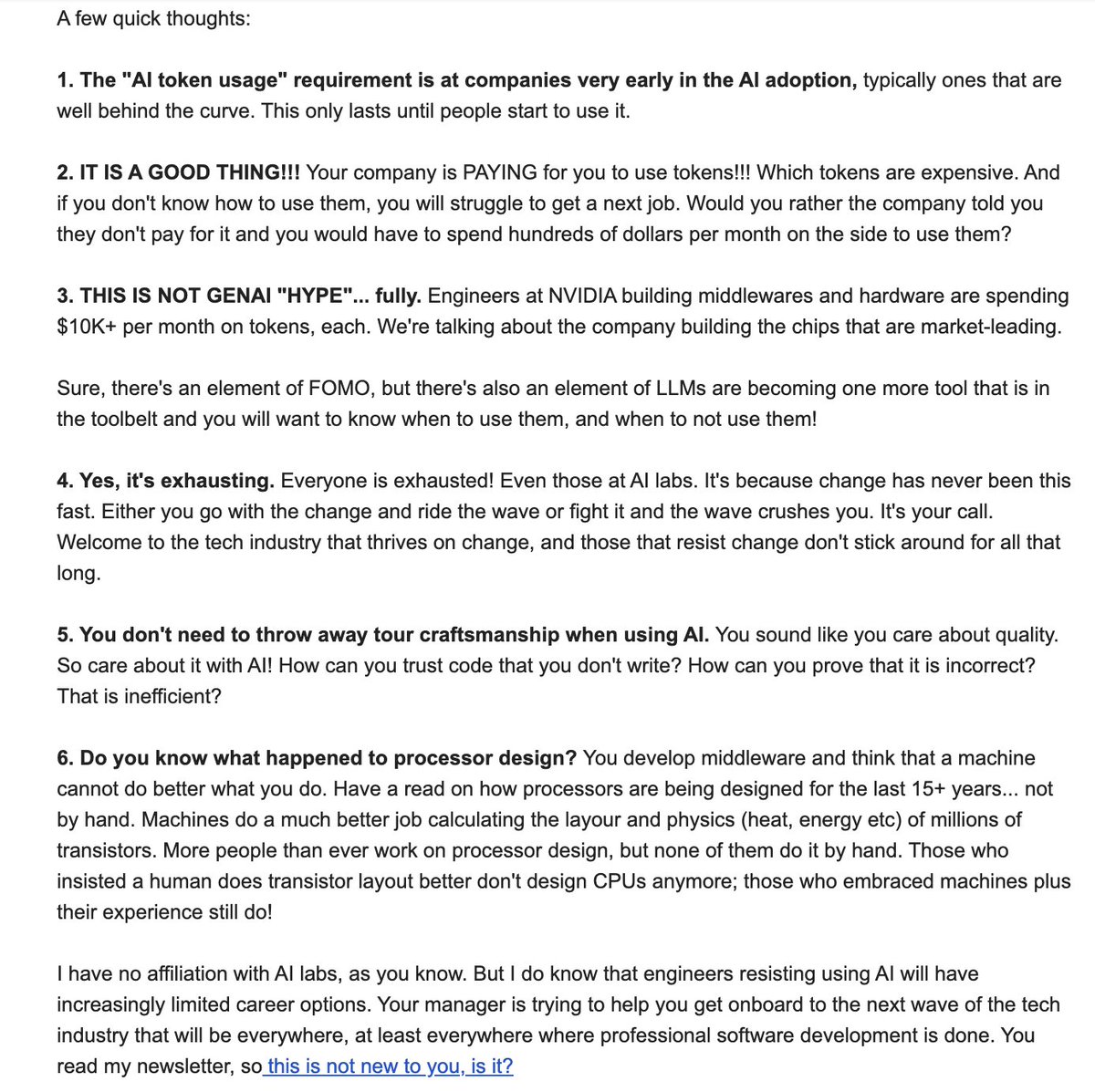
A middleware engineer in South Korea wrote to me, seeking help on what to do now that their manager is "blinded by GenAI hype" and set an "AI token usage" KPI. This eng is using v little AI, so manager is poking them to use more.
My response: your manager is trying to help you
Some observations about the "total" automation of software engineering:
1. There are more software engineers now than in 2025, and demand is growing.
2. Software engineers have never worked harder than they do now.
3. They largely don't write code anymore, agents write ~100% of the code.
4. The bottom line of the companies that employs these engineers and agents (i.e. the terminal purpose of all this code) is typically not budging as a result of AI adoption.
This is why you have to think in terms of systems. Automating one aspect of a system creates its own friction and moves the bottlenecks elsewhere.