Introducing the new VEED.
Our product rebuilt from ground up.
Finally, AI videos worth posting from one prompt. You enter an idea and VEED:
- Creates the script
- Gives viral templates + characters
- Adds captions + music
Free AI credits for first 300 comments.
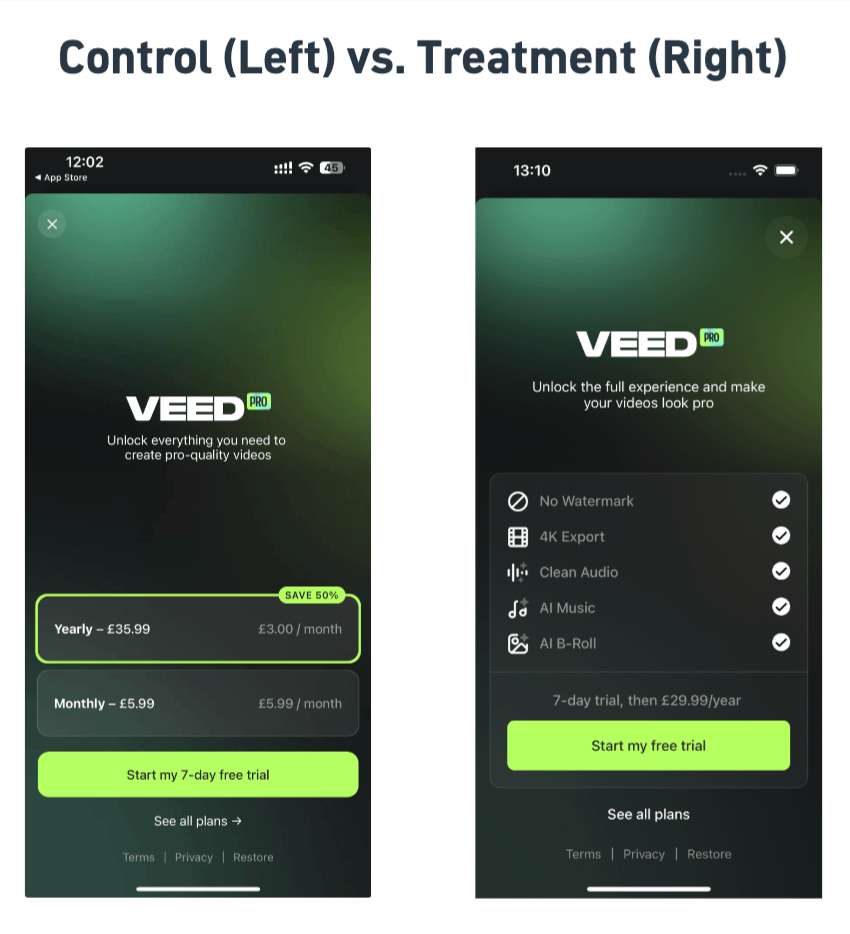
Okay, many people got this wrong...
Correct answer: Left one.
It also brought us:
- 33% higher MRR
- 17% higher ARPU
- 3% higher conversion to paid
PS. we kept the yearly price same while testing ofcourse.
Alright this blew up!
Here are some more amazing ones:
– Figma: Weekly active editors
– Replit: Weekly active Repls
– Instagram: Daily active amplifiers
– DoorDash: Total completed weekly deliveries
– Notion: Teams w. 3+ members using 2+ features
– Cognition: AI-authored share of complex PRs merged (without human edits)
Great examples of North Star metrics:
– Uber: Rides taken
– Airbnb: Nights booked
– Lovable: Daily active apps
– Plaid: Bank accounts linked
– Duolingo: Daily active users
– ChatGPT: Retained active users
– Loom: Videos created that get viewed
– Cursor: Paid users coding 5 days/week
– Gamma: Presentations created & shared
The fastest-growing AI companies today are following the same playbook.
I call it the M.A.G.I.C. framework:
M – Model-native.
Your product gets better every time the underlying model improves. Lovable gets better every time Anthropic releases a new model.
A – Agentic and API-first.
Built for agents and makes your products & features pluggable into other products. ElevenLabs is a great example.
G – Generative by default.
Make the UI super lazy. Look at the products winning right now: Claude, Lovable, Cursor. They are basically a chat box with simple UI.
I – Instant time to value.
Users experience the “aha moment” before any heavy setup. ChatGPT lets you get the experience before even creating an account.
C – Compelling leverage.
Small inputs create enormous outputs. One prompt in Lovable can turn into a working app in seconds.
If you want massive growth, you can’t keep playing by the old rules.
Great examples of North Star metrics:
– Uber: Rides taken
– Airbnb: Nights booked
– Lovable: Daily active apps
– Plaid: Bank accounts linked
– Duolingo: Daily active users
– ChatGPT: Retained active users
– Loom: Videos created that get viewed
– Cursor: Paid users coding 5 days/week
– Gamma: Presentations created & shared
@ryanndngg If you use OpenEdit your rendered project is saved as .wv file and is fully editable after rendering.
It preserves timings, assets and animations in the form of typescript code, almost the same as your after effects project does...
This is insane 🤯
I ran GPT-6 ASTRA on VEED’s OpenEdit.
One shotted VEED’s launch video by just giving the website & brand guidelines.
Try here: https://t.co/n1si0nRdOP
Comment and I'll share the full prompt.
@bygregorr I agree. Rounds will happen, but normally each one costs you time.
Here, the project and all its versions stay editable, so the next round builds on the last instead of starting from scratch.
@_buf Fair. This one was one shot, but tbh the ones I’m most proud of take 3–4 rounds.
The cool part is you’re not starting over each time as the project stays editable, so round 4 builds directly on round 3.
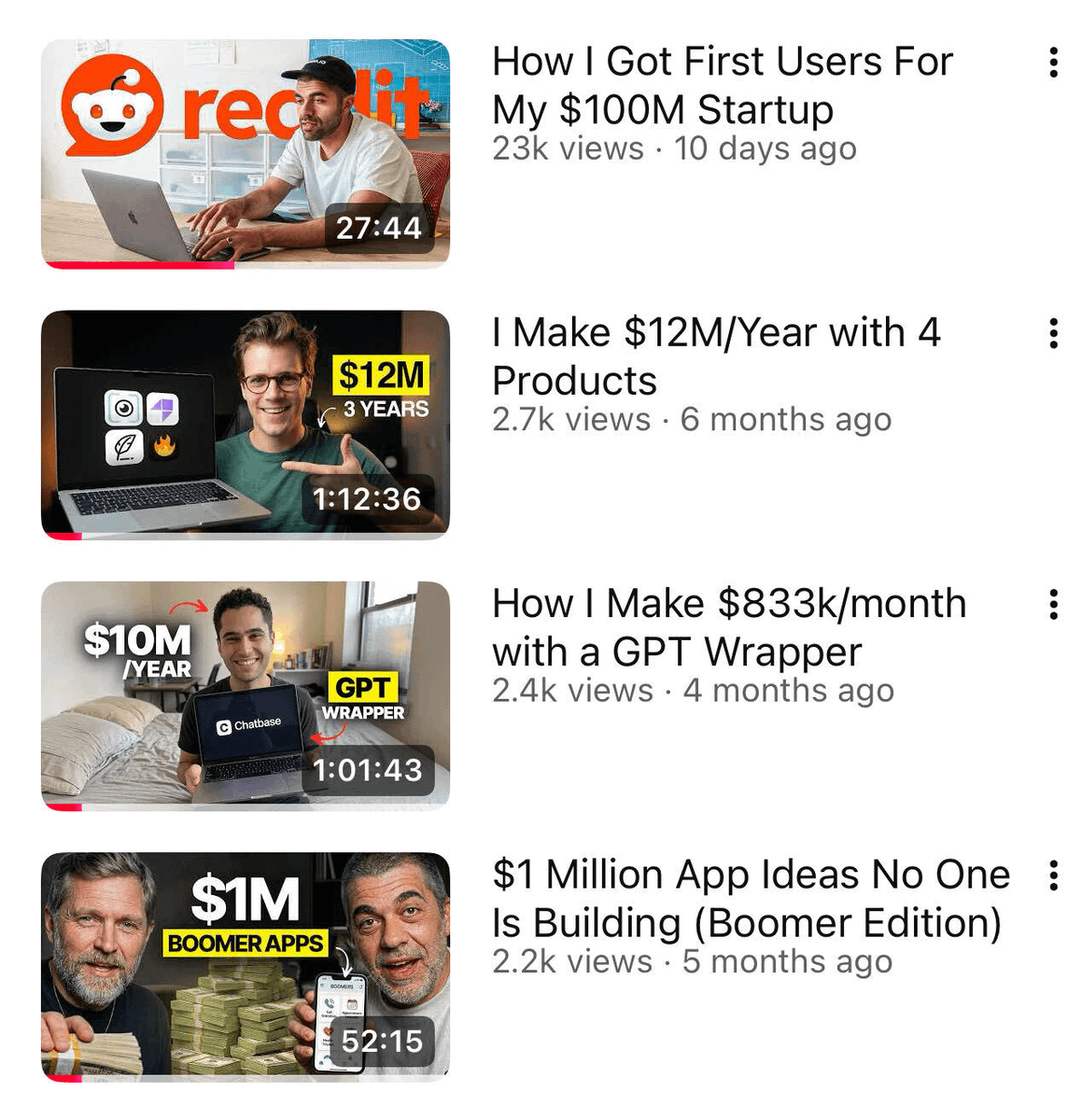
We recorded 24 podcast episodes this year 🎥
The results are impressive!
– 600K eyeballs on X & LinkedIn
– 50K Long form YouTube views
– 11K audio downloads
Here’s everything I’ve learned 👇
1. Set realistic goals.
The YouTube benchmarks for top podcast in our niche (Tech/Startup) is ~30K views per episode for My First Million and ~10k for 20VC.
These are established names with years of work behind them.
If you’re getting 1K views, you’re already at 10% of that 10K benchmark.
That’s worth keeping in perspective.
2. Not all views are equal.
For us, 10,000 VCs and founders listening can be worth more than 100,000 people outside our target audience.
Our videos about app ideas and making $1M got good traction. Those topics appeal to a lot of people.
But videos about growing a business to $50M in revenue interest fewer people.
But those are the people we want to reach.
Chasing views would mean making different content and making it less useful to our audience.
3. Don’t overlook 1,000 true fans.
Imagine 1,000 people listening every week.
– They love what you do.
– They feel like they know you.
– They understand how you think.
That’s incredibly valuable, especially when you’re starting a podcast.
Realistically, I think building that audience can take two years. Maybe more. It’s still a goal worth working towards.
4. Putting in the reps is everything.
Our first 10 episodes sucked.
The next 10 were much better.
Now it finally feels like it’s working.
I suspect a lot of people give up around episode seven, before they’ve given themselves a chance to get good.
Building a company, a podcast or an Instagram following takes significant work over time...
Very few people are willing to keep going for long enough.
5. The depth of the relationship is the real value.
Someone spending 30–60 minutes with you every week gets to know you in a way that’s hard to replicate elsewhere.
I think podcasting is one of the most powerful communication channels you can own.
I’ve noticed:
– Enterprise customers who discovered us through the pod
– $10K–$20K in attributed MRR across my socials
– More engagement on X & LinkedIn
– A stronger personal brand
For me, that ongoing, direct relationship is worth more than a once-a-year feature in TechCrunch, the Sunday Times or the Financial Times.
But you have to put in the work to build that distribution.
6. YouTube comes first.
For us, YouTube offers the best discoverability, and video makes the conversation more engaging.
If there’s one arena I want to compete in, it’s YouTube. The audio podcast comes second.
That changes how we think about what we make and how we present it.
7. Give it years.
Look at Lenny’s Podcast, My First Million, 20VC and All-In.
It’s easy to see the audiences they have today and underestimate the years of work behind them.
The lesson I take from them: plan for gradual growth.
8. Packaging matters way more than you think.
It’s all connected:
– Your title
– Your thumbnail
– Your content
– How it’s scripted, edited and put together
You can turn up with a friend and shoot the shit for an hour.
But growing that is going to be difficult.
You need to learn how to write a title people want to click, create a thumbnail that catches their attention and deliver an opening 30 seconds that makes them want to stay.
This has been one of our biggest lessons.
We’ve still got a long way to go.
9. Recording is only part of the job.
Now we spend more time:
– Planning episodes
– Working on packaging
– Reviewing topics and scripts
– Thinking about guests
– Contacting guests
…than we do actually recording.
Now, I’m more convinced than ever that this is worth building.
We’ll keep recording.
And I’ll keep sharing what we learn.