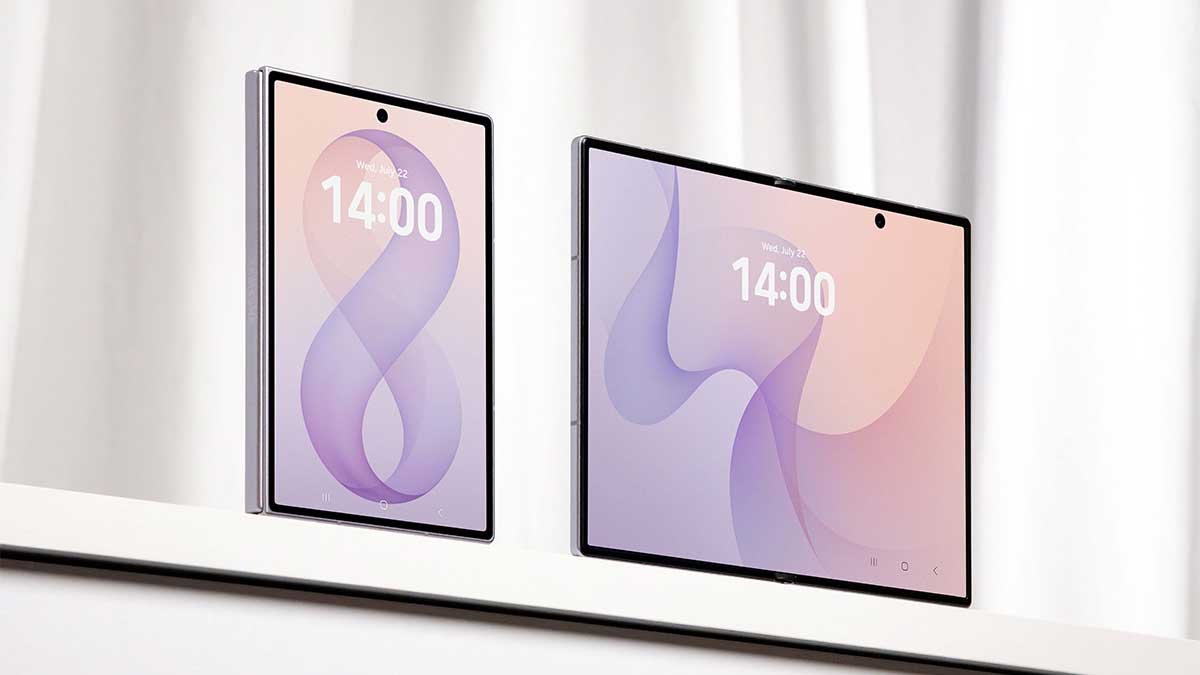
Samsung Display Develops CTG Technology: A New Material-Level Solution for Foldable Display Creases
According to Korean media reports, Samsung Display is advancing the development of a next-generation UTG (Ultra Thin Glass) technology called CTG (Center etched Thin Glass). The technology introduces a new thickness-gradient glass structure, allowing different areas of the glass to achieve different physical properties. By redesigning the glass structure itself, CTG aims to address one of the biggest challenges in foldable displays: the trade-off between crease reduction, durability, and thinness.
As foldable smartphones enter a more mature stage, the competition is no longer simply about whether a device can fold. The focus has shifted toward whether a foldable device can deliver an experience closer to a traditional flagship smartphone.
Among all remaining challenges, display crease remains one of the biggest limitations.
Over the past few years, manufacturers have continuously improved hinge mechanisms, flexible OLED structures, and support materials to reduce visible creases. However, a fundamental material conflict still exists: the cover glass must be rigid and flat enough to provide a premium touch experience, while also being flexible enough to survive hundreds of thousands of folding cycles.
Glass naturally offers excellent hardness, stability, and a premium feel, but it is not designed to repeatedly bend. Flexible materials can bend easily, but they struggle to provide the durability and surface quality of glass.
CTG represents a new approach by attempting to solve this contradiction at the material level.
The Core Principle of CTG: A Glass Structure Optimized for Different Areas
Current high-end foldable displays mainly use UTG (Ultra Thin Glass) as the cover material.
Compared with early CPI (Colorless Polyimide) solutions, UTG provides several advantages:
Higher hardness
Better scratch resistance
More glass-like touch feedback
Improved long-term stability
However, conventional UTG generally uses a uniform thickness structure. The entire glass layer has almost the same thickness from the folding area to the outer regions.
This design provides excellent flatness when the display is unfolded, but creates challenges during folding.
The folding area experiences the highest mechanical stress. During bending, the inner side of the glass is compressed while the outer side is stretched. The center folding region experiences the greatest deformation.
With a uniform-thickness glass structure, the entire panel must balance two conflicting requirements at the same time:
High rigidity for a flat, premium surface.
High flexibility for repeated folding.
CTG changes this approach.
Through precision chemical etching, Samsung Display reduces the thickness of the central folding area while maintaining greater thickness in the non-folding regions.
The result is a thickness-gradient structure:
The folding area becomes thinner and more flexible.
The surrounding areas remain thicker and stronger.
In simple terms, CTG allows the glass to become softer where it needs to bend and stronger where it needs to provide support.
This is similar to advanced engineering materials that optimize different regions of a structure according to their specific functions.
How CTG Could Improve Foldable Display Creases
The formation of foldable display creases is not only caused by visible bending. It is closely related to mechanical stress accumulated inside the materials.
With traditional UTG, the entire glass layer participates in the bending process. The folding center experiences concentrated stress, and repeated cycles may gradually create material fatigue and permanent deformation.
CTG reduces the thickness of the folding area, allowing that region to bend more naturally and reducing stress concentration.
The expected benefits include:
First, reducing permanent deformation and improving flatness after unfolding.
Second, slowing down crease development during long-term use.
Third, reducing the need for additional reinforcement structures, creating more possibilities for thinner and lighter foldable devices.
CTG Challenges: Maintaining Optical Uniformity and Surface Quality
Although CTG offers a promising direction, achieving mass production remains extremely challenging.
The biggest difficulty is ensuring that a glass structure with different thickness areas still looks and feels like a single piece of glass.
The first challenge is optical consistency.
Because the center area and surrounding areas have different thicknesses, the optical path of light changes. If not properly controlled, this could lead to:
Different reflection characteristics
Slight optical boundaries under certain viewing angles
Uneven visual appearance
Traditional foldable displays mainly struggle with visible creases. An immature CTG implementation could potentially introduce new optical differences.
Therefore, CTG requires not only mechanical optimization but also precise optical engineering.
The second challenge is surface flatness.
Simply making the center area thinner could create a height difference that users may feel when touching the display.
A mature CTG design requires a smooth transition between thick and thin areas, ensuring that the surface remains continuous and seamless.
The third challenge is filling materials.
The etched region may require special transparent materials to restore optical and tactile consistency.
Such materials must satisfy multiple requirements:
Similar refractive index to glass
High transparency
Long-term folding durability
Thermal stability
No impact on touch sensitivity
This creates a new challenge for materials science and manufacturing processes.
The Meaning of CTG: A Shift Toward Material Innovation in Foldable Displays
If CTG successfully reaches mass production, its significance will go beyond simply reducing creases.
It represents a fundamental change in the development direction of foldable displays.
In the past, manufacturers mainly tried to make existing glass structures survive folding.
CTG takes a different approach: redesigning the glass itself so that it is naturally better suited for folding.
The ideal future foldable display should not simply be a screen that can bend. It should be a smart material structure where different areas provide different functions.
When unfolded, it should deliver the flatness and touch experience of a traditional flagship smartphone.
When folded, it should provide flexibility and long-term reliability.
If Samsung Display can overcome the challenges of manufacturing precision, optical consistency, and material integration, CTG could become one of the most important display material innovations for the next generation of foldable devices.
From CPI to UTG, and potentially from UTG to CTG, foldable displays are moving from “making glass survive folding” toward “designing glass specifically for folding.”
This could become a key step toward the ultimate goal of foldable technology: a display that feels like ordinary glass when open, while folding naturally without compromise.