There are too many emails. Too many texts. Too many accounts. Too many logins. Too many apps. Too many rewards programs. Too many fundraisers. Too many appointments. Too many virtual meetings. Too many newsletters. Too many forms. Too many social media platforms. My brain hurts.
if you’re trying to “save time” as a writer by using AI, i suggest you find another profession. it takes time to write well, time to write exciting books. it takes time to write one good poem. i’ve spent years on a single poem. the time spent learning one’s craft is everything
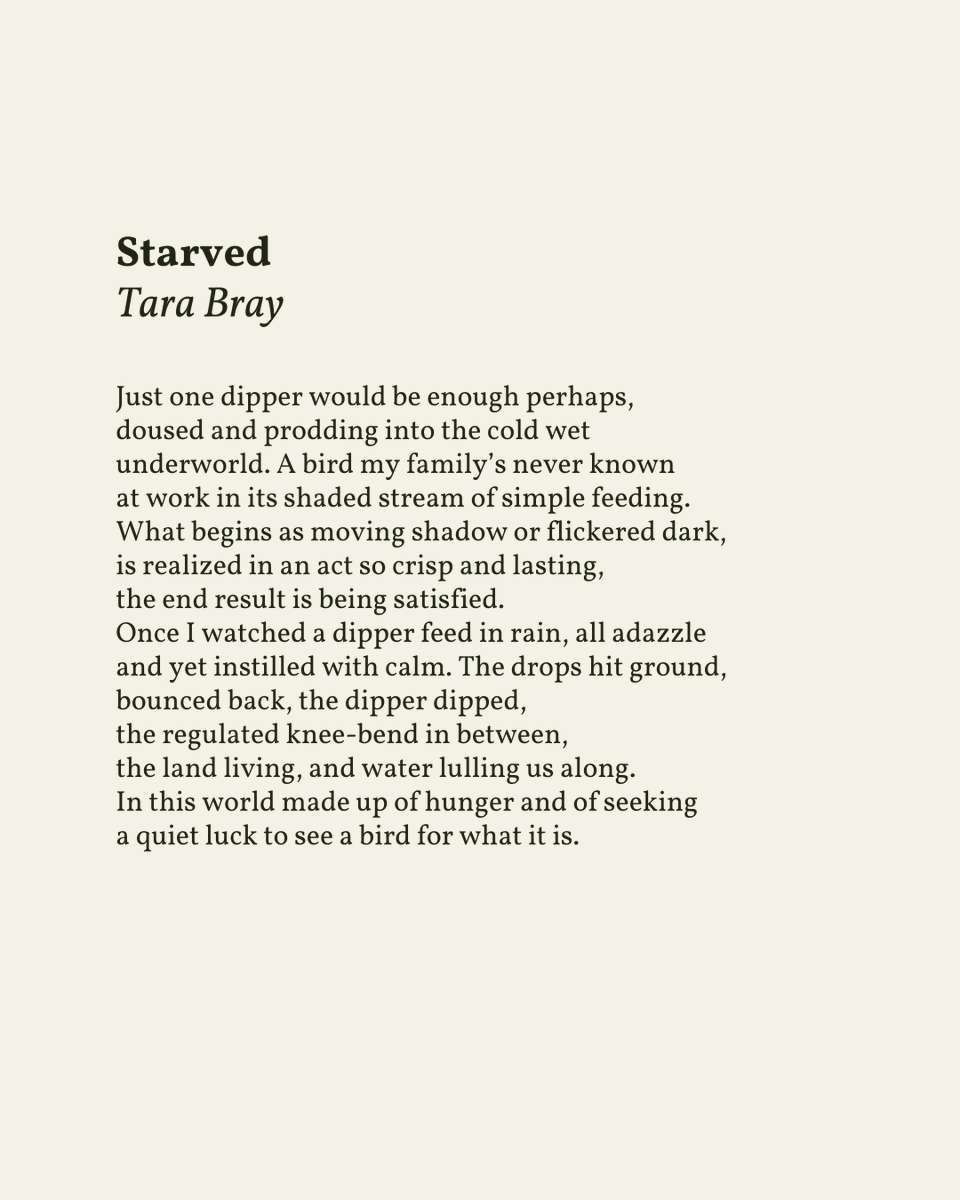
“In this world made up of hunger and of seeking / a quiet luck to see a bird for what it is.”
— Tara Bray
.
.
.
This poem appeared in The Hudson Review, Summer Issue, 2015. Shared here with deep gratitude.
A horse gives way to another
horse and then suddenly there are two horses,
just like that. That’s how I loved you.
[...]
What was between
us wasn’t a fragile thing to be coddled, cooed
over. It came out fully formed, ready to run.
—Ada Limón, from "What I Didn't Know Before"
overheard:
"In a life-time of a regime, a moment arrives when vulgarity isn’t a personal failing — it’s a state policy. Kitsch is armor against ethics; it’s collective anesthesia, pumped through every glowing screen and marching chant."
Go on more walks. Walk for no reason. Walk to solve a problem. Walk to blow off steam. Walk to get outside. Walk to listen, read, and learn. Walk to escape distractions. Walk to improve your health. Walk to think. A simple walking habit can change absolutely everything.
If you need a story about good humans right now, this is amazing:
Leslie Lemke was born prematurely, with brain damage and retinal problems that resulted in his blindness. He was given a foster home by May and Joe Lemke. Though doctors said Leslie would almost certainly die, May refused to believe it. The infant made no sounds and few movements, but May held him almost constantly, laying him on her chest as she said aloud, "Please let this little bit of flesh know that he's loved."
She built a device to help him walk, she helped him chew his food, and she listened to him. Even in his silence, she listened. Though he struggled to move, one day she saw him pluck a piece of string with his finger, and thinking he might have been amused by its sound—and following her instincts—she bought him a little piano. She spent the evenings laying his hands on the keys, playing records, leaving the TV tuned to musical programs, all of which seemed to comfort him. Months passed, seasons, years, and then, in the middle of one night, May and Joe were woken by the sound of music. It was Leslie, playing Tchaikovsky's Piano Concerto No. 1.
Medicine calls Leslie's life an example of "savant syndrome," "a rare—but extraordinary—condition in which persons with serious mental challenges...have some island of genius which stands in marked, incongruous contrast to their overall functioning." But no one would have known about Leslie's island, Leslie's gift, if he hadn't been given that home, that chance, that love.
Simone Weil once wrote, "The love of our neighbor in all its fullness simply means being able to say to him: 'What are you going through?'"—and, we might add, listening to the answer, however long it takes.
What are you going through? Who is sitting alone in the dark, asking for a touch? What astonishing thing is waiting in every life to be loved into life, into song?
[sources: @ABC, National Library of Medicine, Wikipedia]
The photographer Vivian Maier roamed the streets with her camera, capturing images of sublime spontaneity, wit, and compositional savvy. https://t.co/GLAyYbxaLf
You are allowed to be large, so large tonight. Too full, too brimming, too thick, all hips and ass, all flower, all confidence, all swagger. A light. A balmy light.
Happy full moon, poets.




![chenchenwrites's tweet photo. A horse gives way to another
horse and then suddenly there are two horses,
just like that. That’s how I loved you.
[...]
What was between
us wasn’t a fragile thing to be coddled, cooed
over. It came out fully formed, ready to run.
—Ada Limón, from "What I Didn't Know Before" https://t.co/A9Fhy1hfP3](https://pbs.twimg.com/media/EQEQc8dXUAIFJDm.jpg)