@ECISVEEP I see a stray application for some person I don't know under "Track Application Status" in my ECINET app - shows tracking of form 6. What to do?
@TitanEyePlus my unused frame broke under its own stress. Lodged complaint via store, denied with no reason. It's 'natural breakage' and is covered under warranty, why the rejection?
That’s not just bad service, that’s zero accountability.
🧵 (1/5) The “average user” software is on its last legs
Ever notice how most apps taste like plain Khichdi? That’s what happens when teams design for everyone - safe, filling, but zero flavour.
(4/5) The cool part: niches suddenly scale. When customization is this easy, niche = scale. Each persona drives its own use case without feature bloat or endless roadmap debates.
@damn_dysania@chiragbarjatya I have worked with 1mg in the past and they for sure take very good care of the temperature at which carrying samples.
You’ll find ice packs in their bags.
Jeff Bezos explains how he decided to quit his job and start Amazon
At 30 years old, Jeff Bezos had great Wall Street job working at the hedge fund D.E. Shaw. When he told his boss David Shaw about his idea to start an internet book store, David replied:
“I think this is a good idea, but it would be an even better idea for somebody who didn’t already have a good job.”
That made logical sense to Jeff, but he ultimately decided that the best way to make a very personal decision like this was to project himself forward to age 80:
“When I’m 80 years old, I want to have minimized the number of regrets that I have. I don’t want to be 80 years old, in a quiet moment of reflection, thinking back over my life and cataloging a bunch of major regrets.”
And Jeff believes that our biggest regrets are acts of omission:
“It’s paths not taken that haunt us. We wonder what would have happened: I loved that person and I never told them, and then they married somebody else.”
Once Jeff thought about it this way, the answer was immediately obvious to him:
“I knew that when I’m 80, I would never regret trying this thing that I was super excited about and failing. If it failed, fine. I would be very proud of the fact when I’m 80 that I tried. And I also knew that it would always haunt me if I didn’t try.”
Jeff believes this regret-minimization framework is a useful lens for any important life decision.
Video source: @Summit (2017)
Beginners chase complexity, and confuse it for intelligence. But masters of their craft consistently pursue simplicity. After years observing the playing field, they've boiled down the rules to just a few variables — and obsess over them.
It's almost childlike, actually. Think one-pagers, not essays. Back-of-the-napkin math, not spreadsheets.
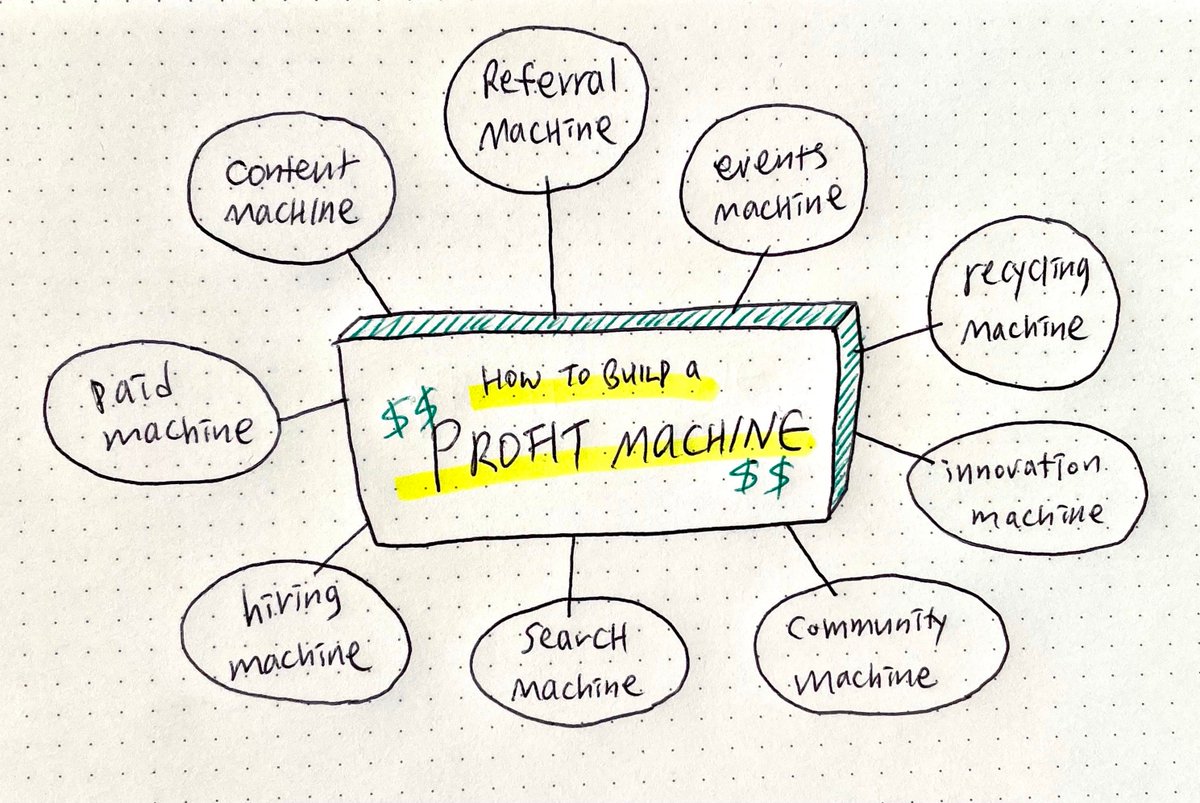
I recently reviewed 1000+ internet businesses.
About 500 of them make $1-5M/ year of profits and 25 of them make $10M+/year of profits.
And I distilled a playbook of how to build your business to be like the top 0.01% of these businesses.
Read the playbook here:
The HackerNews archives are a treasure trove of skeptical early comments on now-huge companies
Ex. for Airbnb 👇
"I have nothing but respect for YC/PG, but I honestly can't understand what they saw in [this]...if I was a VC, I wouldn't touch this site."
Two traits that have a strong predictive power for someone's potential:
1. Hunger for learning - do they run away from or towards what's uncertain?
2. Bias for action - do they keep sitting on ideas or ship things regularly?
Naval for kids. 2 years ago my nephew and I had conversation on important ideas from @naval
Turned his ideas suitable for a 11 year old conversation. Back then he forbade me sharing the project on any social media. He changed his mind last week, sharing this now.




![omooretweets's tweet photo. The HackerNews archives are a treasure trove of skeptical early comments on now-huge companies
Ex. for Airbnb 👇
"I have nothing but respect for YC/PG, but I honestly can't understand what they saw in [this]...if I was a VC, I wouldn't touch this site." https://t.co/QCpHHMVxCo](https://pbs.twimg.com/media/GNZm0OOacAANWic.jpg)