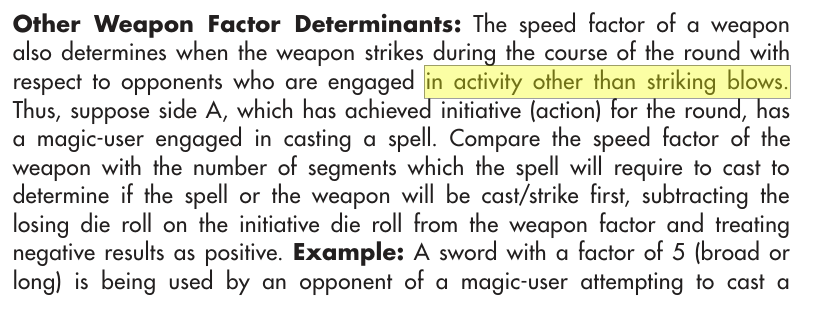
@ericbabe3@_Autarch_ And you can do it in melee. It works just as spellcasting in melee. Id depends on the speedfactor of the weapon of the enemy and the initiative roll of who's lost. It's on page 66 DMG
@rattower Did you see what the guys from the Classic OSR are doing in terms of design and layout of for Oldschool D&D? Check it out. Some of these are great in bringing the oldschool vibe without losing clarity.
https://t.co/94tKsqVFMe
https://t.co/yPqWQKr8jj
https://t.co/UPREgUdMmz
Barry Windsor-Smith was a young man when he was assigned the job of artist for Conan the Barbarian in 1970. He illustrated the book for three years before moving onto other illustration work. In 1987, he returned to Conan a much more polished and experienced artist. This cover that he created for Conan Saga is one of my favorite pieces he did.
Castle Zagyg is in its final days of crowdfunding, and soon it will crack half a million dollars. I never thought the day would come! This is a project that I was a big part of from late 2005 to 2008. It wasn't until 2006 that I was asked by Gary Gygax and Steve Chenault if I would like to be Gary's sole writing partner for the main project, after I had worked on some city development projects for Gary (four Yggsburgh sectors). And although I am not a part of Castle Zagyg's future, my work fills the pages of the second of the three volumes currently being offered. Gary wrote the first one (Yggsburgh) and I was put in charge of the content that is now slated to appear in the second volume of this current set. The third volume is being worked on by Mike Stewart, to my understanding. I am not familiar with Mike's work, but I am sure he is a fine choice for the project.
I am overjoyed to see that content that I worked on is finally going to be released all these years later. Those were some amazing days. I mostly worked using outlines Gary had provided me, and he contributed set pieces for me to incorporate. Also, he was providing feedback and editing content that I was developing. Meanwhile, Gary himself was working hard on his science fiction RPG, called Lejendary AsteRogues, and his card game, King of England, King of France, which was based on the 100 Years War.
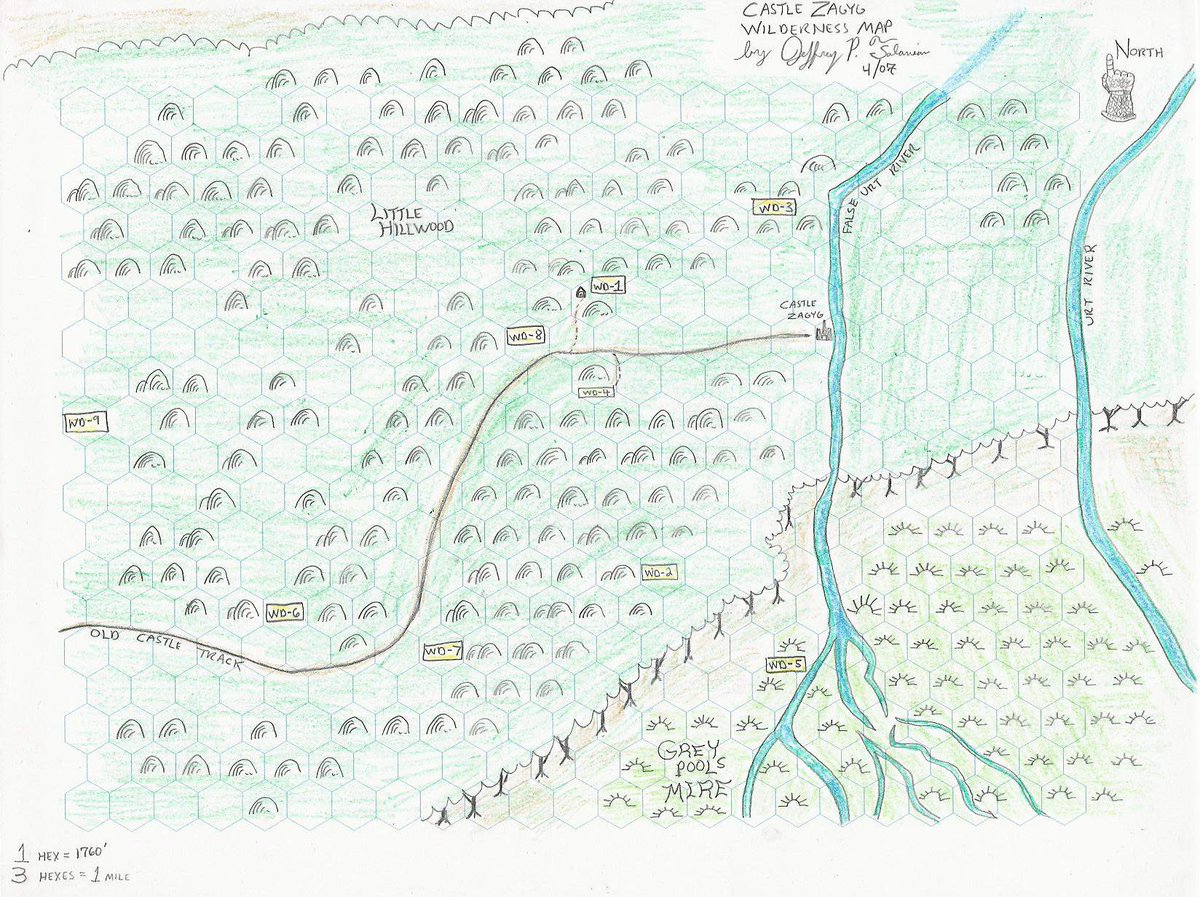
The castle proper was not an area that Gary provided a lot of guidance on, and he encouraged me to develop it to my tastes and interests, which he reviewed when he wasn't working on his sci-fi game. I could probably do a 1- or 2-hour chat on the contents I was developing and my interactions with Gary throughout it, but for now, I thought some of my friends would enjoy seeing a selection of the maps I was drawing back in the day (attached here). I did all my own cartography, which was then digitally copied or redrawn by the TLG artist, Peter Bradley. One of my favorite parts was an idea I had pitched to Gary, which he enjoyed, called "Mouths of Madness," a series of caves and dungeon rooms connecting to Level One of the dungeon complex.
But my favorite part of all, outside of the honor to work with Gary, was the hundreds of hours of playtesting this content with my weekly gaming group. So many good times were had. Cheers!
One of my favorite campaign settings is Fomalhaut, by Gabor Lux, published by EMDT First Hungarian D20 Society. From the introduction:
========
A dim and waning star 25 light years from Sol, Fomalhaut is orbited by six planets of variable sizes. Three of the six are dead slabs of rock and ice, one is a ringed gas giant, and Fomalhaut-II is a world of eternal winter where only a fraction of the former population labours under the yoke of a technocratic dictatorship. Therefore, only Fomalhaut-I remains of the ambitious planet engineering projects under the old Terrans, a medium-sized sphere where great engines sunken under the surface, once known as stabiliser cities, have created Mediterranean and sub-tropical environments in a thin and ever shrinking belt around the equator.
========
The introduction goes on to tell about the colonization of Fomalhaut, an era of scientific success and advancement, but ultimately a collapse due to interstellar wars. Then came an era known as the Techno-Hellenic Age, the rise of city-states, bararism, and sorcery.
The setting is incredibly rich and evocative, and Gabor's writing is both imaginative and unique. I have used several of his works in my own Hyperborea campaign, as they fit well thematically and for their general weirdness and peculiarities. There is a strong Vance vibe here, particularly if you enjoy his Planet of Adventure series, which happens to be my favorite by the literary master.
The book pictured in this post was recently released, with a fascinating cover by Peter Mullen. The note I received from Gabor was a nice touch. :)