Believer-Sceptic. Political junky-Anarchist. Pagan-Buddhist. I am the embodiment of human dual-mindedness. And a connoisseur of true truths. 🇺🇸🇬🇧🇨🇦 JD/JCB
@etnow@Noneofthemknew1 He also has the softest, kindest heart. 💖 The way he loves his fans and coworkers is just as beautiful as his face and his voice.
Dear ladies never forget that: The same world that shames me for being a single mother also shames you for not being a mother and shames another woman for having too many children..lt shames one woman for having a child at the age of 19 because she's too young but also shames another for having at 36 because she's too old..lt shames a woman who marries young as well as the one who marries old..It shames women who don't have beautiful bodies and shames those who go under the knife to get the bodies. This world shames all women, not a single one of us is spared, not a single one. So love and make yourselves happy.
@earthcurated My 11-year-old self. 🤗 I want to tell her how awesome she is and that she doesn’t need other people’s approval to follow her creative dreams. 💕
"Can you not at least put a sane woman among us?"
The words came from a terrified patient inside the Women's Lunatic Asylum on Blackwell's Island. She was begging the doctors, the nurses, anyone who would listen.
She was talking about the new patient. The one who seemed too calm. Too aware. Too sane.
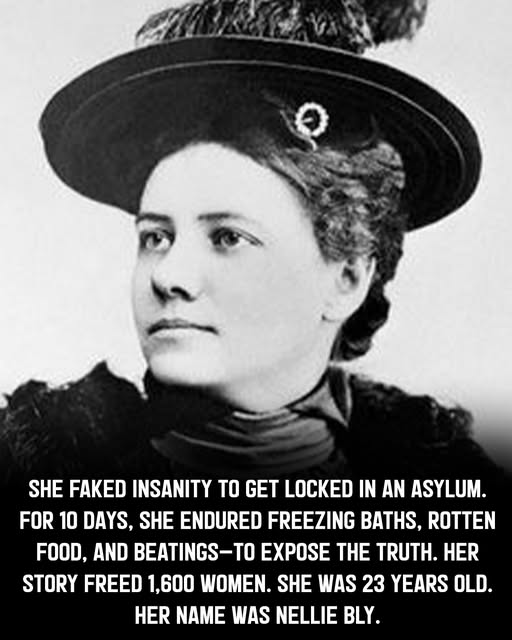
That patient was Nellie Bly. And she was exactly where she wanted to be.
In 1887, New York City's asylums were shrouded in mystery. Rumors swirled about horrific conditions, abuse, and women disappearing behind locked doors, never to be seen again.
But they were just rumors. No proof. No witnesses willing to speak. No way to know the truth.
Nellie Bly, a 23-year-old journalist for the New York World, decided to find out for herself.
Her editor, Joseph Pulitzer, supported her plan: get yourself committed to the asylum, document everything, and expose the truth.
It was dangerous. It was unprecedented. If something went wrong, Nellie could be trapped there indefinitely—declared insane with no way out.
She did it anyway.
Nellie checked into a women's boarding house and began acting erratically. She stayed up all night, spoke incoherently, stared at nothing, and claimed not to know who she was.
The landlady called the police. A judge declared her insane. And on September 25, 1887, Nellie Bly was committed to the Women's Lunatic Asylum on Blackwell's Island.
The moment she arrived, Nellie dropped the act. She behaved completely normally. She spoke clearly. She answered questions rationally.
It didn't matter.
Once you were inside, you were insane. No amount of sanity would set you free.
What Nellie discovered inside was worse than anyone imagined.
The asylum held over 1,600 women. Many of them weren't mentally ill at all.
They were poor. They were immigrants who didn't speak English. They were women whose husbands wanted to be rid of them. They were girls who'd been raped and were considered "damaged." They were inconvenient, unwanted, and discarded.
And once inside, they were tortured.
The "treatment" was barbaric. Patients were forced to sit in freezing cold baths for hours—punishment disguised as therapy. The food was rotten, inedible. Rats roamed freely. The halls were filthy.
Nurses beat patients with sticks. They tied women to chairs and left them for days. They mocked them, starved them, and ignored their pleas for help.
Nellie watched women scream for help and be silenced with violence. She saw patients beg for warm clothing and be denied. She witnessed daily cruelty designed not to heal, but to break.
And she wrote it all down. In her mind. Memorizing every detail.
For ten days, Nellie endured the same treatment as everyone else. She froze in the baths. She choked down spoiled food. She slept on a hard bench in a freezing room with no blankets.
She didn't complain. She didn't fight back. She documented.
On October 4, 1887, after ten days inside, an attorney hired by her newspaper secured her release.
She walked out of Blackwell's Island and immediately began writing.
On October 9, 1887, the New York World published "Ten Days in a Mad-House"—Nellie Bly's firsthand account of life inside the asylum.
The article was explosive.
Nellie described everything in vivid, horrifying detail. The cold baths. The rotten food. The rats. The beatings. The women who didn't belong there.
She wrote about a woman who spoke only German and was declared insane because doctors couldn't understand her. She wrote about girls as young as sixteen locked away for being "difficult." She wrote about women who begged to be released and were told they'd never leave.
The public was horrified. Outraged. Demanding answers.
A grand jury was convened to investigate. They toured Blackwell's Island. They interviewed patients and staff.
They confirmed everything Nellie had written.
The city of New York immediately allocated an additional $1 million to the Department of Public Charities and Corrections to reform asylum conditions. Staff were retrained. Oversight increased. Patients gained new rights and protections.
Some of the women Nellie had met were released. Others received proper care for the first time.
"Ten Days in a Mad-House" became a sensation. It was published as a book. It was read across the country. It sparked a national conversation about mental health, women's rights, and institutional abuse.
Nellie Bly became famous overnight.
But she didn't stop.
In 1889, at 25 years old, Nellie set out to break the fictional record set in Jules Verne's Around the World in Eighty Days. She traveled around the globe in 72 days, 6 hours, and 11 minutes—by steamship, train, and sheer determination.
She became an international celebrity.
But it was "Ten Days in a Mad-House" that cemented her legacy as the mother of investigative journalism.
Nellie Bly proved that journalism wasn't just about reporting what happened. It was about uncovering what was hidden. It was about giving voice to the voiceless. It was about risking everything to tell the truth.
Before Nellie, undercover journalism didn't exist. She invented it.
After Nellie, investigative reporters followed her lead—going undercover in factories, prisons, sweatshops, and more to expose injustice.
Nellie Bly died in 1922 at the age of 57. By then, she had revolutionized journalism, traveled the world, and advocated for women's rights and workers' protections.
But her asylum exposé remains her most enduring achievement.
Because of Nellie, over 1,600 women were seen. Their suffering was acknowledged. The system that imprisoned them was forced to change.
Because of Nellie, mental health reform began in America.
Because of Nellie, journalists learned that sometimes the most important stories require more than a notebook—they require courage.
Nellie Bly didn't just write about injustice. She lived it. She endured it. And then she made damn sure the world knew.
She was 23 years old.
She faked insanity to get locked in an asylum.
For 10 days, she endured freezing baths, rotten food, and beatings.
She did it to expose the truth about 1,600 women who'd been abandoned by society.
Her story changed mental health care in America.
Her courage invented investigative journalism.
Her name was Nellie Bly.
And she proved that one person, willing to risk everything, can change the world.
You need a hobby that requires using your hands: baking, knitting, rock climbing, Lego building, whatever. And you also need an activity that stimulates your mind: reading, learning a new language, Soduku, word searches, the crossword
I think we under-estimate how many people are miserable because they have no enthusiasms, no hobbies, because they gave up reading and quit learning when school ended. It's shocking how much studying a beloved subject elevates your mood. It will transform your life.
All of this just to try and trick ancient pagans out from underneath their groves of trees. 🤷🏻♀️ Nope. I’ll take the ever-changing beauty and bounty of nature, and you can keep your ostentatious displays of wealth and power.
@WorldScholar_ All of this just to try and trick ancient pagans out from underneath their groves of trees. 🤷🏻♀️ Nope. I’ll take the ever-changing beauty and bounty of nature, and you can keep your ostentatious displays of wealth and power.
@lovedropx Respectfully, as a person who works in mental health, this is BS & completely negates the variety of human experience. People are lonely for many reasons: ill health, trauma resulting in fear, neurodivergence w/social anxiety, breakdown of communities, technology overuse etc.
Imagine growing up in a world with no gardens, no color, no music, just concrete walls, flickering screens, and silence.
You wouldn’t call it home.
You’d call it survival.
This is why beauty matters... 🧵👇
📺 I somehow missed this hilarious moment from Rome: After all of Trump’s constant attacks on Canada’s sovereignty, a Canadian citizen asked President Biden if he thinks Canada is truly independent.
Biden gave a big smile and said:
"Of course it’s an independent country. It’s a great independent country. If I were defecting, I’d go to Canada!"
😂😂😂😂