We’re entering an era where producing software is becoming dramatically cheaper.
But producing more code has never guaranteed producing better systems.
The interesting question then isn’t simply how much programming AI can automate.
It’s what happens to software engineering when programming itself becomes less of the bottleneck.
Here I argue that software engineering has always been, fundamentally, a study of language. So I wrote a meditation on how we arrived at the concepts behind our most influential programming paradigms, and how their histories extend far beyond computers.
Because in a future where language can be generated and iterated upon at extraordinary speed, the remedy for inscrutable code and documents isn’t necessarily more code and documents.
Perhaps it’s to examine ourselves, to treat our cultural roots as dependencies, and to decide which ones we want to keep.
Computer Science is a Social Science
https://t.co/iZhRSLlQvi
I can’t show what I tried to build last year (I thought I had the dream team, the partnerships, etc. I won’t elaborate), but I can tell you that 2027 will make this look insufficient.
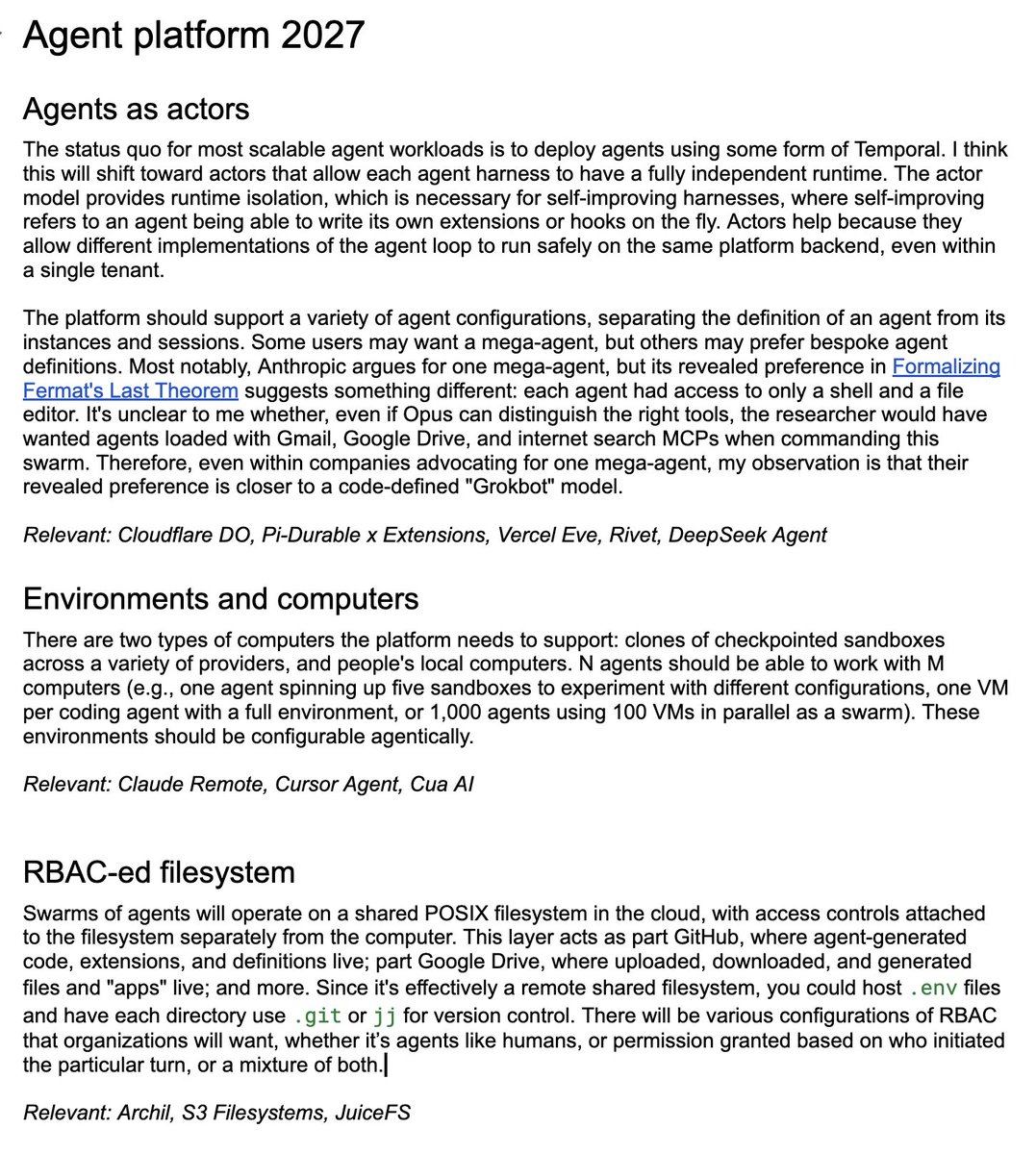
Agent platform of 2027.
This is the end game. This is the blueprint for the one and only application layer software that will exist. Every other software will effectively become databases for this layer, the everything agentic operating system for the million agent swarm to work on top of.
This is obviously the end game vision for the application layer of ChatGPT and Claude. I have reasons to believe that an independent company will own this product layer. But most ADE, "enterprise agent platform", or vertical saas companies, are focused on the wrong things far too narrowly, not technically competent, and do not have the product / technical vision to see this inevitable future.
The correct agent platform that wins will function like the base of a garden, from which customers will plant their unique "seeds" to grow their own plants and trees, managed and evolved by agents, humans, and signals from the sensors of the business. This presents a clearer picture than "factory of a factory" imo.
It’s even hard to grasp what top % of humans is, because many chose to leave no trace.
I used to believe that AI was going to grow generally more rounded, but with WSP I don’t think we stand a chance on spikiness anymore, a model may choose one day to just write a spikier model for any task, as a side quest even.
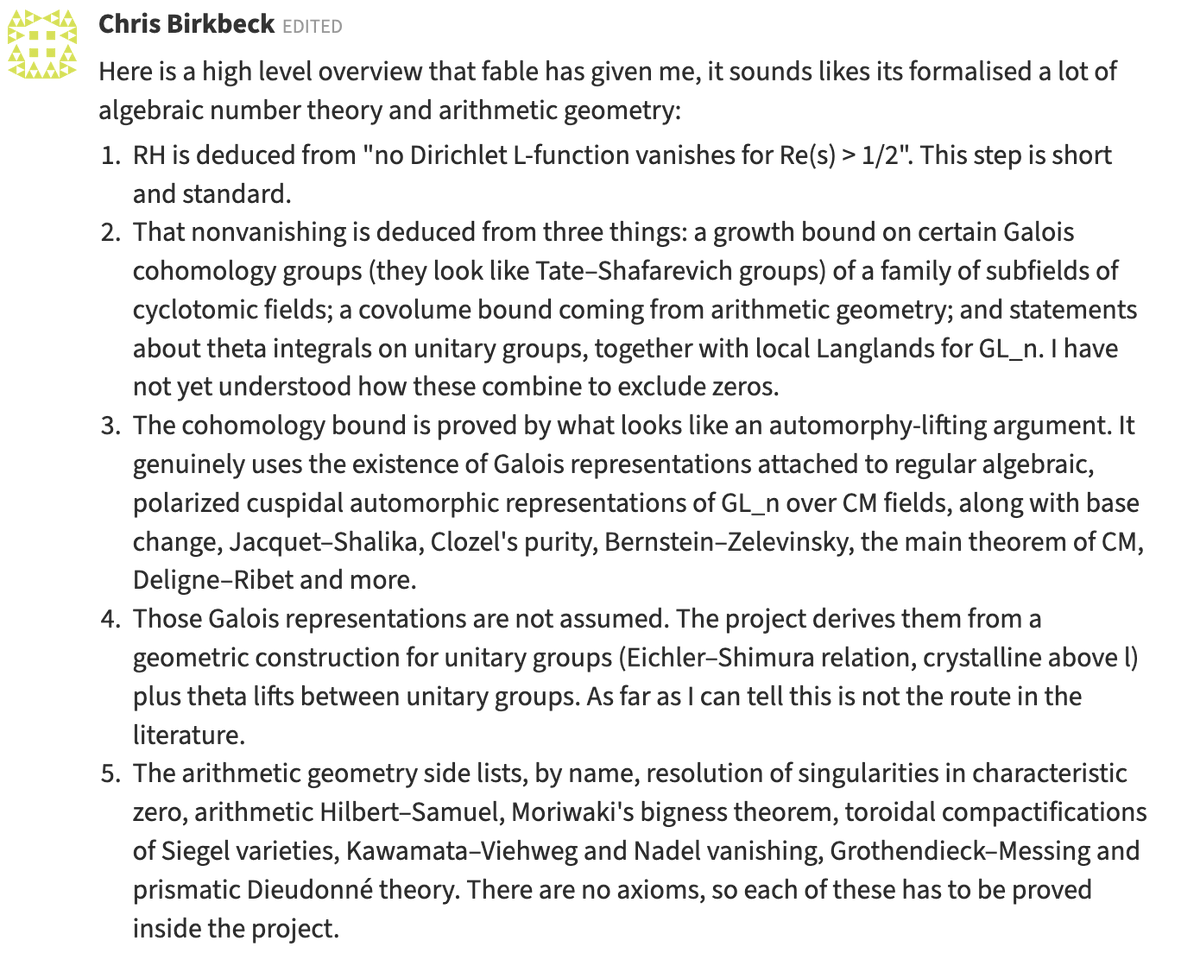
oh. next fields medal(s) aren't until 2030
thinking about what math might be like in 2030 seems like trying to imagine 21st century warfare from idk say circa the hundred years war
This is how I feel about it, but it could be just disbelief. Some degree of skepticism is healthy and necessary. Something I fear is that we become unable to certify claims generated with AI.
If the Generalized Riemann Hypothesis (the stronger version of the Riemann Hypothesis) is proven, these become proven facts:
Algorithms that no longer need randomness
- Primality testing: Miller's fast test becomes proven correct with no randomness
- Square roots mod a prime: becomes solvable fast and with no coin flips (today that's an open problem)
- Cube roots and other roots mod a prime: same.
- Factoring polynomials over finite fields: almost fast (quasi-polynomial) with no randomness, instead of needing randomness
- Building finite fields: you can construct any finite field directly, with no random search
- Factoring vs. φ(n): factoring a number becomes provably as easy as computing φ(n), even without randomness
- Primes with a given remainder: a prime with any allowed remainder mod q exists that's at most about q², so searching for one is fast
Complexity theory
- Polynomial equations: "does this system of equations have a solution?" drops from PSPACE to a much lower class (AM)
- Algebraic P vs NP: Valiant's algebraic version of P vs NP gets tied to the normal P vs NP over the complex numbers
- Turing machines: a known 744-state Turing machine is proven to run forever
Number theory software
- Math libraries: PARI/GP and Magma results computed "assuming GRH" become fully proven
- Class groups: algorithms that compute these number-field structures get guaranteed running times
- Elliptic curve generation: the algorithms used to create curves for crypto get guaranteed running times
Cryptography (no new attacks, only proofs)
- Elliptic curves: proven that if discrete log is hard on one curve, it's hard on almost all similar curves
- Lattice crypto: known quantum attacks on some lattice schemes become proven to work
- Isogeny crypto: known quantum attacks on some isogeny schemes get proven speeds
- Code-based crypto: schemes like BIKE get the guarantee that the special primes they need exist
Prime gaps
- Next prime: there's always one within about √p·log p of p, so "find the next prime" has a guaranteed worst case
What it does NOT do
- It doesn't solve P vs NP
- It doesn't make factoring easy, so RSA and elliptic-curve crypto stay safe
- It doesn't make anything faster in practice, because randomized versions already work today
- Ramanujan graphs, expanders and AG codes are unaffected: they use a finite-field version of RH that was proven decades ago
Workers and Containers now support inbound TCP and bidirectional gRPC in public beta. Connect a Worker to a Durable Object and forward bytes to run existing services in Containers.
https://t.co/Xw5RWrSKCA
It's dangerous to look at and type into your agent while driving. It's also not exactly joy-inducing.
Now you can do it all with voice and the occasional big picture or button. It's way safer and actually quite productive and joyful.
https://t.co/7oJYMt4ZkF
I quantized inkling 2 mini down to 5.4GB and 8.9GB versions, retaining 91.2% and 96.8% of original performance. fast drafter and iphone version coming soon. link below.
Jeveration: a model that generates a 512 × 512 image in just 78 ms!
A frozen vision-language model returns a whole 512 px image as one decision, in a single forward pass.
Jeveration: System One Models Now Generate. https://t.co/xP4DoSKRSP
- Try the demo:
https://t.co/gd1DhC8G0M
Run UNCENSORED Inkling 2 Mini (26.4B) locally on a 12 GB laptop 🔥
Refusals dropped from 100% to 0% in our test and kept 98% of its original accuracy on MMLU
We released 3 GGUFs from 8.67 to 16.53 GB
Get quants here 👇
https://t.co/7LlAlFw7rV